
By Miles Layton
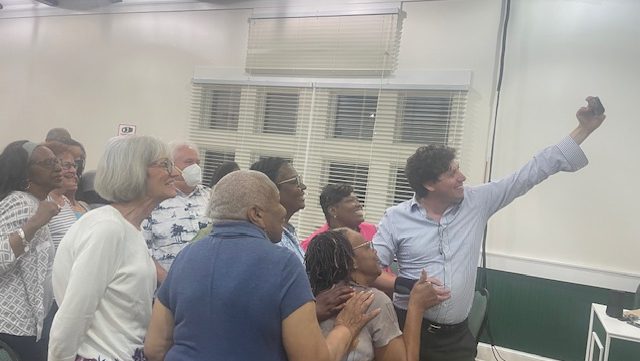
WINFALL — Jonah Garson, vice chair of the North Carolina Democratic Party and a Chapel Hill attorney, has been selected to fill the state Senate seat vacated by Sen. Graig Meyer — a selection that will come as no surprise to Perquimans County Democrats who heard him deliver a keynote address at their party convention in Winfall nearly a year ago.
And I’ll say it — Garson has got game, so pay close attention because I suspect that you’ll be hearing about him again.
A senatorial selection committee — composed of two delegates from each of the three counties in the district — chose Garson on Saturday over state Reps. Allen Buansi and Renée Price, both of Orange County, as well as Person County official Kenneth Perry and attorney Sheila Mikhail. Garson will represent Senate District 23, which encompasses Caswell, Orange, and Person counties. Meyer is departing to lead the North Carolina Justice Center.
In Winfall, Garson had offered local Democrats a candid preview of the reform message he would carry into his Senate campaign — a frank assessment of the party’s organizational failures, its court battles over gerrymandering, and his vision for rebuilding Democratic infrastructure from the ground up across all 100 counties.
The appointment marks Garson’s first time winning elected office. He previously ran against Buansi in the 2022 Democratic primary for House District 56, losing by fewer than 500 votes.
Before taking his seat, Garson must be formally appointed by Gov. Josh Stein to serve the remainder of Meyer’s term. He will then face a Republican challenger on the November ballot to hold the heavily Democratic district’s seat through 2028.
In a video posted Saturday evening, Garson expressed gratitude to supporters and acknowledged Meyer’s decade-plus of public service.
“Thank you to everyone who lent support for this campaign, who wrote letters of recommendation, who made those endorsements, who helped me put together the best job application we could for this very hard job,” Garson said. “We’ve got a lot of work to do ahead, and I am thrilled to be doing it with you.”
A Familiar Face in Party Circles
Garson’s selection comes as little surprise to Democratic insiders across the state. A native of Chapel Hill, he earned a bachelor’s degree from UNC in 2009 and a law degree from Columbia Law School in 2014. He practices at Parry Law, PLLC, in Chapel Hill, focusing on commercial and civil litigation, and serves on the Orange County planning board. His civic affiliations have included the Chapel Hill-Carrboro NAACP, Carolina Performing Arts, and the Orange County Democratic Party, where he once served as chair.
His pitch to the selection committee centered on three pillars: protecting voting rights, preserving Medicaid expansion, and ensuring equal access to educational resources — a theme that gained particular urgency when, one day before the committee convened, the state Supreme Court ruled that judges lack the authority to overhaul state educational funding.

Hard Truths and a Long-Term Vision
At the Perquimans County Democratic Convention in Winfall in 2025, Garson did not shy away from difficult truths. He told attendees that the party’s struggles were rooted not just in election losses, but in a failure of honest self-assessment and long-term organizational investment.
“Two years ago, the current members of the North Carolina Democratic Party board ran for state party leadership very, very frustrated at the performance of battleground North Carolina,” he said. “We were not taken seriously nationally as a battleground state. We kept losing election after election.”
He described a culture within state party leadership that glossed over poor results rather than confronting them — an approach he argued was corrosive to trust with both grassroots activists and donors.
“You cannot treat them like fools,” he said. “So we all ran as a reform-minded board saying we want to build a North Carolina Democratic Party that doesn’t promise folks the moon, but that is capable of fighting and winning some of the toughest fights at the ballot box, in the field, and in the courtroom.”
Garson also spoke bluntly about the structural decay he said has hampered Democratic organizing nationally, pointing to a reliance on candidate-centered campaigns at the expense of permanent party infrastructure.
“These parties have been hollowed out,” he said. “People are focusing on candidates over the permanent infrastructure. It is a broken system. Until we start investing in organizations, the individual political leaders come and go.”

Gerrymandering and the Courts
Garson devoted significant time in Winfall to the consequences of Republicans holding a state Supreme Court majority, arguing that the shift had cost Democrats fair congressional representation and fueled the continued manipulation of legislative maps.
He extended the argument to the General Assembly itself.
“More North Carolinians voted for Democratic state legislators to send to Raleigh than they did for Republicans. That’s true in 2024. You would not know it from the makeup of our North Carolina General Assembly,” he said. “So losing unconstitutional partisan gerrymandering from a court that doesn’t care about whether it’s right or wrong to have politicians choosing their voters, not the other way around — that’s what we lost.
Project 100 and the Road to 2028
In Winfall, Garson outlined the party’s signature organizing initiative, Project 100, a six-person team of regional organizing directors tasked with building year-round infrastructure across all 100 counties.
“Our idea is that we need a backbone of full time, well compensated, hardworking regional organizing directors from their regions to serve the county parties as their clients,” he said.
He offered a sobering data point to underscore why the investment is necessary: North Carolina is one of only two states in the country that retained its organizing staff following the 2024 presidential election.
“If that sounds disturbing, it should sound disturbing,” Garson said. “That’s not the way you want to build democratic power, especially at a time like this.”
Looking further ahead, Garson argued that Democrats must move beyond reactive campaign cycles and develop a durable, long-term message rooted in the everyday concerns of North Carolinians.
“I think that in so many ways, we have to focus on identifying at the local level what the good life messages are in a North Carolina context,” he said. “North Carolina just happens to have an outsized role in the future of this country because of its status as a battleground state.”
That message, he said, must speak to the aspirations of families who want to stay — and thrive — in their home communities.
“In North Carolina, our message has been a variation of Democrats really want to fight and fighting like hell for you to live the good life right here in your home place,” Garson said. “And for your kids to want to stay here too.”
With his Senate appointment now secured, Garson moves from making that pitch on behalf of the party to making it on behalf of a district — and, he would argue, on behalf of a state with something larger than itself at stake.

Subscribe — it’s free!


