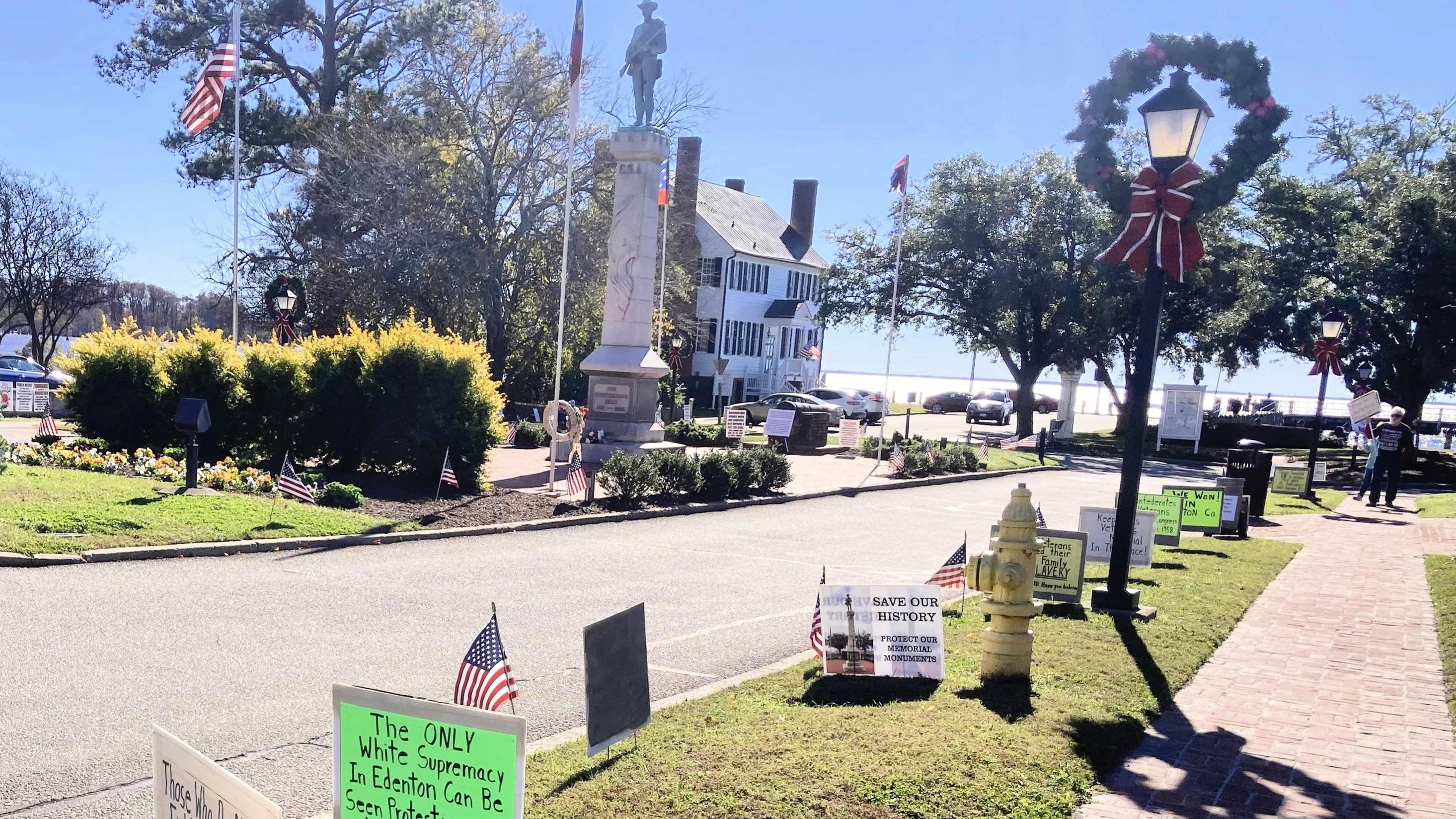
EDENTON — Earlier this week, Dr. Florian Deltgen gave a presentation to the Sons of Confederate Veterans, Edenton Bell Battery.
A resident of Columbia, NC, Deltgen has a Ph.D from Cologne University, Germany, with a focus on comparative linguistics and anthropology. He is fluent in five languages with a working knowledge of six more, including several non-European languages. To use/paraphrase Congressman Tim Burchett’s turn of phrase — Deltgen is dadgum smart!
Maybe Rod Phillips might want to read Deltgen’s presentation — trigger warning!
Chowan County’s Confederate Memorial update — the case is still percolating through the courts; the statue is still in storage. The file photo accompanying this story is a bit dated because I’m not going to do drone footage over the Chowan County Detention Center, where the statue is said to be stored. On that note, Tyrrell’s case is still percolating, too.
Subscribe — it’s free!

Florian Deltgen
Some want to tear down Confederate Soldier Memorials because they see them as a glorification of Slavery. Others want to keep them in place because they see them as monuments that honor their fallen ancestors. Both may have a point. This brief essay assesses how these two conflicting views hold up in a global comparison.

Confederate Memorial in Edenton, NC
Torn down by night in violation of NC law.
Ivan the Terrible
Ivan IV Vasilyevich (1530–1584), commonly known as Ivan the Terrible or Иван Грозный (Ivan Grozny) in Russian, was the Grand Prince of Moscow and the first ruler to be crowned Tsar of All Russia in 1547. His reign transformed Russia from a medieval state into a powerful empire, but his legacy is defined by the paradox of significant reform and extreme brutality. In 1565, fueled by paranoia following the death of his first wife, Anastasia, Ivan established the Oprichnina, a territory under his personal control. It was enforced by the Oprichniki, a brutal personal guard that executed thousands of perceived traitors and infamously ravaged the city of Novgorod. Ivan enslaved and killed thousands of noblemen, the Boyars, who had previously opposed him, and he also murdered his own son and heir, Ivan Ivanovich, in 1581 by striking him with a pointed staff.

In October of 2016, the Russian city of Oryol erected a monument for Tzar Ivan the Terrible. In November 2025, another monument was erected for this butcher in the Russian city of Vologda.

Mao Tse Dung
Mao Tse Dung’s regime killed about 70 million people and enslaved about 20 million, mostly Chinese.
Today, approximately 3,000 Mao memorials exist worldwide, most of them in China, but there are also Mao monuments in Nepal, Peru, and Albania as well as in London, Los Angeles, San Diego, Montreal, Vancouver, and Sidney, Australia. A summary can be found in Cheng Wenjun’s book on Mao Statues. (图解毛泽东雕塑 ISBN-10: 7503324163 and ISBN-13: 978-7503324161, published by the People’s Liberation Army and Art Publishing House, 2013).

Mao Tse Dung Monument in China
Genghis Khan
The Mongols under Genghis Khan and his successors killed approximately 40 million people – nearly 10% of the world population at the time – and they enslaved an estimated 5-8 million people.
Today, there are many Genghis Khan monuments in Mongolia. Almost every provincial capital has one. There are several also in Kazakhstan, China, and Russia and one even in London’s Hyde Park, erected in 2012.

Gigantic Genghis Khan Monument in Ulan Bator
Lenin
Lenin’s regime killed about 10-12 million people and enslaved hundreds of thousands.
Today, there are an estimated 10-12,000 Lenin memorials worldwide, about 80% of them in the Russian Federation. There is a Lenin memorial in Seattle, showing Lenin in a dynamic revolutionary pose. There are two Lenin memorials in Germany, one in Gelsenkirchen and one in Berlin. Another one is in Cavriago, Italy. Yet another Lenin bust is located in Gullspång, Sweden and one is located at an abandoned Soviet research station in Antarctica.

Largest Lenin Monument in Russia
Stalin
Stalin’s regime killed approximately 20 million people and enslaved about 32 million.
Today, there are approximately 140 Stalin memorials worldwide. 110 of them are in Russia. 95 were newly erected under Putin since 2000. There is a Stalin memorial in Bedford, Virginia. One is in Vienna, Austria, and one in Berlin, Germany.

New Stalin Monument in Moscow
The Romans
The Roman empire killed approx. 40 million and enslaved an estimated 20 million people around the Mediterranean and in Northwestern Europe.
Today, there are still thousands of Roman monuments all over Europe that memorialize and celebrate Roman dominion and rule over more than 70 ethnic groups or nations. Roman rule is still very present in Western Europe today. Yet nobody in Europe has ever publicly demanded that Roman triumphal monuments or the remains of Roman military installations should be removed because they are perceived as glorifying the enslavement of German tribes. Today, “cheers” in German is still “Prost!”, which is short for the Roman (Latin) “Prosit” = “may it be useful”.

France and Germany
France and Germany
The Germans attacked France three times in modern history: 1871, 1914, and 1939. In these three wars, the Germans killed approximately 2.2 million French soldiers and civilians.
Roughly 1 million German soldiers are today buried in France in seven cemeteries, and the French maintain these cemeteries. There has never been a public voice in France demanding that these cemeteries, some of which also hold graves of SS officers, should be closed, because they are perceived as glorifying military aggression or Nazi totalitarianism.
About 6 million non-French Europeans died in the Napoleonic wars. Yet, today, millions of European tourists visit Napoleon’s Memorial Tomb in the Dôme des Invalides in Paris every year and the bridges across the river Seine are still named after Napoleon’s main victories.

Napoleon’s Tomb in Paris
Hilde Benjamin
Germany has not only suffered under Nazi rule. It also suffered under communist rule during the time of the communist German state, ironically called the “German Democratic Republic”, which no longer exists today. The terror rule of the communists was just about as brutal and bloody as the Nazi rule. One of the worst characters of this communist terror regime was its Minister of Justice, a woman by the name of Hilde Benjamin, wife of the famous communist Georg Benjamin and sister-in-law of his brother Walter Benjamin, also a notorious communist. She cracked down mercilessly on any opponent of the communist regime and was responsible for the deaths of hundreds of political prisoners. Her nicknames were “Bloody Hilde” and “Red Guillotine” – and she sure earned them. Today, she has an “Ehrengrab” – a grave of honor – on the Central Cemetery in Berlin. Here is the Wikipedia definition of ‘Ehrengrab’:
An Ehrengrab (English: ‘grave of honor’) is a distinction granted by certain German, Swiss and Austrian cities to some of their citizens for extraordinary services or achievements in their lifetimes.
Well, I guess one cannot deny that her services were extraordinary.


Honor grave for Hilde Benjamin
Sadam Hussein
In October of 2017, the Palestinian city of Qalqilya on the West Bank erected a memorial for Sadam Hussein, whose merits we are probably all familiar with.

Memorial for Sadam Hussein in Qalqilya on the West Bank.
Latin America
There are still thousands of memorials for the Spanish and Portuguese conquerors all over Latin America. Some have been removed, but some have also been re-erected. Cortés, Pizarro, Balboa, de Soto, Ponce de León, da Gama, Cabral, Albuquerque. There are thousands of memorials for these conquistadores and streets and places are named after them all through Latin America. Many Latin-Americans are actually proud of their Spanish or Portuguese heritage. In Colombia SA, where I lived and worked for some time, people refer to the Spanish language as “nuestra lengua Castillana” – “our Castilian language”. Castile is of course the Spanish region that resisted Islamic occupation and started the re-conquest of Spain.

Pizarro Monument in Lima, Peru
George Floyd
George Floyd was arrested and charged for nine incidents between 1997 and 2007, mostly drug possession+delivery and theft resulting in several convictions and jail sentences. His most serious conviction was for a 2007 home invasion and robbery. He impersonated a water department worker and held a pistol to a woman’s abdomen while searching for loot. He was charged with aggravated robbery with a deadly weapon, pleaded guilty in 2009 in a plea bargain deal, and was sentenced to five years in prison. After four years, he was paroled in 2013. On the day of his death Floyd was arrested for using counterfeit money to buy cigarettes. Reports remain unclear about whether or not he knew the money was counterfeit. He died when police officer Derek Chauvin knelt on his neck for nine minutes. Chauvin was convicted of second-degree unintentional murder, third degree murder, and second-degree manslaughter. He received 22.5 years in prison. I should add that the report of the medical examiner also stated that Floyd had a significant level of Fentanyl in his blood, that he had an acute COVID condition, and that he was suffering from a serious heart condition. But the court considered Chauvin’s action the sole cause of Floyd’s death.
Do Chauvin’s wrongdoings negate Floyd’s wrongdoings? Do they make Floyd a better person? I do not think so. Yet there are currently at least four Floyd memorials in the USA: in Newark, New Jersey, in New York City, in Charleston South Carolina, and in the George Floyd Square in Minneapolis, Minnesota. Advocates of these monuments see them as mementos against racist police brutality. Opponents see them as glorifications of a low-life drug criminal.

George Floyd Monument in Minneapolis
Slavery and the Civil War
At the beginning of the Civil War, at least five Union States had slavery: Delaware, Kentucky, Maryland, Missouri, and West Virginia.
Key demographic data from the 1860 Census are:
- Total Black Population: 4,441,830
- Enslaved Population: 3,953,760
- Free Black Population: 488,070
Approximately 89% of the total Black population was held in slavery at the time.
According to the 1830 census data, there were 3,775 black slave holders in the USA together holding 12,907 black slaves. According to the 1860 census data, there were approx. 3,250 black slave holders in the USA holding approx. 20,000 black slaves. This was the so-called “compassionate slavery” to protect freed black people from laws requiring them to leave certain states. But I am not sure how compassionate this really was. The 1860 census also shows that 393,975 Americans held black slaves. This number includes black slave holders. All slave holders together represented about 1.5% of the US population in 1860.
Although Confederate Vice President Alexander H. Stephens proclaimed in his infamous speech in 1861 that the preservation of slavery was the “cornerstone” of the Confederate States for their secession, unbiased analysis suggests that slavery was clearly only one aspect of the Civil War, never its sole motive or cause.
At least not for the Union. In a letter to Horace Greeley, Abraham Lincoln wrote on August 22, 1862:
“My paramount object in this struggle is to save the Union, and is not either to save or to destroy slavery. If I could save the Union without freeing any slave I would do it, and if I could save it by freeing all the slaves I would do it; and if I could save it by freeing some and leaving others alone I would also do that. What I do about slavery, and the colored race, I do because I believe it helps to save the Union.” (Super Grok 4, punctuation and orthography as in the original.)
Clearly, Lincoln did not care about slavery. He only wanted to save the Union. There are several similar statements from Lincoln. Ergo: the South fought mainly for independence, while the North fought mainly to preserve the Union. Slavery was not a main issue for either.
Slavery as a Global Phenomenon
Slavery is bad. Period. No ifs or buts. Yet, those who seem to treat it as an exclusively American phenomenon, are patently wrong. The institution of slavery in its many variants has existed for millennia and Black Africans have not been its sole victims. In fact, when we look at the world history of slavery, it becomes obvious that Black people have not only been a minority among enslaved humans but that they were also often the enslavers. Africa is occasionally described euphemistically as a land where all Black Africans lived free, e.g. in schoolbooks or teaching materials about “Black History”. Unfortunately, this claim does not reflect the historic facts.
Slavery in Africa
For millennia, slavery has been a worldwide phenomenon and black people were not always the slaves but often the slave holders, the slave raiders, and the slave traders. In Africa, slavery was endemic. Both slaves and slave holders were mostly black. To my best knowledge, all sub-Saharan African kingdoms were slave states: Ghana, Mali, Songhai, Kanem Bornu, Oyo, Benin, Ashanti, Dahomey, the Wolof Empire, Aksum, the Swahili City States, Buganda, the Bunyor Kitara Empire, the Luba Kingdom in the Kongo, the Lunda Empire, the Kuba Kingdom, the Ndongo Kingdom, the Ma-pu-ngubwe Kingdom, and the Kingdoms of Zimbabwe, Monomutapa, Rozvi, Zulu, and Swazi.
Between 800 and 1600 AD, the premier slave holding and slave trading states in sub-Saharan Africa were the West-African kingdoms of Songhai and Mali. In 1325, Mansa Musa, the ruler of Timbuktu in the kingdom of Mali and probably the richest man who ever lived, had over 20,000 personal slaves in his entourage during his hadj to Mecca, many of them Europeans, who had been caught by Muslim pirates in the Mediterranean.

Mansa Musa, Ruler of Mali, in his capitol Timbuktu.
(Information about African slavery and slave trade is mainly derived from the two Arab historians Ibn Khaldun and Ibn Battuta.)
Islamic slave traders had controlled the trans-Saharan slave trade for over 800 years before Columbus ever set foot on America in 1492.
The Quran and authentic Hadith collections (such Sahih al-Bukhari and Sahih Muslim) contain numerous references to slavery, reflecting that it was a pre-existing institution in 7th-century Arabian society and the broader ancient world. These texts do not abolish or condone slavery outright but regulate it as a normal fact of life, often emphasizing humane treatment for slaves and characterizing freeing Muslim slaves as a virtuous act or expiation for sins. Slavery is presented as a normal feature of society in these sources, with rules governing ownership, treatment, marriage, sexual relations (particularly with female captives/slaves), inheritance of slave status, and paths to freedom. The primary source of new slaves in early Islamic contexts was prisoners of war. Below are key examples from the Quran and the Hadiths that imply or assume slavery as an accepted and regulated part of society. Translations are approximate and based on widely accepted English renderings (e.g., from quran.com, sunnah.com, and other scholarly sources). I have focused on verses and narrations that most directly reference slaves or related practices. The Quran uses phrases like “ma malakat aymanukum” (“those whom your right hands possess”) as a euphemism for slaves i.e. private ownership of another person.
Skip if too long
- Quran 23:5-6 (Surah Al-Mu’minun):
“And they who guard their private parts, except from their wives or those their right hands possess, for indeed, they will not be blamed.“
→ This permits sexual relations with wives or female slaves/captives, assuming male ownership of female slaves as normal.- Quran 33:50 (Surah Al-Ahzab, addressed to the Prophet):
“O Prophet, indeed We have made lawful to you your wives to whom you have given their due compensation and those your right hand possesses from what Allah has returned to you [of captives]…“
→ Explicitly allows the Prophet (and by extension believers) sexual access to female captives/slaves acquired in war. - Quran 4:24-25 (Surah An-Nisa):
Permits marriage to slave women and treats them similarly to free women in some marital contexts, while allowing relations with “those your right hands possess” i.e. female slaves. - Quran 24:33 (Surah An-Nur):
“And let those who do not find the means to marry keep themselves chaste until Allah enriches them… And if any of those whom your right hands possess desire a contract [of manumission], then make a contract with them if you know there is goodness in them… And do not compel your slave girls to prostitution if they desire chastity…“
→ Regulates slavery by allowing slaves to buy their freedom (mukataba contract), prohibits forced prostitution of female slaves, but also assumes that owners have authority over them. - Quran 4:36:
“Worship Allah and associate nothing with Him, and to parents do good, and to relatives, orphans, the needy, the near neighbor, the neighbor farther away, the companion at your side, the traveler, and those whom your right hands possess…“
→ Lists slaves alongside family and vulnerable groups as deserving of kind treatment. - Quran 9:60 (uses zakat (obligatory charity) funds for freeing slaves):
One category of zakat recipients is “for freeing slaves” (fi al-riqab).
→ Institutionalizes manumission as an act of religious charity. - Quran 90:12-13 (Surah Al-Balad):
Describes the “steep path” of righteousness as including “freeing a slave” (fakku raqabah).
→ Strongly encourages emancipation.
- Quran 33:50 (Surah Al-Ahzab, addressed to the Prophet):
Other verses (e.g., 2:177, 4:92, 5:89, 58:3) mandate or reward freeing slaves as expiation for sins like breaking oaths or accidental killing.
Key Hadith Examples (from Sahih collections):
Authentic Hadith texts often discuss practical aspects of owning, treating, buying/selling, and freeing slaves, treating slavery as daily routine.
- Sahih al-Bukhari 2545 (on treatment):
Narrated Al-Ma’rur: The Prophet said, “Your slaves are your brothers… Feed them from what you eat, clothe them from what you wear… Do not overburden them…“
→ Commands humane treatment but assumes ownership. - Sahih al-Bukhari 2517:
The Prophet said, “Whoever frees a Muslim slave, Allah will save all the parts of his body from the Fire as he has freed the body-parts of the slave.“
→ Reward for manumission, implying Muslim slaves exist to be freed. - Sahih al-Bukhari (various in Book of Manumission):
Multiple narrations discuss partial manumission (e.g., freeing a share of a jointly owned slave), valuation of slaves for buyouts, and the Prophet encouraging or performing manumissions. - Sahih al-Bukhari 7:137 (on captives):
Narrations describe taking female captives as war booty and relations with them (with coitus interruptus discussed, approved in context).
→ Reflects slavery from war as standard. - Other Sahih narrations: The Prophet owned slaves (e.g., traded or received them), prohibited abusing them, and encouraged freeing them, but never banned the institution of slavery.
CONTINUE HERE
These texts imply that slavery was a normal social reality. It is therefore not surprising that, with the advent of Islam, the slave trade in Africa and above all the Trans-Saharan slave trade received a marked boost. Remember here that Islam does not treat Muslim and non-Muslim slaves the same.
The West African chiefs conducted most of the slave raids and sold their own fellow countrymen to the European and Arab slave traders.
And make no mistake: the trans-Saharan slave trade still exists today.
Many African political leaders have acknowledged the fact the Africans were the slave raiders and suppliers to the European and Arabic slave traders. Here are some of their statements:
The Ghanaian diplomat Kofi Awoonor stated:
“I believe there is a great shadow over Africa, and it has much to do with our guilt and denial of our role in the slave trade. We too are blameworthy in what was essentially one of the most heinous crimes in human history.”
Benin’s then President Mathieu Kerekou apologized for his country’s role in
“selling fellow Africans by the millions to white slave traders.”
Luc Gnacadja, then Benin’s minister of environment and housing said:
“We cry for forgiveness and reconciliation,”
Cyrille Oguin, then Benin’s ambassador to the United States, acknowledged:
“We share in the responsibility for this terrible human tragedy.”
In the PBS’s “Africans in America” series companion book, the author writes:
“The white man did not introduce slavery to Africa … And by the fifteenth century, men with dark skin had become quite comfortable with the concept of man as property … Long before the arrival of Europeans on West Africa’s coast, the two continents shared a common acceptance of slavery as an unavoidable and necessary – perhaps even desirable – fact of existence. The commerce between the two continents, as tragic as it would become, developed upon familiar territory. Slavery was not a twisted European manipulation, although Europe capitalized on a mutual understanding and greedily expanded the slave trade into what would become a horrific enterprise… It was a thunder that had no sound. Tribe stalked tribe, and eventually more than 20 million Africans would be kidnapped in their own homeland.” (https://historynewsnetwork.org/article/41431).
Pre-Columbian America
Almost all of the North American cultures had slaves. Approx. 750 Indian languages existed in North America and Canada. In Mesoamerica approx. 125, and in South America about 600. These languages were all very different from each other, which made communication between ethnic groups difficult. The result was never-ending tribal warfare, which produced a never-ending stream of captives who then became slaves – if they were lucky. If they were not so lucky, they might be sacrificed to the gods.
In North America for example, the Kwakiutl, Kwakawaka, Salish, Comanche, Yurok, Klamath, Pawnee, Creek, Muscogee all had slaves. The Cherokee, Chickasaw, Choctaw, Creek, and Seminole did not originally have slaves but adopted slavery when Africans were brought to America. The Sioux took the land from the Cheyenne, who had taken it from the Kiowa, who had taken it from the Pawnee, who had taken it from the Crow, who had taken it from the Arikara. The victors not only took their enemies’ land, but they also enslaved them.
The Moché, Inca, Aztecs, Chichimeca, Tolteca, Olmeca, Mixteca, Mazateca, Zapoteca, and Maya empires all had extremely brutal forms of slavery. Tribes waged constant war against each other.
European Chattel Serfdom
In the Middle Ages, chattel slavery was a common institution all over Europe. It existed in the Holy Roman Empire of a German Nation, in Prussia, Austria, Bavaria etc. In Prussia, German chattel slavery (called Leibeigenschaft) was only abolished on March 31, 1850 – just 13 years before the Emancipation Proclamation. It was abolished in England at the end of the 16th century, in France in 1789, in Denmark in 1788, in Austria and Hungary in 1782, in Bavaria in 1808, Russia in 1861, and in Island 1894. On the British Island of Sark, feudal law was only removed in 2008, although classic chattel slavery had disappeared earlier. And nota bene: that was Europeans enslaving Europeans.
Conclusions:
It seems that there are many memorials worldwide for arguably bad actors and bad behavior, some of them definitely worse than the enslavement of Black Africans in America.
Slavery of Africans in North America was a relatively brief episode in the history of slavery. It was always considered wrong by many white people, many of whom were often also enslaved. Slavery lasted in the United States legally for exactly 89 years, that is from Independence to Abolition. If white Americans did indeed fight over slavery I know of no other nation that fought a bloody war that killed over half a million white people to abolish Black slavery.
Through the millennia, people fought, killed, and died for what they believed in or valued most. As we all know, the history books are written by the victors. Later generations and their historians, judging by their own values, often disagree. Values change. What will coming generations think about the values we hold today?
About the year 600 BC, Chilon of Sparta, one of the “seven sages of Greece”, coined the principle of “tòn tethnekóta mè kakologeîn” (τὸν τεθνηκóτα μὴ κακολογεῖν), later adopted by the Romans as “De mortuis nil nisi bonum.” In modern speak:
“Honor the dead regardless of how they lived, what they believed in, or what they fought or died for.”
In 1432, the humanist monk Ambrogio Traversari proclaimed this to be a universal moral principle.
It seems to me that the examples I have presented so far show convincingly that today most peoples and nations accept this moral principle. And many persons have been honored with memorials whose merits are considerably more debatable than those of Confederate soldiers. I therefore plead that we should also apply it to the fallen Confederate soldiers, most of whom never had slaves. Most of them fought for Southern Independence, not for the preservation of slavery. They died for what they believed in, and we should honor their final sacrifice even if we do not share their values.
As I see it, Confederate soldier memorials do not glorify slavery. They simply honor the dead. Nothing more and nothing less. It’s not even a political issue. Just one of human decency. Even African folklore acknowledges this:
Kiswahili:
Hakuna ila mambo mazuri kuhusu wafu!
English: Nothing but good things about the dead!
Make a one-time donation
Make a monthly donation
Make a yearly donation
Choose an amount
Or enter a custom amount
Your contribution is appreciated.
Your contribution is appreciated.
Your contribution is appreciated.