By Miles Layton
A recent decision by the North Carolina Court of Appeals allowing a Confederate monument to remain outside the Gaston County courthouse may carry implications for ongoing legal disputes in eastern North Carolina involving Confederate memorials in Chowan and Tyrrell counties.
The ruling, reported by the News & Observer, concluded that the presence of a Confederate soldier monument outside a courthouse does not violate constitutional rights unless plaintiffs can show it actually prevents access to the courts. That conclusion could influence how judges evaluate similar claims connected to monuments in Edenton and Tyrrell County, where legal disputes remain unresolved.
While the cases involve different facts and legal theories, they share a central question that courts across North Carolina have increasingly faced in recent years: whether historic Confederate memorials located on public property violate constitutional rights or other legal protections.
And as our readers all know, plans are afoot to reconstruct Chowan County’s Confederate Memorial at Veterans’ Park by the courthouse, that is, if the courts allow a reprieve and the statue can leave the broom closet that it’s stored in at the Chowan County Detention Center. And don’t forget that the fate of Tyrrell County’s memorial is being adjudicated by US District Court.
Subscribe — it’s free!
Appeals Court Rejects Civil Rights Claim in Gaston County
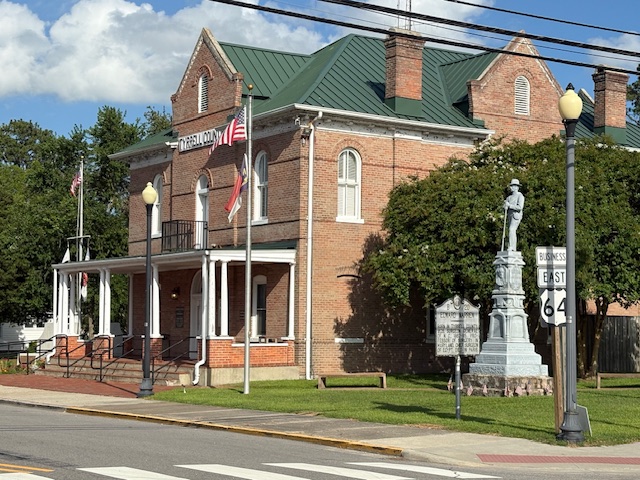
The case in Gaston County centered on a Confederate monument that stands outside the county courthouse. The memorial features a statue of a Confederate soldier holding a rifle atop a roughly 30-foot obelisk.
Civil rights organizations argued that the monument’s presence violated the rights of Black residents by discouraging them from seeking justice at the courthouse. According to the News & Observer, the Gaston County branch of the NAACP, along with several other groups and individual taxpayers, filed the lawsuit in 2020.
The plaintiffs contended that the monument’s symbolism created an atmosphere of racial hostility and signaled bias within the justice system.
A three-judge panel of the North Carolina Court of Appeals rejected that argument.
In a written opinion, the panel determined that the plaintiffs had not demonstrated that the monument actually interfered with their ability to access the courts. The judges concluded that subjective feelings about the monument were insufficient to establish a constitutional violation.
The decision emphasized that plaintiffs must prove an “actual denial of access to functioning courts,” rather than relying on perceptions that the monument might discourage someone from entering the courthouse.
Because the plaintiffs could not demonstrate that level of harm, the court allowed the monument to remain in place.
Legal Background and Earlier Rulings
The Gaston County case arose during a period when Confederate monuments across the country faced renewed scrutiny following nationwide protests in 2020 after the killing of George Floyd by a Minneapolis police officer.
Many local governments faced pressure to remove or relocate monuments honoring the Confederacy. In North Carolina, those decisions were complicated by the state’s 2015 Monument Protection Law, which restricts the removal or relocation of certain historical monuments from public property.
Gaston County officials argued that the law prevented them from removing the statue even if they wanted to do so.
However, a superior court judge rejected the argument that the law absolutely barred relocation. The judge concluded that some exceptions in the statute could potentially allow the monument to be moved under certain circumstances.
Even so, the court dismissed the lawsuit because the plaintiffs failed to prove that the monument violated their constitutional rights.
The Court of Appeals’ recent ruling affirmed that outcome.
The decision also aligns with a previous appellate ruling involving a Confederate monument in Alamance County, where judges similarly rejected arguments that the presence of a memorial outside a courthouse limited access to justice.
Together, those rulings establish a legal precedent that could affect future cases involving Confederate monuments located near courthouses.
Implications for the Edenton Monument Dispute
The Gaston County decision arrives while litigation involving a Confederate monument in Edenton continues to move through the courts, according to reporting by the Albemarle Observer.
The dispute centers on a Confederate memorial that once stood on South Broad Street in the historic downtown area.
Three Confederate heritage organizations filed a lawsuit against the Town of Edenton in 2022. The plaintiffs included the North Carolina Division of the Sons of Confederate Veterans, the North Carolina Division of the United Daughters of the Confederacy, and the Colonel William F. Martin Camp of the Sons of Confederate Veterans.
The organizations challenged actions by the town related to the monument, arguing that officials violated legal protections connected to the memorial.
The case took a major turn in March 2025 when Edenton and Chowan County reached an agreement that fundamentally changed the legal landscape.
Under that memorandum of understanding, Chowan County agreed to purchase the monument from the town. The plan called for the monument to be relocated from South Broad Street to a new location near the Chowan County Courthouse, within the Veterans Park area at the intersection of East Queen and Court streets.
The relocation plan effectively transferred ownership of the monument from the town to the county.
During an August 2025 court hearing, two of the three plaintiff organizations agreed to the relocation plan. Those groups consented to the arrangement between the town and the county.
However, the North Carolina Division of the Sons of Confederate Veterans did not agree to the compromise.
Superior Court Judge Wayland J. Sermons Jr. ruled that the relocation agreement rendered the claims of the two consenting organizations moot because the town would no longer own the monument after the transfer to the county.
The judge dismissed the lawsuit and dissolved a restraining order that had previously blocked changes to the monument.
Attorneys representing the Sons of Confederate Veterans later filed a notice of appeal with the North Carolina Court of Appeals, seeking to overturn the dismissal and continue the legal challenge.
The appeal represents the latest step in a legal battle that has stretched over three years.
Potential Influence of the Gaston County Ruling
Legal analysts say the Gaston County decision may offer guidance to courts reviewing cases involving Confederate monuments located near government buildings, particularly courthouses.
The key issue in the Gaston case involved whether the monument interfered with access to the courts, a claim grounded in constitutional protections.
In Edenton, however, the dispute focuses more heavily on property ownership and whether the town had the authority to relocate the monument.
Because the legal questions differ, the Gaston ruling does not directly decide the Edenton case. Still, it reinforces a broader judicial trend that has been reluctant to find constitutional violations based solely on the presence of Confederate monuments.
That precedent could shape how appellate judges approach arguments about the impact of such memorials on civil rights.
Tyrrell County Case Takes a Different Legal Path
Another monument dispute unfolding in eastern North Carolina involves a Confederate memorial outside the Tyrrell County courthouse.
Unlike the cases in Gaston County and Edenton, the Tyrrell lawsuit focuses on specific language engraved on the monument rather than the existence of the monument itself.
According to the Albemarle Observer, the lawsuit was filed in May 2024 by a group called Concerned Citizens of Tyrrell County, which court filings describe as consisting primarily of elderly Black residents.
The monument, erected in 1902, includes a phrase praising “faithful slaves.”
The plaintiffs argue that the inscription violates their constitutional rights and constitutes an offensive public message endorsing racial discrimination.
Rather than seeking removal of the entire monument, the group has asked the court to order Tyrrell County to cover or alter the phrase.
A federal judge allowed part of the lawsuit to proceed in 2025, concluding that the plaintiffs had plausibly alleged an equal protection violation.
The ruling permitted the case to move forward while dismissing a separate claim involving property rights.
Discovery Dispute Adds New Legal Questions
As the Tyrrell case moves deeper into litigation, a new dispute has emerged over whether county commissioners can be compelled to testify about their decisions related to the monument.
Attorneys for Tyrrell County have asked the court to block depositions of commissioners, arguing that legislative privilege protects elected officials from being questioned about their policymaking decisions.
County attorneys maintain that decisions about the monument represent legislative actions involving broad policy considerations affecting the entire community.
They argue that lawmakers at all levels of government are shielded from civil liability and compelled testimony for actions taken in their legislative roles.
According to the county’s legal filings, discussions of the monument at public meetings do not waive that privilege.
The plaintiffs, however, seek to question commissioners about how the county has handled the monument and whether discriminatory motives played a role in maintaining the inscription.
The outcome of that dispute could shape the evidence available as the case moves toward potential summary judgment or trial.
In his earlier ruling, the federal judge determined that the plaintiffs had presented enough evidence to allow the equal protection claim to proceed.
The court found that the complaint plausibly alleged that the “faithful slaves” inscription had a racially disproportionate impact on Black residents of Tyrrell County.
The judge also determined that the plaintiffs had sufficiently alleged discriminatory intent behind the installation of the language in 1902.
However, the court emphasized that the plaintiffs still face significant hurdles in proving their case.
The ruling made clear that the equal protection claim would ultimately have to withstand further legal scrutiny during later stages of litigation.
At the same time, the court dismissed the property rights claim, concluding that the plaintiffs failed to demonstrate that the monument interfered with a personally held property interest.
Make a one-time donation
Make a monthly donation
Make a yearly donation
Choose an amount
Or enter a custom amount
Your contribution is appreciated.
Your contribution is appreciated.
Your contribution is appreciated.