By Nicole Bowman-Layton
MOREHEAD CITY — Until they can’t flush their toilet, most people don’t think about iwater infrastructure.
That’s the problem, said Lynn Davis, town manager of Belhaven.
“Until water bills become as important as cell phone bills, we’re all going to be fighting an uphill battle,” Davis told attendees at the 40th annual Emerging Issues Forum on Feb. 25. “You turn somebody’s cell phone off, they’re going to make sure that bill’s paid. But they don’t think about water until it’s not there. And guess what? You really need running water — and you really need to be able to flush the toilet.”
Davis’ remarks set the tone for a daylong discussion about aging infrastructure, rising costs, workforce shortages and environmental threats facing North Carolina’s water systems — particularly in rural communities.
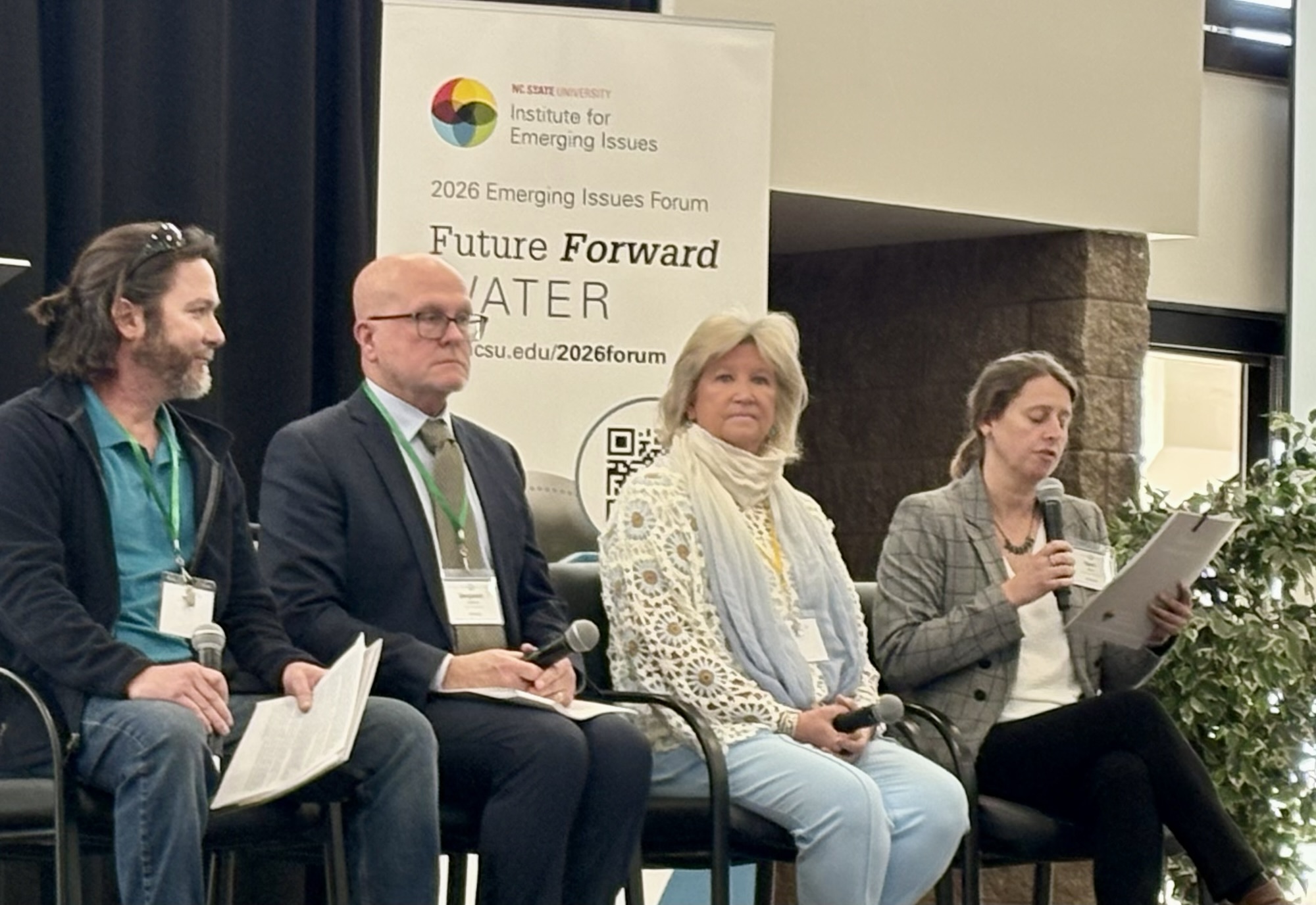
Held simultaneously in Morehead City, Asheville and Winston-Salem in honor of the forum’s 40th anniversary, this year’s event focused on water infrastructure. The forum, founded in 1986 under former Gov. Jim Hunt, has long sought to bring leaders together to tackle the state’s toughest challenges. This year, those challenges were impossible to ignore.
Over 500 people attended the forums. At the Morehead City forum, the attendees represented nonprofits, government organizations and universities and colleges. At the end of the event, some noted that without proper funding or community input, many of the items discussed would not be attainable.
After the forum, the Emerging Issues Institute will take the recommendations and suggestions to a council working on the water infrastructure issue to create a plan to present to the state.
A fragile system under strain
Gov. Josh Stein, speaking by prerecorded video since he attended the forum’s Winston-Salem site, cited the American Society of Civil Engineers’ most recent water infrastructure report card for the state: C+ for drinking water, C- for stormwater, D+ for dams and wastewater.
Storms like Hurricanes Matthew, Florence and Helene have damaged wells and treatment systems across the state, leaving communities without safe water. Meanwhile, population growth in some regions — and the arrival of water-intensive industries like life sciences companies and data centers — is increasing demand.
“In the past year, we’ve advanced more than $850 million in water infrastructure projects,” Stein said, including $356 million directed to western North Carolina after Hurricane Helene. “Clean, reliable water — it’s essential to public health, economic vitality and opportunity in every corner of North Carolina. Basically, water is life.”
But in eastern North Carolina, the burden is often heaviest on towns least able to bear it.
Pat Harris, community development director with the Mid-East Commission Council of Governments, said 93% of the municipalities in her five-county region have fewer than 5,000 residents. More than three-quarters serve fewer than 1,500.
“These communities face the same regulatory requirements as large cities,” Harris said, “but operate with a fraction of the tax base and staff.”
A single infrastructure failure, she noted, can equal a major portion — or even all — of a small town’s annual budget.

Aging pipes, aging workforce
In Beaufort, whose water system dates to the 1920s, Mayor Sharon Harker said the town must balance modernization with affordability. The coastal community swells from 4,600 year-round residents to more than 10,000 during tourism season, straining systems built for a different era and a different climate.
“We don’t just manage pipes,” Harker said. “We manage risk, we manage equity, and we manage local community health.”
The challenges extend beyond pipes and pumps.
Across multiple panels, town managers described a looming workforce cliff. Many utilities report that as much as a third of their operators could retire within five years. Certification requirements are stringent, and salaries often struggle to compete with urban markets.
In Belhaven, Davis said half her staff could retire today. Small towns often lack in-house engineers or planners to guide long-term capital improvements.
“You don’t know what you don’t know,” she said.
Panelists stressed the need for partnerships with community colleges and apprenticeship programs to build a pipeline of local operators — workers with roots in the community who are more likely to stay.

Stormwater and sea level rise
Coastal communities face another layer of complexity: water that comes from below as much as above.
Mayor Ben Cahoon of Nags Head described a barrier island town that grows from 3,000 year-round residents to 40,000 or more in the summer. Eighty percent of homes rely on septic systems. Sea level rise is raising groundwater tables, reducing septic effectiveness and increasing flood risk.
“Our drainage was built after the Ash Wednesday storm in 1962,” said the Hyde County native. “We’re constantly thinking about drinking water, wastewater and stormwater together.”
That “one water” approach — integrating all water systems into land-use planning and capital improvements — emerged as a recurring theme.
Pat Donovan-Brandenburg, stormwater manager of Jacksonville, warned that many stormwater systems are already partially filled due to sea level rise and aging pipes. Heavy downpours now follow drought periods, overwhelming infrastructure designed for smaller, more frequent storms.
“Stormwater has to be brought up to equal footing with water and wastewater,” she said.
She also encouraged county and town leaders to secure a grant writer to help find funding for projects.

Design, dollars and “micro-migration”
Keynote speaker Andrew “Andy” Fox, director and co-founder of NC State University’s Coastal Dynamics Design Lab, placed eastern North Carolina at the center of a national disaster hotspot map. Since the 1970s, he noted, federal disaster declarations have increased nearly 300%.
North Carolina’s coastal plain — more than twice the size of Massachusetts but with half the population — faces vast geographic exposure combined with economic distress.
Fox argued that resilience isn’t a choice between retreat and rebuilding. Instead, he proposed “micro-migration” — relocating homes and infrastructure out of harm’s way while keeping residents within their communities.
In Pollocksville, the lab helped secure more than $2 million in recovery funding within a year of Hurricane Florence, eventually leveraging more than $30 million for park restoration, wetland reconstruction, downtown improvements and business floodproofing. The town is located in Jones County, near Craven County.
“It’s not binary,” Fox said. “It’s about incremental implementation, building financial leverage and keeping the community intact.”
Who pays?
If engineering and workforce challenges weren’t enough, water utilities are increasingly paying to remove contaminants they did not create.
Kemp Burdette, Cape Fear Riverkeeper with the Waterkeeper Alliance, described the $50 million granular activated carbon system installed in Wilmington to remove PFAS — “forever chemicals” — from drinking water, plus $5 million annually in maintenance costs. Upriver communities are also investing in advanced treatment.
“Our citizens didn’t put PFAS in the river,” Burdette said. “But we pay to take it out.”
That cost, panelists noted, ultimately shows up in customers’ monthly bills — in communities already struggling with affordability.
A call for coordination
Despite tensions — between growth and conservation, upstream and downstream communities, local control and regionalization — speakers emphasized collaboration over fragmentation.
Regional utilities can offer economies of scale. Watershed-level planning can reduce long-term treatment costs. Nature-based solutions like wetlands and permeable pavement can filter water before it reaches treatment plants.
But none of it works in isolation.
“If we don’t coordinate, you end up with a fragmented system,” Harker said. “And it won’t work well for your community.”
Forty years after its founding, the Emerging Issues Forum returned to its core mission: convening diverse voices to confront complex problems. This year’s message was clear.
Water may be invisible when it flows freely from the tap. But for North Carolina’s rural towns — balancing aging systems, climate threats and economic pressures — the future depends on seeing it clearly now.
Attendees at the form noted that unless
And perhaps, as Davis suggested, treating it with the urgency of a disconnected cell phone.
Because when water stops flowing, everything else does, too.