
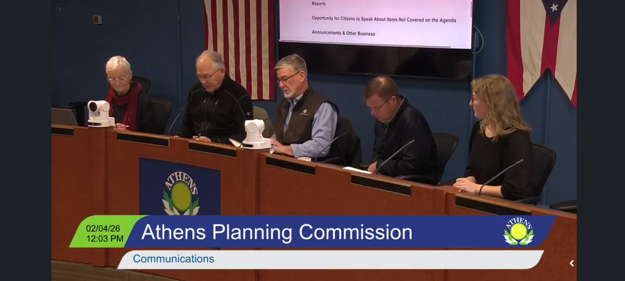
ATHENS, Ohio — Having once lived in Athens, I was tipped off that there may be something worth covering at the Athens City Planning Commission so I figured I’d tune into the meeting, particularly since I don’t see the local corporate media having the staff to cover such affairs.
Planning Commission devoted much of its Wednesday meeting to an in-depth discussion about how the city should regulate residential healthcare facilities and recovery housing, as officials, administrators, and residents weighed state law, neighborhood concerns, and the growing demand for treatment and recovery services. City Council member Alan Swank
Whether it’s a Tyrrell County Commission meeting in coastal Carolina or an Athens City Council — I think folks need to know what’s going on in their communities as their local newspapers fade away.
Subscribe — it’s free!
Discussion at the Planning Commission was prompted by recent cases involving recovery homes operating in residential neighborhoods and by the city’s lack of clear definitions and zoning rules governing such facilities.

David Riggs, director of Athens Code Enforcement, told the commission that changes in development patterns and social services have outpaced the city’s zoning code.

“We have found that, as cities develop and businesses develop, our zoning code actually has to change to keep up with the new things that are going on,” Riggs said. “What we’ve found is that we have recovery housing facilities that we have not defined in our city code that are starting to come into our community.”

Riggs said Athens’ zoning ordinance, created in the 1960s, does not adequately address newer land uses.
“You got new things that come up, like solar panels and other things that they weren’t aware of or didn’t consider back in the 1960s,” he said. “These recovery housing facilities actually need to be defined in our code, and then we need to decide where we want to locate those and what controls, if any, we want to have.”
Distinguishing Two Types of Facilities
Much of the discussion centered on the distinction between residential healthcare facilities and recovery housing.
“These types of facilities are well-defined in the Ohio Revised Code,” Riggs said. “We just don’t have those in our local City of Athens zoning code.”
Planning Commission Chairman John Kotowski asked whether staff was proposing to add new definitions.
“Yes,” Riggs replied. “One of the things we want to do is actually get a definition of what a residential healthcare facility is. We don’t have a good definition of that in our code.”
Riggs also noted an apparent error in existing regulations.
“We have residential healthcare facilities that are currently allowed as a principally permitted use in an R1 zone and are also shown as conditionally permitted in an R3 zone,” he said. “You can’t have both of those. You have to have that correct.”
He said recovery houses may need to be treated differently.
“They’re actually treated differently in the state law, and so we would like to look at treating those differently in our zoning code as well,” Riggs said.
Mayor Steve Patterson emphasized the legal distinction.
“We’re talking about two different things that do exist under the Ohio Revised Code,” Patterson said. “We’re talking about residential healthcare facilities, which have layers of preemption, but we’re also talking about recovery houses under state code.”
Patterson said the Athens code does not address recovery housing.
“There is no definition for a recovery facility, and nor is there a definition as to where they can actually be placed,” he said.
State Law and Local Limits
Riggs said state law limits the city’s ability to regulate residential healthcare facilities.
“There is a state law that says that residential healthcare facilities are permitted in any residential zone, and it preempts any local zoning regulations,” he said.
While the city cannot prohibit such facilities in residential areas, Riggs said it may be able to regulate density.
“We can probably put controls on density or total number of facilities,” he said. “Like no more than five in an R1 zone, or 500 feet from any other residential healthcare facility.”
Service-Safety Director Andrew Stone agreed that density restrictions could help.
“We can regulate the density, we just can’t zone them out,” Stone said.
Stone suggested a starting point.
“I think 500 feet is a good beginning point,” he said. “That would be a jump for density, so you don’t have clusters.”
Riggs outlined different state classifications.
“There are actually three classes,” he said. “Class A is two to three people. Class B is one to five unrelated persons. Type C is six to 16 persons.”
He said Class B facilities are allowed in any residential zone, while larger facilities may be limited to multi-family districts.
For recovery housing, Riggs said the city has more discretion.
“There’s nothing in state law about number of unrelated people for a recovery house,” he said. “That’s purely on local zoning.”
Stone raised broader housing concerns.
“One of the largest market pressures on our housing is Ohio University,” he said. “The tendency to convert single-family homes into student rentals is another market pressure. This use is another market pressure.”
He said officials should consider the city’s limited housing stock.
“If there is a reason to try to alleviate that market pressure, that should drive some of our recommendation,” Stone said.
Permits and Inspections
Riggs proposed creating a local permitting system for recovery houses.
“We would create a permit for recovery housing facilities, very similar to how we do residential rentals or short-term rentals,” he said. “I would suggest that we also do periodic inspections.”
“This is not going to be like a residential use,” Riggs added. “It’s really more commercial.”
He said some newer facilities are not following state rules.
“These facilities don’t seem to be following the State of Ohio regulations,” Riggs said. “We’d like to make sure they’ve got all their ducks in a row.”
Riggs proposed licensing and inspections for health and safety.
“We don’t want these facilities to operate over occupancy or have some kind of issue with health and safety,” he said.
Neighborhood Concerns
Several residents described problems associated with unregulated recovery homes.

Paul Mullins, who lives near two such homes, said police had been called multiple times.
“One time, a person was arrested after running around evading the police,” Mullins said. “Another time, our house became full of smoke because someone started a six-foot bonfire.”
He said he learned the operator was not certified.
“This company is not on their registry and has never applied for certification,” Mullins said. “What we have is a place that is not regulated.”
He said neighbors found a person who had overdosed.
“The oversight is deplorable,” Mullins said.

Jack Stauffer, of Elmwood Place, urged stronger protections.
“Five hundred feet is not far enough,” Stauffer said. “That’s a block and a half. You may go by three or four of these things.”
He called for wider spacing and stronger ordinances.
“We are looking for you folks to tighten up the Athens ordinances,” he said.
Fourth Ward Councilman Alan Swank said the issue has both immediate and long-term implications.
“We’re talking about the situation we’re facing today, which is primarily an administrative issue, and what the future of Athens is going to look like,” Swank said.
He cited police reports showing residents placed in Athens from other communities.
“Treatment is best delivered in their home environment,” he said.
Swank praised established programs.
“Clem House runs like a clock,” he said. “The Gathering Place runs like a clock. Timothy House seems to be working.”
He encouraged restrictions on poorly run operations.
“I would encourage you to make those as restrictive as possible while still taking care of those who are in need,” Swank said.
Diane Pfaff, executive director of the Alcohol Drug Addiction and Mental Health Services Board for Athens, Hocking, and Vinton counties, was the first speaker.
An advocate for high-quality residential facilities and recovery homes, Pfaff said the Mental Health Services Board contracts with five recovery houses.
“They are all certified by the state, and they have to meet a very high level of standard,” she said.
She said quality programs deserve community support.
“A well-done quality recovery house is something we should all support,” she said. “It’s really helping people to turn around their lives.”
Pfaff offered assistance to city officials.
“We would be happy to work with the city to help understand those codes,” she said.
Pfaff also cautioned against isolating residents in recovery.
“Be mindful about not zoning these homes out to the fringes of society,” she said. “Having access to employment is a very important part of that recovery journey.”
Legal Concerns
Anne Rubin, an attorney and former social worker, criticized how the city has handled the issue.
“The city officials were misinformed that Ohio Revised Code 5119.341 overrides local zoning,” Rubin said. “For the last four months, the city has been operating under this misinformation.”
She questioned the administration’s sources.
“I seriously question that this administration was taking its legal advice from entities it is charged to regulate,” Rubin said.
Rubin urged commissioners to study the law.
“Please take the first step of informing yourselves as to the law and the business of recovery,” she said.
Looking Ahead
Throughout the meeting, commissioners and staff emphasized that their work will eventually go to City Council.
Stone said the commission must balance community concerns with legal realities.
“Planning Commission’s going to do what it thinks is best for the city,” he said, “but we don’t want to deliver something that’s dead on arrival.”
Riggs asked for direction.
“If you could give us some guidance on how you want me to define those,” he said.
Kotowski supported aligning local definitions with state law.
“My first instinct is that our definition reflect pretty much what the state defines,” he said.
Riggs agreed, with limited exceptions.
“I recommend that we don’t adjust it,” he said.
Mayor Patterson urged caution in protecting neighborhoods.
“Eighty-five percent of our housing stock is rental units,” he said. “We need to really think through carefully and protect the R1 residential areas.”
By the end of the meeting, no formal decisions were made. Instead, staff was directed to develop draft definitions, zoning recommendations, and possible permitting requirements for future review.
Kotowski said the discussion was only the beginning.
“We’re trying to better understand the situation,” he said.
The commission is expected to continue studying the issue, gather more public input, and eventually forward recommendations to City Council for possible amendments to the city’s zoning code.


