By Miles Layton
Since local government is shut down this week due to the weather in coastal Carolina, my attention turned to a city council meeting in Athens, Ohio, rather than doomscrolling while our family waits for the snow to melt.
And since the Athens News is…
Add to that — readers should know what’s going on in their backyard without having to pay an asinine fee for the privilege of reading about council meetings in the local corporate media outlet.
Related note – in days of yore, Athens’ dueling newspapers in town would each knock out a quick council story on deadline for their readers. These days… well… not so much… but at least there’s the Athens County Independent to do a deep dive into local government.
ATHENS, Ohio — Much like when you have to pay for emergency car repairs or an expensive vet visit with rent due in a week, Athens faces a bleak financial future. There’s a hiring freeze ahead and the City Auditor will begin looking for ways to save money.
Monday, Athens City Council took its first major steps toward tightening city finances, debating a proposed hiring freeze and an ordinance that would authorize the city auditor to reduce 2026 appropriations to address rising healthcare costs, unexpected expenses, and concerns about possible future budget shortfalls. The nearly 2-hour meeting was a combination of a committee meeting and a regular meeting.
First out of the gate – aimed at City Hall, council approved a non-binding resolution endorsing a hiring freeze for any vacancies in city government.
At-large Councilmember Jessica Thomas said the freeze would take effect immediately because it would be adopted through a one-reading resolution.
Mayor Steve Patterson told council that a hiring freeze is “critical” given the city’s current financial situation, particularly the rising cost of employee healthcare.
“This is critical that we do this at this point in time,” Patterson said. “This has been mentioned before. Our healthcare costs have become high. This is only after careful iteration as to the criticality of that position.”
Under the proposal, vacant positions would be reviewed individually to determine whether they are essential to city operations. Some jobs would be filled immediately if they are necessary for public safety or infrastructure, while others could remain unfilled.
“I’ll give you an example. It’s only an example. This isn’t going to happen,” Patterson said, “But if the operator of our wastewater treatment plant were of retirement age or whatever, took a job elsewhere and left that position, that’s a position that absolutely has to be refilled.”
At the same time, Patterson said, other positions may not be replaced.
“There are other positions that could be vacated that are not critical positions, and we will hold that position, not fill it,” Patterson said.
Those positions would remain listed in the city’s staffing ordinance, even if they are left vacant.
“It’ll still be in the staffing ordinance, but in terms of hiring someone to go into that, even though we budgeted for it this year, we’re just at that point to where we will not do that,” he said.
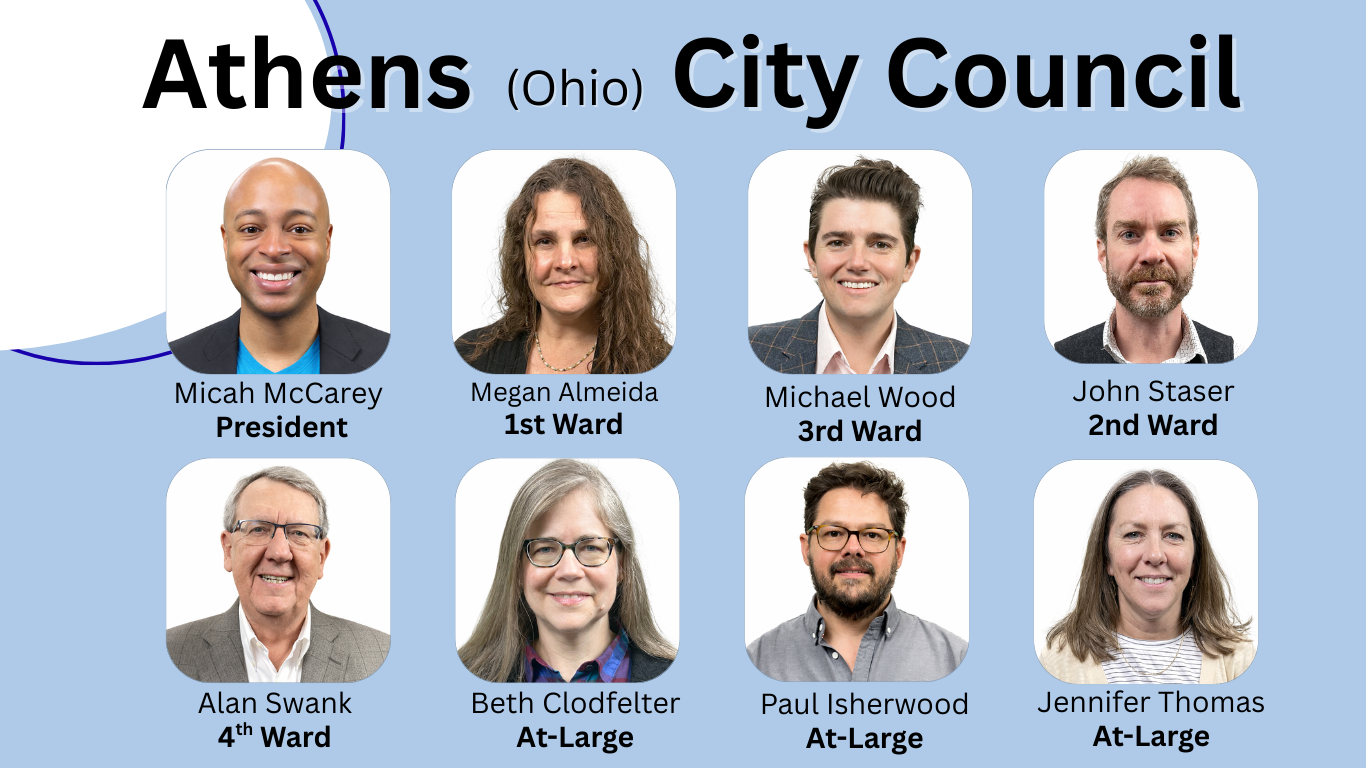
Council member Beth Clodfelter called the hiring freeze proposal fiscally responsible and said she supports the hiring freeze as a way to avoid layoffs.
“I agree with the city’s decision to do this,” she said. “It’s never a good thing when you have to implement a hiring freeze.”
“To me, a hiring freeze is much better than actually cutting jobs,” she added. “The budget really is tight.”
Public concerns about affordability
During public comment, Aaron Thomas of Avon Place said the hiring freeze reflects broader problems related to affordability and workforce recruitment in Athens.
“My goal is to look at how can I stay in Athens when I retire? How can I survive in Athens?” Thomas said.
Thomas said he has watched positions go unfilled and has seen council pass emergency measures to raise job classifications when applicants were scarce.
“You all have to pass emergency resolutions to move jobs up from a level eleven to level twelve because no one is applying for the job,” he said.
Thomas pointed to housing costs as a major barrier.
“When your rent is $1,800 a month for a rental, not to buy a house, plus taxes, fees, and everything else, it’s hard to attract talent to this area,” Thomas said.
Thomas questioned how the city reached its current position.
“This is something that really need to be discussed more in-depth as to how did we get to this point with the rise in healthcare and everything else,” he said.
Early budget reductions proposed
After discussing staffing, council turned to an ordinance authorizing the city auditor to begin reducing 2026 appropriations if revenues fall short. The ordinance would allow the auditor to adjust/reduce spending throughout the year if revenues and carryover funds are insufficient.
Thomas explained that starting the process early could help the city avoid deeper cuts later.
“They look at what we’ve appropriated into various funds and budget lines and determine whether there’s enough revenue there to support those lines,” she said.
Thomas added that the city’s carryover funds were lower than usual, making it harder to cover early-year expenses.
Mayor Patterson emphasized that some city funds are legally restricted and cannot be used to cover general expenses. He cited parking meters, the parking garage, water, sewer, and trash funds as examples of revenue that must be used for specific purposes.
“I cannot take money legally, and I never would, take that from there and go, ‘I’m gonna put this money into the general fund,’” he said. “So there are certain monies that I can’t touch.”
Council members then debated whether to suspend the rules to pass the ordinance immediately, rather than moving it through the standard three-reading process.
Council member Alan Swank strongly opposed expediting the measure.
“We normally do this much later in the year,” Swank said. “What has changed in the last six weeks on the budget that we approved, and what is the hurry?”
Flashback – Swank said the request was significant, given that council had passed a budget for 2026 less than two months earlier in December.
“This may be routine on the surface, but this is a rather large request,” he said. “The message that I’m getting now is, ‘Maybe that budget wasn’t so solid.’”
Swank said council needed more time and more information, especially because the city auditor was not present.
Thomas responded that the auditor and deputy auditor had requested the ordinance.
“When they did the budget, that would have been earlier,” she said. “As December comes, bills come due. We had the large tax refund that came through. It was out of our control, and it was not anticipated.”
Thomas said the ordinance was intended to allow staff to prepare.
“They just want to be able to begin preparing,” she said.
Council member Michael Wood asked whether the ordinance authorized immediate cuts.
“Are we authorizing specific cuts at this point, or are we authorizing looking at cuts?” Wood said.
Thomas replied that line-item reductions are handled by the auditor.
“It’s my understanding that council does not have the authority to make specific line item cuts,” she said.
Swank added that council could still make broader changes in terms of budget cuts, but he returned to the timing issue.
“This is a radical change,” Swank said. “What has changed in the last seven weeks?”
Clodfelter pointed to rising health insurance costs and a major tax reimbursement.
“The city budget really is in pretty dire straits between the health benefit costs that shot up and were just shockingly high, and that unexpected tax reimbursement,” she said.
Clodfelter argued that acting early could prevent deeper problems.
“If they’re going to have to reduce the allocations, the sooner they start looking at that, the better,” she said.
Patterson later explained that the city recently paid a large, unexpected refund. The refund, forced by a 2014 state law, stems from a net operating loss deduction where the recipient, an unnamed business, applied losses from previous years to reduce taxable income.
Patterson said the payment, which a business was legally entitled to receive, affected other budget lines, thus forcing the city to use reserves and created pressure elsewhere in the budget.
Patterson acknowledged concerns about moving too quickly but said the administration is trying to prevent future problems – maybe holding an emergency meeting ahead or perhaps discussing it during council’s next meeting, Feb. 16.
Wood said he was hesitant to approve the ordinance without knowing what could be cut.
“I’d like to have some idea of what we’re cutting,” he said. “I think that’s why I would just like to know more.”
Swank cautioned against rushing a special meeting, perhaps on Monday, noting that the auditor can already analyze the budget without formal authorization.
“There is nothing that prevents the auditor’s office from looking at this right now,” he said. “What this ordinance does, it authorizes the auditor to actually do something to make a reduction.”
After the discussion, Thomas called for a vote on suspending the rules. The motion failed, with Swank and another council member voting no.
With the rules not suspended, the ordinance advanced only to its first reading and will return for further consideration at future meetings. Before City Hall begins shaking the couch cushions for spare change, the matter will be moving forward at a future council meeting.
After the vote, Patterson said he would work with the auditor to provide more details to the council and the public.
“I will work with the auditor to expedite all this, to get the information that council is asking for,” he said.
More from Monday’s meeting to appear in a future article.
Subscribe — it’s free!
2 responses to “Athens City Council Initiates Hiring Freeze; Approves Resolution Aimed at Tightening Finances”
Good read for Elizabeth City Residence. This community actually has a council member who said, “acting early could prevent deeper problems.” Wow a council member with good common sense.
Elizabeth City voters, vote the same people in expecting a different outcome. If Elizabeth City does not start saving for the future, Elizabeth City Residence can expect higher taxes coming in the very near future. And a future council meeting that may be forced to take the same steps in the article that this community is facing. A good Elizabeth City council member would be one like in this article. A person who is looking out for the taxpayers and cutting a little now so it will be easier later.
It’s also refreshing for a local news source to add an out of state report to give all some fresh new ideas. And it’s great to once and a while read about elected officials with a little common sense. Pay attention, the Albemarle Observer actually reports news. A refreshing change to the other so called news sources in the area. We appreciate that you report, and the readers get to conclude their own opinion on the report.
Thx
We used to live there, many years. Daughter graduated high school from Athens High School, so we keep up with stuff from back there. Thanks for reading!
— Miles