BY MILES LAYTON
GATESVILLE — Gates County Schools officials are confronting one of the most consequential decisions in recent district history: whether to consolidate the county’s three elementary schools into two.
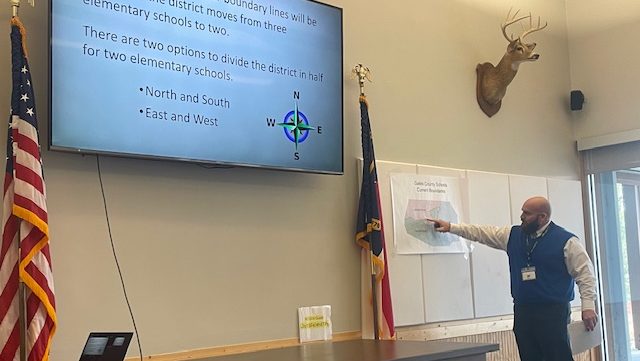
Wednesday’s work session of the Gates County Board of Education offered a comprehensive look at the potential benefits, challenges, and long-term impacts of such a move, with presentations from department directors and Superintendent Barry Williams.
The session provided board members and the public with a detailed picture of staffing projections, curriculum alignment, financial considerations, and facility limitations, alongside research on the academic and social impacts of consolidation.
Before we get into this story, I’m going to say this — I listened to all the presentations. This is not going to be an easy decision — each choice about consolidation and which school to close comes with pros and cons. Like buying a house or having children, the decision ahead to move forward is going to be felt for many, many years to come. There’s something to be said for small schools with small class sizes — however, there’s no denying that the status quo has to change because the school system is losing money, lots of money. And there’s no denying that any decision will cost money to properly implement — it’s not as simple as adding a few more chairs to a classroom. Take to time to read this story — think on it.
Take time to learn more about what’s ahead because it is a big decision.
In January, there will be three information sessions where the community can learn more and provide valuable input as to what you think.
Tentative times and places for community info sessions
- Jan. 5, 2026 at Gatesville Elementary School at 6:30 pm.
- Jan. 6, 2026 at T.S. Cooper Elementary School at 6:30 pm.
- Jan. 7, 2025 at Buckland Elementary School at 6:30 pm.
Subscribe — it’s free!

Back to the work session that highlighted the complex web of considerations surrounding elementary school consolidation in Gates County. Board members examined staffing, curriculum alignment, financial realities, facility limitations, and research on student outcomes, weighing the costs and benefits of such a move.
From HR projections to HVAC replacement, cafeteria renovations, parking concerns, and social-emotional implications for students, the session underscored the magnitude of the decision and the careful planning required.
“This isn’t just about numbers on a spreadsheet. It’s about the lives of our students, the careers of our teachers, and the future of our communities,” Dr. Williams said. “We need to think carefully, involve the public, and make sure every voice is heard.”
Staffing and Human Resources Implications
Human Resources Director Dr. Chante Jordan outlined projected staffing changes if the district moved forward with consolidation. Using enrollment projections, she indicated that certified staff numbers would likely decrease.
“If we look at the projected elementary classroom teacher needs based on this model…going from three elementary schools to two, our classroom teacher needs would be reduced. For kindergarten, one class. First grade, one teacher. Second, third, fourth, and fifth, a reduction of one for each grade. The total reduction of certified staff or teachers would be five,” Jordan said.
Jordan emphasized that these reductions could result in significant savings. “If one school is closed, the following staff reductions and savings will occur: five classroom teachers, guidance staff, media specialists, part-time instructional staff, cafeteria manager, lead staff, and custodian. That would result in a total potential savings of $668,042 if we go from three elementary schools to two,” she explained.
She also outlined the mechanics of a reduction in force (RIF) and attrition. “Our hope is that some of these positions will be vacated through attrition. Some of these positions may be absorbed, but it’s not guaranteed. If the school system must conduct a reduction in force, it would apply district-wide. Employees impacted by RIF may occur throughout the entire county.”
Jordan also addressed operational concerns regarding front office staff, bus drivers, and cafeteria needs. “Two elementary schools will have larger enrollments, which may require reconsideration of front office positions. Longer driving distances may require more buses, and larger numbers for breakfast and lunch may require additional cafeteria staff or increased hours, especially with all students eating for free.”
Questions from board members clarified staffing counts, particularly positions currently filled by long-term substitutes or teacher assistants. Jordan confirmed, “Those positions are still considered certified positions. For example, a teacher assistant serving in a teaching role is considered a teacher position and could be part of those five positions.”
Financial Considerations and Budget Shortfalls
Finance Director Steven Harrell presented the financial context, noting both potential savings and current funding challenges.
“My numbers are a little higher than Dr. Jim Watson. I have seven certified positions and four classified positions projected for reduction. Dr. Watson’s retirement numbers were slightly low, resulting in a total savings of around $822,000. Currently, our state budget shortfall exceeds half a million dollars, which we are supplementing with local funds,” Harrell said.
He outlined specific cuts and savings measures. “We’re cutting local budgets just to get through this year and reach consolidation. Five certified teachers, media specialists, guidance counselors, a bookkeeper, cafeteria manager, lead staff, and custodian make up the projected reductions. Additional costs fluctuate depending on factors such as electricity or winter weather.”
Harrell also addressed Exceptional Children (EC) services, highlighting the financial challenges of supporting students with special needs. “The state funds about 13% for EC expenditures, but our actual costs hover between 18% and 20%. EC expenditures vary widely. Some students may cost $10,000 a year, while others may cost as much as $170,000. Budgeting for this is difficult, but state guidelines require us to meet all student needs.”
Curriculum and Instruction: Collaboration and Consistency
Director of Curriculum and Instruction Susan Casper addressed the instructional benefits and challenges of consolidating schools. She focused on how two schools would allow for more consistent curriculum implementation and stronger professional collaboration.
“There are benefits to consolidating for curriculum and instruction. Two schools will allow district personnel to more easily ensure that we are using common pacing and evidence-based instructional practices when time is not split among three schools,” Casper said.
Professional learning communities (PLCs) would also benefit. “Professional development and PLCs become more unified when staff are in the same building and have constant communication. This reduces curriculum misalignment and inconsistent implementation. Increases in instructional quality are expected, as research by John Hattie highlights collective teacher efficacy—the shared belief among teachers that they can positively impact students—as the most powerful factor in student achievement.”
Casper noted the benefits of co-locating grade-level teachers. “Being in the same school allows stronger collaboration. Even with two teachers per grade level, teachers will no longer be isolated. They can meet in person, have more frequent hallway conversations, and align pacing and curriculum vertically across grade levels. More teachers together also provide more opportunities to analyze data and plan for students, whether for enrichment or intervention.”
She also discussed strategic distribution of teacher expertise. “Teacher moves allow for strategic distribution of skill sets to benefit students. We can ensure AIG-certified teachers and staff trained in multi-tiered support systems or mentorship are appropriately allocated.”
Casper acknowledged potential challenges with consolidation. “Transitional disruptions will occur, and we must mitigate them. Temporary dips in academic performance and state testing may happen due to forming a new school culture. Students who are used to being ‘Pandas’ may struggle if moved to another school with a different mascot. Teacher reassignments to new schools can be challenging, especially for long-serving staff. New school assignments may also impact attendance if students feel uncomfortable or unsafe. Larger class sizes may increase classroom management demands and reduce personalized feedback. Scheduling will be complex, particularly for connected classes like PE, arts, and technology.”
Facilities and Infrastructure Challenges
Maintenance Director Johnny Greene detailed the physical constraints and infrastructure requirements associated with consolidation. Gatesville Elementary, built in 1998, uses a geothermal heating and cooling system.
“The mechanical system consists of 41 packaged geothermal heat pumps and two split system air source heat pumps. Equipment is 27 years old. Replacing HVAC units will require ceiling removal and replacement in hallways and the cafeteria, along with upgraded lighting,” Greene said.
Wastewater systems across the elementary schools also present challenges. “At all three elementary schools, wastewater is treated either via recirculating sand filter beds or constructive wetlands. Any increase in student population will require engineering evaluation to determine if plants can handle additional flow. We’ll work with the Department of Environmental Quality to determine costs and modifications needed.”
Buckland Elementary presents additional capacity constraints. “The cafeteria does not meet capacity for additional students. Renovation of the former boiler room could expand capacity if permitted by building inspectors and fire marshals. Classrooms would need mobile units or a new addition, as existing mobile units are around 30 years old and not suitable for long-term use.”
Parking and traffic flow were also addressed. “Both parking lots are near capacity. To accommodate additional students, we may need additional asphalt or staggered pick-up and drop-off times. Gatesville and Buckland have some land to expand, but T.S. Cooper is more constrained. Principals have done well managing traffic flow to prevent vehicles from backing onto highways.”
Greene indicated that cost estimates for renovations and equipment replacement are underway. “I’ve reached out to estimators to provide accurate numbers. Parking improvements are among the easier projects to address.”
Academic Research and Superintendent’s Perspective
Superintendent Williams framed the consolidation discussion within research on school size, student achievement, and social-emotional outcomes.
“Research on small schools has repeatedly found them superior to large schools on most academic measures and equal on the rest, across all ability levels. Students in smaller schools often learn more, particularly in low-income communities,” Williams said.

He highlighted the social and emotional benefits of smaller schools. “Students have a greater sense of belonging, stronger relationships with teachers, and higher levels of extracurricular participation. Attendance and graduation rates improve when students feel connected to school.”
Williams also noted the potential negative impacts of consolidation. “Students exposed to school closure experienced test score declines. Consolidation may not save as much money as projected, and transportation costs often rise. Longer bus rides disproportionately affect low-income students and students of color.”
He concluded with questions for the board and community. “What is the true purpose of consolidating to two elementary schools? Will consolidation benefit students? How much is it worth to displace over one-third of our students? Are larger classes beneficial? Will consolidation save money or will additional costs offset predicted savings? Will the communities and the county benefit? We need thoughtful discussion and input from all stakeholders.”
One response to “Gates County Schools Weigh Elementary Consolidation: Balancing Finances, Facilities, and Student Success”
Not an easy decision for anyone. After 20+ years in education, there is so much value in smaller class sizes. If a consolidation is the decision that is made, any thoughts to make all of the schools have the same mascot as the high school? This could create more school spirit in the county and would give everyone a “fresh” start if the decision is made to consolidate. Young students attend high school games and are excited to have shirts, etc with the same mascot! In addition, has a four day school week been discussed or investigated? I know it has the potential to be successful and save funds as well.