BY MILES LAYTON
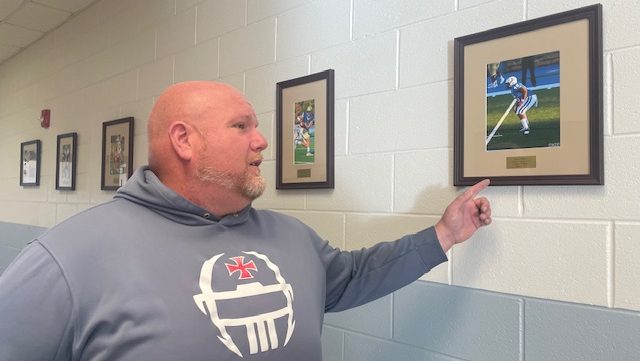
GATESVILLE — On most fall afternoons, long before he ever imagined himself trading a whistle for an office, Matt Biggy could be found where he always felt most at ease: standing on the sun-faded practice field behind Gates County High School, watching teenagers do hard things.
That’s where he believed character lived. That’s where he spent 19 seasons building a football program, not through flash or pedigree, but through routine, grit, and whatever players the small rural school happened to have that year.
This winter, for the first time in nearly two decades, Biggy won’t be drawing up a practice script or breaking down film into the early hours. Promoted in July to athletic director, he’s stepping away from the sideline not because his love for coaching faded, but because he believed the job demanded more than he could give while running an entire athletics department.
“I just didn’t feel like I was capable of doing both of them the way I felt they both needed to be done at the same time,” Biggy said. “I think there’s so much time that goes into being a head football coach and then so much time that goes into being an athletic director and I felt like I was gonna have to neglect one of them to get the other one done correctly. And so I just didn’t feel like that was the right thing to do and, and so decided to, to start pouring my, my focus and energy into the athletic director role.”
The decision was difficult, but it was not complicated. Biggy has never been wired to do anything halfway. He has always been a grinder, and that identity has shaped nearly every aspect of the program he built.
A 25-Year-Old Whose Ideas Were Bigger Than His Résumé
The story of Gates County’s longest-serving football coach begins in 2007, when a young, wiry, wide-eyed 25-year-old walked into a job that, frankly, should have been overwhelming.
“So, I had a little bit of experience then came here and they hired me as a young 25-year-old guy who came in and had all sorts of plans and then been here ever since, so,” he said.
Biggy, 43, grew up in Sarasota, Florida — later earning a degree in physical education from Chowan University. He picked up bits and pieces of coaching experience along the way — he coached a year at Hertford County then a year at Chowan University, then two years at Northampton East, and a brief stint at Weldon before being named coach at Gates County.
But he wasn’t a household name. He wasn’t a coordinator at a powerhouse. He was simply someone who couldn’t let go of the game.
“I missed it terribly,” he said of stopping football after his injury. “All of a sudden I found myself staying at practice.”
That compulsion — the inability to detach from the work — would become one of the threads that held the next 19 years together.
After contacting Hertford County head coach Delton Cotton, Biggy spent a year assisting before jumping into his first head-coaching position. From the moment he arrived in Gates County, he dug in.
“I’m kind of a grinder,” he said. “Hard work beats talent when talent doesn’t work hard, you know? You, if you’re willing to work hard enough, we can be successful.”
Building a Program the Small-School Way
In many places, coaches build systems around ideal personnel. In Gates County, Biggy learned quickly that he had to do the opposite.
“So from a football standpoint, you know, I like power football. I want to run power football,” he said. “But I also believe that, particularly in a small school… we kind of get what we get. It’s try and mold and adapt to what your kids are able to do, try and fit what you do to what they’re capable of doing.”
That adaptability wasn’t philosophical — it was survival.
“Don’t ask them to do stuff they’re not capable of doing,” he said. “Don’t try and put a square peg into a round hole.”
Some years, the Red Barons were explosive through the air — like in 2018. The very next year, the pendulum swung so dramatically that Gates County didn’t complete a pass until week eight.
“It just, you know… that was something that I was, you know, tried to, tried to focus on what we were capable of doing,” he said.
This flexibility became the foundation of the program: schemes changed, players graduated, but the willingness to tailor everything to the roster never did. And in a tight-knit rural community, that philosophy matched the kids who came through the fieldhouse.
“I can’t tell you how many kids I have show up dirty, sweaty, and sometimes in boots, because they just come out of the field,” Biggy said. “Those type of kids, you, you know, they’re going to be ready, they’re gonna be tough.”
The school’s small size created a different sort of advantage — deep familiarity.
“A lot of these kids know each other from the time they’re five years old,” he said. “They were all pretty tight.”
That closeness lasted long after graduation.
“That group… they graduated 15 years ago and they’re all still close,” he said. “I see pictures of them posted… with groups of them together still to this day, 15 years later.”
For Biggy, that was the real proof that the program worked.
The Games That Turned into Memories
Across 19 seasons, certain Friday nights hardened into permanent memories — sometimes because of triumph, sometimes because of survival.
He recalls the 2010 conference-deciding win over North Edgecombe first. The Red Barons were down 18–7 at halftime. They won 19–18.
“That, that was, that was a really, um, good game,” he said. “That’s definitely one that stands out.”
He also remembers the wild, exhausting second-round playoff shootout at Pamlico in 2019.
“If you’re a defensive guy, it was not a good football game,” Biggy said with a laugh. “There was a ton of points scored. It was just back and forth, and you just didn’t feel like you could hold your breath. I counted the final score, I think it was like 68 to 49 or something like that.”
But the game he calls one of his proudest came in 2009, when half his roster was sidelined by illness.
“I had about six or seven kids that were sick and got sent home with, with fevers,” he said. “Our starting running back had sprained his ankle so he, we knew he wasn’t playing going in.”
Then, during the first half, he checked on his quarterback.
“I look at my quarterback, I said, ‘Man, you look terrible.’ He said, ‘I got the flu.’”
Despite all that, Gates County won 22–7.
“That was one of those games when… guys had every reason,” Biggy said. “They could have said, ‘Well, everybody’s out. We could just, you know, could just lay down and bend over.’ But they, they fought hard… that was a lot of grit from those kids.”
He also remembers heartbreak — especially a last-second loss at Pasquotank in 2015.
“They threw a fade ball and just caught it right at the end of the game and it was kind of a heartbreaker,” he said.
Asked about the worst loss, though, he won’t play that game.
“I hate losing no matter what it is,” he said plainly. “I’ve been competitive since I was a little kid. So… losing is, just doesn’t ever sit well with me.”
Thanksgiving Practices and a Growing Résumé
Biggy’s teams made the postseason in all but two years — his first season and the COVID-adjusted spring schedule in 2021. Several seasons pushed deep into the playoffs.
“I think there was four seasons in five years where we had a Thanksgiving practice,” he said. “That’s always what we want to.”
Gates County also won the 2010 conference championship and finished runner-up several times, including in his final season.
His win total? He genuinely doesn’t know. He only figured out his 100th win because the East-West All-Star Game needed his record.
“So I’m, I’m guessin” he sighs, “I had 114, 115, something like that, wins. I couldn’t tell you how many I lost. I didn’t count that many games.”
Because Biggy is so humble, a little bit of math and research uncovered that Biggy’s has compiled a record of 108 – 93 during his time at Gates County where his teams have won one conference title, shared many other conference titles and made 16 state playoff appearances and been ranked in the Top 10 in the state 3 times — twice named Conference Coach of the Year. He coached in the East–West All-Star game in 2023.
What Coaching Became for Him
Over time, Biggy’s understanding of coaching changed. It became less about football and more about shaping the kind of community he wanted his players to experience.
“I think, you know, coaching is, it’s an opportunity to give kids… a quality athletic experience,” he said. “They don’t often talk about, you know, the algebra class. They talk about what they did at basketball practice or what happened…”
That belief cut deeper than he expected. One compliment in particular stuck with him.
“One of the best compliments I’ve ever gotten was… after practice one night… a couple of years ago,” he said. “Somebody say, ‘You know, Coach… You’ve won some games and you’ve done some things here. But… you’ve had a lot of good men come out of this program.’”
Biggy paused when he remembered it.
“And I said, ‘Hmm. Yeah. You know what? You’re right.’ Now that I look at it and think about it, you’re absolutely right. And then, you know what? That means a lot to me.”
That, in many ways, became the true scoreboard of his career.
A School That Became Home
Biggy lives in Hertford County, but professionally — and emotionally — he has rooted himself at Gates County High. It never became just a workplace.
“This place is a really unique place,” he said. “We have a bunch of really good kids and this is a good place to work — I’ve enjoyed my time here.”
His morning routine — the drive, the anticipation, the hallways filled with players — has become part of his life rhythm.
“I wake up and I look forward to coming here and interacting with the kids and, and, and the staff,” he said. “It’s a good place to be and… at this point, I don’t, I don’t know why I wouldn’t go ahead and give them another 10 years.”
Letting Go, but Not Leaving
Stepping down from coaching doesn’t mean leaving the sport behind. Biggy now assumes responsibility for all of Gates County athletics, including finding his own replacement.
“We’re gonna post it and we’re gonna take applicants and go through the interview process and see, see what we get,” he said.
He told his players something simple — and honest — when he broke the news.
“Now my job is to find the best coach to do the job,” he said.
And that’s what the grinder will do. He built a program by adapting, by grinding, by caring deeply about kids who showed up dusty from the fields and bonded from childhood. Now he’ll build the future of an entire athletic department the same way — by working, by teaching, and by never asking anyone to fit into a space they weren’t built for.
Because for 19 years, Gates County football wasn’t a job for Matt Biggy. It was home. And in many ways, it still is.
One response to “THE PROGRAM BUILDER: How Coach Biggy Spent 19 Years Turning Gates County Football Into a Home”
[…] I interviewed Red Barons’ football coach Matt Biggy, I asked him about Gates County High School’s mascot namesake. I love that name – Red Barons […]