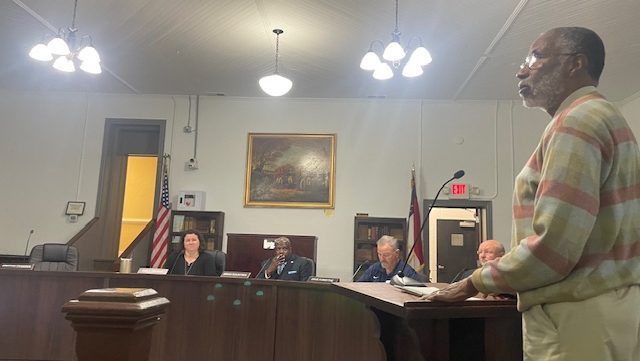
GATESVILLE — Elder Ben Keeling urged the Gates County Commission to join a growing regional effort to secure a federal National Heritage Area (NHA) designation for the Great Dismal Swamp, calling the swamp “one of the biggest resources environmentally on the East Coast” and a landscape whose cultural and historical importance demands permanent protection.
Meanwhile, the Gates County Lions Club urged commissioners this past week to support a new pediatric vision-screening initiative aimed at identifying early eye-health problems in local children. More about that below.
Wednesday, Keeling appeared before the commission on behalf of the Great Dismal Swamp Stakeholder Collaborative. The collaborative is a coalition of tribal, cultural, environmental, and governmental partners working to “conserve the swamp’s ecological integrity, preserve its rich cultural and historical legacy, and elevate public awareness in an equitable and inclusive way.”
National Heritage Areas (NHAs) are sites designated by Congress to hold historical, cultural and environmental significance to the American people that tell important stories celebrating our nation’s diverse heritage. This designation does not affect private property rights. Studies by the National Park Service have shown that National Heritage Areas provide billions of dollars in economic benefits to communities via revenue from tourism, local jobs, federal investments and private philanthropy while also elevating the history and culture of the region.
Should the Dismal Swamp be designated an NHA, it will contribute to the first ever national conservation goal of protecting 30% of U.S. lands, waters and ocean by 2030. Within the swamp’s bounds, The Great Dismal Swamp National Wildlife Refuge is the largest intact remnant of a habitat that once covered more than one million acres of southeastern Virginia and northeastern North Carolina.
Keeling said the purpose of the presentation was straightforward. “The stakeholders are going to share the proposal and seek support for asking the U.S. Congress to designate the Great Dismal Swamp as a National Heritage Area,” he told commissioners.
He explained that the collaborative was founded by “three people, Dr. Alexa Sutton, Chief America Bass, and Mr. Eric Shepherd,” and built around a mission “to bring people together who are of the same mind and determination to do what we can do for now and for the future in regards to preserving the Great Dismal Swamp.”
Keeling emphasized the swamp’s deep and varied significance: ecological, cultural, historical, and economic. “It encompasses a lot of things, recreation, but there’s the ecology, there is history… especially in regards to the Native Indian nations that have been a part of it.” He highlighted the region’s legacy as a refuge for people escaping enslavement. “Individuals who escaped because they wanted their freedom… found their way into the Great Dismal Swamp and were able to stay there because others… were too afraid to go in.”
He stressed that the swamp’s value extends into the modern era through research opportunities, recreation, tourism, and local economic development. “There is a whole lot that can be looked at and is worthwhile to preserve,” he said, noting that Gates County is “very fortunate in your location that you’re right on the border of part of the Great Dismal Swamp.”
The collaborative hosts biannual meetings—one in early summer and one in December—bringing together stakeholders from across the region. Their next meeting is scheduled for December 4 in Suffolk, Virginia. Keeling invited commissioners and the public, saying, “It’s informal… an opportunity to share information, to update on activities… and to keep things moving forward.”
The group’s work includes cultural mapping, educational initiatives, and storytelling projects.
“We’ve started a storytelling histories, having individuals tell their own story about their interaction… with the Great Dismal Swamp,” Keeling said. He noted that many residents have personal ties: “I’m sure if I ask questions here, there will be a number of you… that have some involvement with the swamp.”
As part of the presentation, Keeling played a video featuring Chief Emeritus Sam Bass of the Nacotchtank Indian Nation, who shared a childhood memory of hunting with his father in the swamp. Bass described standing along the historic Jericho Ditch, “dug by slaves in the past,” and encountering a six-point buck submerged in the water with only its antlers and nose visible. “Like the deer vanished,” Bass recalled, until “after looking closer, the deer’s antlers were sticking up out of the water.”
That story, Keeling said, illustrated the swamp’s enduring place in local culture and identity.
The core of Keeling’s request was support for the National Heritage Area designation. “There are 62 of these… throughout the United States. We want to be number 63, all right?” he said. Congress must approve the designation, and a feasibility study is now underway by the National Park Service. That study, he said, stemmed from a bipartisan act passed in 2022 and signed by President Biden directing federal officials to evaluate the swamp’s eligibility.
Keeling said the collaborative has remained in “constant communication” with the National Park Service and was encouraged that “public comments… were very positive, in fact overwhelming,” in favor of the designation.
He walked commissioners through the remaining steps: National Park Service recommendations will go to agency leadership and then return to Congress for final action. In the meantime, he said, “we’re continuing to gather support for this activity.”
Designation would carry both cultural and economic benefits. “It can cause tourism, more tourists to come in and take advantage of the Great Dismal Swamp,” Keeling said. Environmental research, educational opportunities, and access to federal funding would also expand—though any federal funds require a “one-to-one match… to get the public involved on the financial side of the fence.”
Keeling concluded by reminding commissioners that Gates County has previously supported the effort. “In 2022, Dr. Althea Reddick… did sign a letter of support that was needed at the time to get the bill through Congress.”
He closed with a direct appeal: “Will you, the Board of Commissioners, continue to support the National Heritage Area designation?”
Commissioners seemed supportive — time will tell as federal, state and local authorities place their signature on this proposal to turn a dream into a reality.
Lions Club Seeks County Assistance
During a detailed presentation, Lions Club members Lindsay Vick and Jennifer Samper outlined the benefits of the national KidSight program and explained why the group is seeking county assistance in purchasing specialized screening equipment.
The request centered on acquiring a PlusOptix S2 vision screener, which the presenters said would expand the club’s ability to reach families across the county.
Vick introduced the purpose of the visit: “We’re here tonight on behalf of the Gates County Lions Club. We are respectfully requesting the board’s consideration and support for the purchase of a plus Optics S2 vision sprayer for our county.” She said the device would “significantly enhance our ability to fulfill the Lions Club’s international kidsight mission, providing free, reliable and early vision screenings for children of Gates County.”
Vick emphasized that the club is already heavily invested in preparing for the project. “Our club has already invested heavily in the training of members on the device and obtaining certification for individuals within the club to pursue the endeavor,” she said. “We’ve prepared a small slideshow for you guys… We’ve also prepared a packet for each of you for your review.”
Explaining KidSight’s purpose, Samper said, “Our mission is to ensure that all children can receive vision screenings by Lions Clubs and facilitate necessary follow-ups with an eye care professional. We believe every child deserves to learn and see the world clearly and to succeed in school and society.”
The screenings focus largely on early childhood. “We concentrate on ages from six months to six years to identify and refer children with risk factors of amblyopia… and children through 12th grade with refractive errors who need eyeglasses.”
Vick cited the consequences of undetected vision problems. “Eighty percent of what children learn is visual,” she said. “Five percent of preschool children have a vision problem… Fifteen plus percent of school-aged children have a vision problem.” Too often, she noted, “children and parents are not always aware of vision problems.”
Vick described what the device can and cannot detect. “We only conduct screenings not to be confused with complete eye examinations… Our machines will only detect those things that are significant for their vision, but we always recommend that they go to an eye care professional.”
Commissioners asked about the availability of local eye doctors. The presenters responded plainly: “In our county? Yeah. None.”
The presenters detailed conditions the device can flag, including “anisometropia, which is a significant refractive difference between the eyes, and strabismus… and anisocoria.” They also reviewed common refractive errors such as “nearsightedness, farsightedness, and astigmatism.”
Early detection is essential, they said. With amblyopia, “This condition can become permanent after the age of seven.” Without correction, “the brain can’t use the eyes together,” a problem that can carry into adulthood.
Lions Club members said they could bring screenings to a wide range of sites: “Early Head Starts, Head Start programs, pre-Ks… public schools, community groups, festivals, vacation Bible schools.” They also confirmed their training capacity: “We have the ability to train every member in our club to operate the cameras and be successful with this endeavor.”
Commissioners asked about partnerships with schools. Samper responded that while they have not approached schools yet, “we didn’t have the equipment to actually provide the services,” but noted the screenings could help nurses by allowing them to “eliminate their paperwork.”
Cost was also discussed, with one commissioner citing the quote of “7,819.44.” Samper said, “We would offer any, you know, any amount of support… any amount would be appreciated.”
The Lions Club told commissioners they had already begun discussions with preschool staff. “She actually wanted us to be able to attend the preschool screenings,” Vick said.
The board took no formal action — due to protocol and whatnot regarding appropriations needing to be on the agenda before a vote — but thanked the group for its presentation as the county weighs whether to help fund the device — that said, commissioners were supportive and that $7,800 appropriation will probably be approved at the next meeting in December.