BY MILES LAYTON
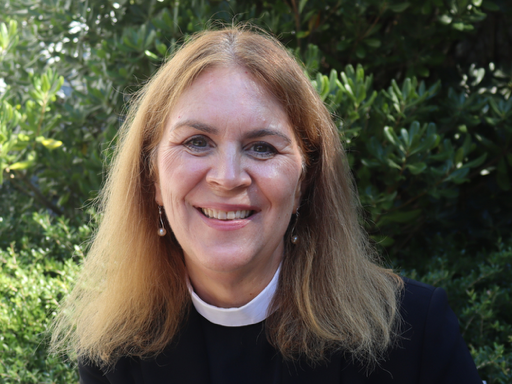
GOLDSBORO — The Rev. Sarah Fisher, rector of St. Catherine’s Episcopal Church in Marietta, Georgia, made history on Saturday when she was elected the first female bishop of the Episcopal Diocese of East Carolina.
Fisher, 54, who is openly lesbian and married to the Rev. Mandy Brady, an Episcopal priest, was chosen during the diocese’s Nov. 15 convention at the Maxwell Center in Goldsboro.
Fisher was elected on the third ballot, receiving 36 votes in the clergy order and 70 votes in the lay order. Under the constitution of the diocese, a simple majority from both orders on the same ballot is required for election. The Rev. Brian Cannaday, rector of St. Christopher Episcopal Church in League City, Texas, and the Rev. Caleb Lee, rector of St. Paul’s Episcopal Church in Wilmington, were also on the ballot. Lee withdrew after the second ballot. The bishop-elect will succeed Bishop Rob Skirving, who will retire in 2026 after 11 years in office.
The Diocese of East Carolina consists of 67 parishes, two college ministries, and congregations that range from small rural missions to large coastal churches in places near and far such as St.Paul’s in Edenton, Church of the Holy Trinity in Hertford, Grace Episcopal Church in Plymouth, St. Andrew’s Episcopal Church in Columbia and St. George’s in Engelhard.
Moments after her election, Fisher spoke to the convention — she was visibly moved.
“To know me. I’m rarely at a loss for words, so take this moment as the one time that I’m at a loss for words,” she said to the audience via Zoom. “I am in awe that y’all have elected me. I am beyond honored. And I’m so excited to get to come and to get to know you and to work with you and to be with you.”

Reflecting on weeks spent visiting congregations, she said, “I see so much hope and life and joy in your diocese and spiritual depth. So much spiritual breath again and again when we get back every night. And I would talk about the places we’ve seen God just moving among you.”
Calling the election process “a holy and a beautiful and a long one,” Fisher praised her fellow nominees. “It has been a real gift to walk alongside this with Brian and Caleb and their beautiful spouses,” she said. “They are extraordinary priests… what delightful priests they are to have in this church.”
Fisher asked the diocese to hold her family in prayer as she prepares to leave her Georgia parish. “I love this place so much that it’s going to be really hard to say goodbye,” she said. “I hope y’all like to drink coffee because I am a good coffee drinker… I just can’t wait to get to know you.”
She also offered a theological reflection that grounded her sense of calling: “God is doing in us infinitely more than we can ask or imagine,” she said. “And I think this is so true for East Carolina.”
Bishop Skirving offered his blessing as the convention concluded. “Sarah, you and Mandy and your family will be in our prayers,” he said. “We will do everything we can do to be ready to support you in your transition to East Carolina. God bless. God bless you.”
Fisher closed by promising prayers in return and reaffirming her eagerness: “Until I see you in person… I can’t wait to join you.”
Pending the required consents from diocesan standing committees and bishops with jurisdiction across the Episcopal Church, Fisher will be ordained and consecrated as bishop diocesan on May 23, 2026, at the Riverfront Convention Center in New Bern.
A historic election in a church that has steadily expanded LGBTQ+ inclusion
Fisher’s election as the first female bishop of East Carolina is also historically significant because she is openly lesbian and married to a woman. Her leadership will unfold in a denomination that has spent nearly five decades broadening the full inclusion of LGBTQ+ Episcopalians. Fisher’s selection followed months of parish forums, discernment conversations, and published essays from each of the three nominees.
Since the mid-20th century, the Episcopal Church in the United States has increasingly affirmed LGBTQ+ people and their full participation in church life. As early as 1976, a General Convention resolution declared that “homosexual persons are children of God who have a full and equal claim with all other persons upon the love, acceptance, and pastoral concern and care of the church.”
Ordination of gay and lesbian clergy followed. The first openly gay priest, Ellen Barrett, was ordained in 1977. Later, in 2003, the church made history by electing Gene Robinson, an openly gay man, as bishop of New Hampshire — a groundbreaking moment that drew both international celebration and sharp internal controversy.
The church’s policies continued to evolve. In 1994, the Episcopal Church added “sexual orientation” to its non-discrimination canons for ordination. In 2015, the General Convention authorized gender-neutral marriage rites, and later approved a requirement that priests be permitted to perform same-sex marriages even in dioceses where the local bishop objected.
Today, the Episcopal Church is widely recognized as one of the most LGBTQ-affirming mainline Christian denominations. It not only welcomes LGBTQ members in its pews but also fully includes them in its clergy, leadership and sacramental life, consistent with its long-standing theology of dignity, inclusion and love.
“Why this diocese?” — Fisher’s hopes for East Carolina
In her published essay for the bishop search process, Fisher wrote candidly about why she felt drawn to East Carolina at this moment in its history. “Two ministry gifts I carry are skills for Congregational Development and a heart that can sit with people in times of both joy and heartbreak,” she wrote.
“East Carolina seeks a Bishop who can help her people and her churches dream, grow, redevelop, and thrive. What I hear in this profile is a strong desire for a pastor and leader who can speak with passion, joy and hope, while partnering and discerning with communities where God is leading them. I believe I can help in this strategic and pastoral work.”
She also pointed to national and regional trends that make eastern North Carolina fertile ground for growth. Citing a February report from the Pew Research Center, she noted that the long-running nationwide decline in church attendance has slowed. “The Diocese of East Carolina is home to some of the fastest growing communities in the nation,” she wrote.
“Churches of all sizes are offering places for people to combat the pandemic of loneliness, to reimagine what church life can be, and to grow as disciples and friends of Jesus. Every congregation, of every size, has the ability to grow in health, vitality and faithfulness.”
She described the moment as “exciting and full of possibilities,” adding that she “would be honored to be part of a conversation about how God’s work in the world might continue to grow and flourish throughout the Diocese.”
A faith shaped by struggle, story and welcome
Fisher’s spiritual autobiography, reflected in her essay responses, is rooted in memory, vulnerability and the transforming power of a faith that she said has repeatedly called her home.
“As a child, before I knew the words to the liturgy or sang hymns with delight, my eyes focused on a stained-glass image of Jesus above the altar: welcome, love, joy,” she wrote. That image stayed with her through tumultuous family transitions, early adulthood, and periods of self-doubt.
“I ran from myself and from God. I was lost and afraid. Despite fear of rejection, I made my way back to church, that stained glass image still proclaiming welcome, joy and love.”
Her return to church marked a turning point. “Returning to the church meant returning to the One who had been patiently waiting for me to remember who and whose I was.”
Her love of Jesus, she wrote, “is personal, rooted in the Gospels, amplified by study, made known in the breaking of the bread and through God’s people.”
She said her ministry—whether as priest, friend, neighbor or stranger—aims to make that same path of return accessible: “I hope that in everything I do and say… I make the same journey accessible to others.”
Navigating division with dignity and relationship
Fisher, who describes her current parish in Georgia as “very purple,” says her approach to leadership in a polarized country is grounded in scripture and human proximity.
She quotes a friend’s definition of conflict as “two or more conflicting ideas trying to inhabit the same space,” and pairs it with a line from Ephesians 6:12—“flesh and blood, people, aren’t the enemy; the struggle is conflicting ideas inhabiting the same space.”
That understanding, she wrote, shapes how she leads. “My approach is to dive into relationship—relationship with Christ, relationship with one another. Getting proximate to those who differ from us is vital to seeing the inherent dignity and divinity that dwells in every person.”
She added that “words matter. Teaching matters.” When interpersonal proximity isn’t possible, she uses her voice “to offer a lens through which the world might be imagined as God dreams it.”
A wide-ranging ministry career
Fisher has served as rector of St. Catherine’s since 2017. She previously served congregations in Chicago, Clarkesville, Dunwoody and Atlanta, as well as in hospital chaplaincy. Her résumé highlights her emphasis on stewardship, transparency, hospitality and congregational health.
She described her ministry as collaborative, especially in politically diverse settings. At St. Catherine’s, she worked with church leaders to update policies on finances, human resources and facility use “while being transparent with the parish about money.” She also focused on engaging families with young children in the years following the pandemic.
Before moving to Georgia, she revitalized St. Peter’s Episcopal Church in Chicago, helping the urban congregation grow financially and spiritually. She also served as chaplain at Children’s Healthcare of Atlanta, where she provided pastoral care in the Emergency Department of a Level One Pediatric Trauma Center.
A life shared with family, faith and joy
In her “Tidbits” section filed with the diocese, Fisher describes her personal life with characteristic warmth: “I share my life with my wife Mandy, who is also an Episcopal priest, and our dogs Bayton & Maggie, the black labs. Bayton serves as the Chief Joy Officer of my parish.”
Her identity spans personal, spiritual and playful descriptors: “beloved child of God,” “very proud auntie,” “human tennis ball dispenser to two delightful black labradors,” “yoga student,” “yoga teacher,” and “pilgrim following the Risen Christ.”
She lists what she loves most: “Jesus,” “my family,” “justice is what love looks like in public,” “good food,” “Holy Scripture,” “laughter,” “a good story,” and “joy.” Of this last passion she wrote: “It may seem an odd thing to say I love joy, but I do. I think it’s one of my God-given charisms. I tend to abide in joy.”
Her hopes for her ministry are similarly direct: “love, inasmuch as I am able, the way Jesus loves,” “serve the Church and her people with humility and care,” and “use my voice to heal and never harm.”
And her most enduring belief is simple: “God is irresistible. Love…always gets the last and best word.”
2 responses to “Fisher Elected As First Female Bishop of East Carolina, Marks Historic Milestone for LGBTQ+ Inclusion”
Thank you much for this great article about our new bishop. We are excited to welcome her. Hopefully she will help us grow on love and Christ.
Thanks — Miles