
BY MILES LAYTON
COLUMBIA — Tyrrell County Schools Superintendent Brianna Williams outlined a detailed school improvement plan this week aimed at lifting the district out of its state-designated “low performing” status — a label she said reflects both statewide accountability formulas and the district’s ongoing struggle with small class sizes, teacher shortages, and post-pandemic behavioral challenges.
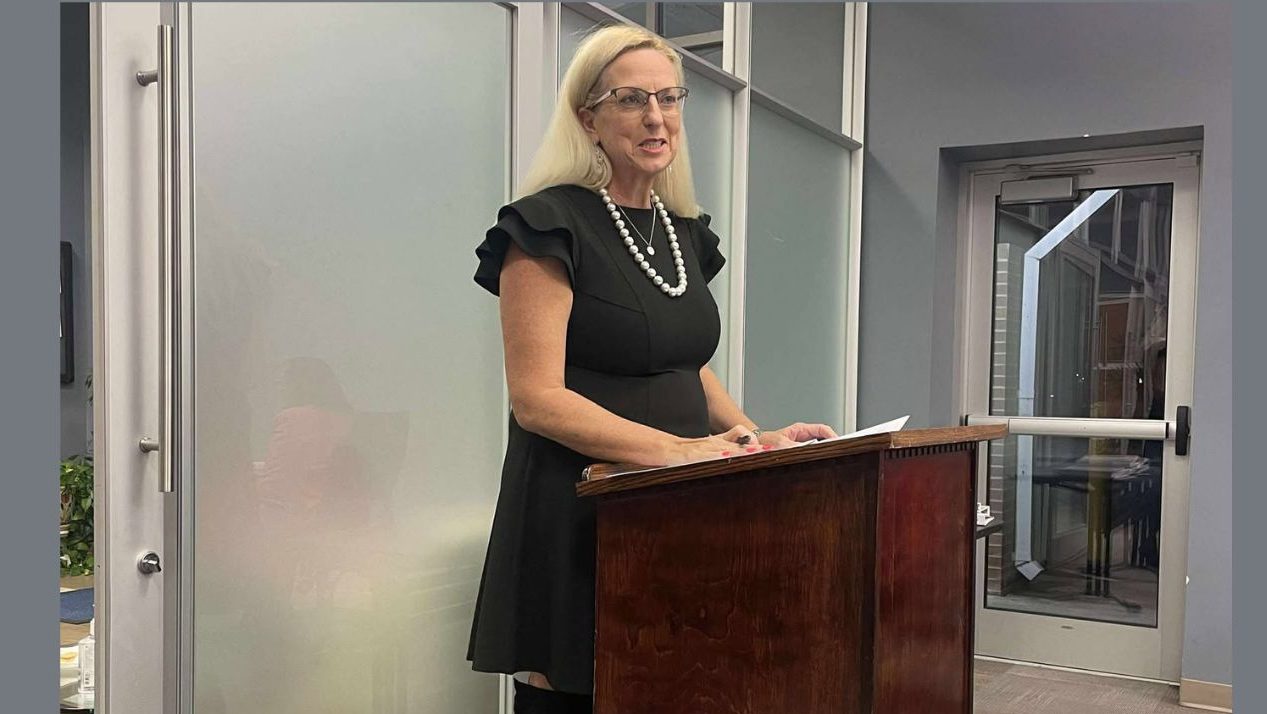
“Good evening,” Williams began as she addressed the community, teachers, staff and even a few top notch Wildcats’ students who were presented with awards on Tuesday at the Tyrrell County Board of Education meeting. “Thank you all for being a part and for staying for this. The district in North Carolina schools is low performing. The superintendent must draft an improvement plan for each low performing school in addition to a district plan.”
Under North Carolina law, she explained, low-performing schools are those that receive a performance grade of D or F and fail to meet expected growth as measured by the Education Value-Added Assessment System (EVAAS). Low-performing districts are those where a majority of schools fall into that category. That plan is included at the bottom of this story.
“TES last year was a D school and did not meet growth,” Williams said, referring to Tyrrell Elementary School. “CMS was a D but did meet growth. CHS was a C school and met growth in all areas except economically disadvantaged. But because more than one school in our district is considered low performing, our whole district is considered low performing.”

That statewide definition, Williams emphasized, is weighted heavily toward test results. “Eighty percent of the formula is based on proficiency,” she said. “Twenty percent is based on growth. For a long time, educators and principals like myself have argued to have a 50-50 model … however, we are still stuck with the model of 80-20.”

A Data-Driven Roadmap for Improvement

Williams said each school’s improvement plan includes “strategies to raise school performance grades and growth scores, how the central office will monitor the progress, necessary policy changes, and specific goals for early childhood learning.”
The district plans will be made public online, she added, and must first be approved by the Tyrrell County Board of Education before being submitted to the State Board of Education.
Tyrrell’s plans, she said, are guided by North Carolina Professional School Executive Standards and Teaching Standards, both of which hold administrators and teachers accountable for “acceptable, measurable progress for students based on established performance expectations.”
To meet those expectations, Williams identified three focus areas from the NCStar school improvement model:
- A107: “All teachers employ effective classroom management and reinforce classroom rules and procedures by positively teaching them.”
- A204: “Instructional teams develop standards-aligned units of instruction for each subject and grade level.”
- A401: “The school implements a tiered instructional system that allows teachers to deliver evidence-based instruction aligned with the individual needs of students across all tiers.”
“We heard that [classroom management] also addressed in public comment,” she noted. “So that’s one thing our district is also supporting in our schools.”
Professional Development and Instructional Focus
Williams described a district-wide instructional plan centered on teacher training, curriculum fidelity, and data-based decision-making.
“The district is going to provide high-quality professional development,” she said. “We’re already doing that in SEL with doing a district-wide Capturing Kids’ Hearts. Beginning teachers receive BT induction program and a partnership of support with East Carolina University.”
For early grades, Williams said, the district is investing in literacy and math programs that align with state standards and the “Science of Reading.”
“K through six (Core Knowledge Language Arts) CKLA — that’s actually a K-5 initiative for reading — Envisions Math and Letters, Volume 1 and 2, which is aligned with the Science of Reading for all K-5 teachers,” she said. “Classroom management and student engagement PD [professional development] for grades 6-8, and content-specific PD opportunities for grades 9-10.”
The district also aims to “protect instructional time” through better scheduling and fewer classroom interruptions. “That means well-planned master schedules, streamlined transitions, clear and consistent routines, minimizing interruptions, proactive classroom management, and protecting teacher planning and collaboration time,” Williams said.
She also stressed the importance of data use to monitor student growth — including end-of-grade and end-of-course results, EVAAS projections, DIBELS benchmarks, classroom assessments, attendance, and discipline data.
To ensure fidelity, she said, “School and district walkthroughs, fidelity checks, and the use of the super observation” will be implemented. “If you’re a district with a low performing status, the first observation has to be a full 45-minute observation, even if they’re on the abbreviated schedule,” she added.
Elementary School Focus: Literacy and Time Fidelity
At Tyrrell Elementary, the improvement plan places particular emphasis on reading blocks and consistent schedules.
“Reading in K3 is 120 minutes,” Williams said. “Grades 4-5, 90 minutes. Grades 6, 60 minutes. Math grades K3, 65 minutes; grades 4-5, 90 minutes; grades 6, 65 minutes.”
She said teachers requested protected morning time to start the day calmly. “It was also a value for the elementary teachers and teaching staff from 8:05 to 8:20 to have morning announcements and breakfast and not try to force instruction into that kind of flex time in the mornings,” she said.
Professional learning communities (PLCs) meet biweekly “for literacy, focus on student engagement and academic rigor,” Williams said. Teachers use ongoing assessments — such as “common formative assessments, NC check-ins, and exit tickets” — to answer key questions: “Where are we now? Where are we going? And how do we get there?”
The goal, she said, is “growing the student from the current level of prediction or proficiency.”
Middle School Focus: Engagement and Consistency
At Columbia Middle School, Williams said the challenge is keeping students engaged.
“How do we keep middle school children engaged for the entire block?” she asked rhetorically. “And if there was a magic pill for that, we would all swallow it and take it.”
“Middle school brings a whole new level of consistency that has to happen in expectations and engagement so that we can keep our kids actively engaged in learning,” she said.
The plan for CMS includes “horizontal and vertical planning,” PLCs facilitated by teacher leaders in English Language Arts and Science, and “a focus on student engagement and academic rigor.”
Using Data to Track Progress
When asked what kind of data the district will use to measure progress, Williams said the approach is comprehensive and cohort-based.
“There is formative data, classroom data, common formative assessment data, NC check-ins throughout the school year,” she explained. “But a lot of what we look at initially is the data from the year end from the previous year, and we follow that cohort. So where was the proficiency in third grade, and where did they end up?”
For younger students, she said, reading progress is tracked using DIBELS benchmarks, while middle and high school math teachers communicate vertically about student needs. “Those teachers are talking to each other and planning vertically, saying, ‘These kids are weak in these areas and based on these standards, this is what they need to work on,’” she said.
Williams described a color-coded system to identify student needs: “Are they red, are they yellow, are they green? Some kids do really well in reading but struggle in math. Are they struggling in both? So it’s really drilling down — where are our kids?”
The ultimate goal, she said, is that “every child shows one year of growth every year.”
State Oversight and Local Responsibility
When asked if the state monitors the district’s progress, Williams replied that there are multiple levels of oversight.
“There’s a series of steps, and part of that step is you guys approving this plan and me submitting this plan,” she told the board. “Then me working with principals to ensure they’re monitoring teachers and observing the teachers to make sure their lesson plans are aligned with the standard course of study and that we’re assessing what we’re teaching.”
She said the goal is to get Tyrrell County Schools out of low performance — a task that hinges on improving results at just one school. “Here in Tyrrell County all we have to do is get one school out,” she said. “The middle school experienced a tremendous amount of growth last year, but they were still a D school because of low proficiency.”
In small districts, she added, “One or two kids makes a huge difference. It’s not like 50 kids — two, three, four, five kids scoring a certain level can change the whole trajectory of the grade level, of the subject, of the district.”
Funding and Class Size Challenges
Board members and parents raised concerns about large elementary class sizes and their effect on discipline and learning.
“It not behoove [Tyrrell] Elementary to have smaller classes?” one speaker asked. “The fourth grade — they’re just overwhelmed.”
Williams said the district is working to hire an additional teacher but faces limits in state allotments. “We are allotted 19 teachers for Tyrrell County Schools,” she said. “Seven teachers for Tyrrell Elementary — that’s one teacher per grade level that the state allots those positions for. Period. That’s it.”
Kindergarten through third grade have class size caps, she said, but “after fourth grade, there are not class size limits in the state. You can go up to 50 children per class. Now, is that best practice? Absolutely not.”
To relieve pressure on upper grades, the district is seeking additional funding sources like Title I and at-risk student funds to hire more teachers.
Loss of Funding to Charter and Regional Schools
Williams warned that the district has lost significant funding as local students enroll in charter and regional schools.
“We just reverted $247,000 to NE-RSBA, which is a regional school — Tyrrell County dollars,” she said. “That is four teaching positions and two TA positions. So I encourage everyone in this room to contact your legislators … and tell them that we do not want our dollars leaving Tyrrell County Schools.”
She added that $201,000 was also diverted from the district’s alternative program fund, reducing local flexibility. “We are trying to navigate that the best we can and also be fiscally responsible,” she said. “But a lot of what has happened in the last year is we have lost money due to Tyrrell County children leaving our district and going to private, charter, and regional schools.”
Williams offered to help community members advocate for funding: “If you want me to craft an email and send it to you and let you send it from yourself, I’ll be more than happy to do that.”
Post-COVID Behavioral Struggles
Williams also connected discipline challenges to broader social trends. “We are seeing an increase in behaviors, kids that are emotionally dysregulated — all kinds of things,” she said. “A lot of this is post-COVID stuff. You’re just seeing where kids were isolated and parents were still working and they didn’t have schools. So we are battling it.”
A parent in attendance agreed, Ashley White noted during public comment, “The class sizes are larger, the discipline problems are getting worse, and then the parents — and me, as one of them — I can see that people are drawing their children out because of the discipline problems.”
Williams assured parents their voices are being heard. “Having been a principal for the last 10 years, I take safety and discipline and ordering a school very seriously,” she said. “So I can assure you that we can talk about that outside of this meeting. But all of your voices have not gone unheard.”
A Plan Rooted in Consistency and Community
Despite the challenges, Williams emphasized that the district’s improvement plan is not built on new theories but on “research-based best practices that are already happening.”
“This is nothing from left field,” she said. “It’s basically using our practices and making sure we have fidelity checks to make sure that it’s happening.”
School Improvement Teams, she added, remain active and “are required by law to meet monthly.”
Williams ended on a note of resolve. “It’s our goal as educational professionals to ensure we have highly qualified teachers in each classroom,” she said, “and that every year they’re showing a year’s worth of growth, even if they’re not proficient.”
As Tyrrell County Schools moves forward with its plan, Williams said the task ahead is both technical and human. “We can fix the schedules, we can fix the curriculum, but we can’t do it without our community,” she said. “We’re in this together.”


