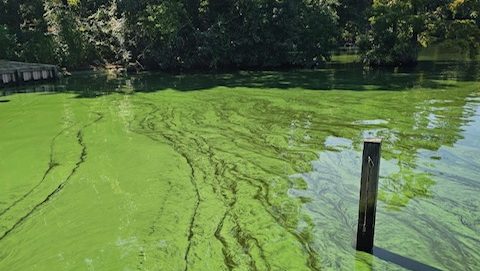
EDENTON — About that green stuff in the water…
Though we live about 400 yards, give or take, from Edenton Bay, I can smell the algae some mornings. And I know from other folks and government agencies, that it’s in the Albemarle Sound.
Talked to Steve Karl the other night at the town’s only grocery store — he can smell it too. Him and his wife Colleen have been spearheading the algae awareness project through the Chowan-Edenton Environmental Group for years to try and identify what’s causing the green goo that seems to be worse this year than in years past — even lasting longer than the summer flare up into the fall.
I thought that maybe the Nor’easter maybe cleaned out the algae from the Sound, but here we are about a week later. Means probably not a good idea to go kayaking or sailing — dang!
Thus, we’re posting this press from the North Carolina Department of Environmental Quality Division of Water Resources (DWR) that was issued Thursday that advises the public to avoid contact with green or blue water on the Chowan River and in associated tributaries between Occano and Arrowhead Beach due to algal blooms that have lingered in the area since Oct. 6.
The bloom has been observed in Bertie and Chowan counties on the Chowan River at its confluence with Salmon Creek near Occano; on the Chowan River near Whites Beach; and on Dillard Creek (Indian Creek) near its confluence with the Chowan River at the Arrowhead Beach boat launch. Algal blooms do tend to move due to wind and wave action.
Based on analysis of samples collected from this area, DWR determined the blooms are dominated by species of Dolichospermum (also known as Anabaena) and Microcystis, which belong to the algal group cyanobacteria, also known as blue-green algae. Cyanobacterial blooms usually appear brights green, but when a bloom starts to decay, the color can change to a milky blue. Decaying algae may produce a strong, foul odor that can impact a large area.
Dolichospermum and Microcystis can produce microcystin, an algal toxin that may cause adverse health effects in humans and pets. An analytical test detected microcystin in this bloom 2,600 parts per billion on the Chowan River at its confluence with Salmon Creek near Occano; at 35 parts per billion on the Chowan River near Whites Beach; and at 89 parts per billion on Indian Creek near its confluence with the Chowan River, exceeding public health advisory levels.
Results have been reported on DWR’s Algal Bloom Dashboard. The N.C. Department of Health and Human Services Division of Public Health (DPH) routinely encourages the public to avoid contact with large accumulations of algae and to prevent children and pets from swimming or ingesting water in an algal bloom.
DPH suggests the following steps to safeguard against algal blooms:
- Keep children and pets away from water that appears bright green, blue, discolored, or scummy.
- Do not handle or touch large mats of algae.
- Avoid handling, cooking, or eating dead fish that may be present.
- If you come into contact with an algal bloom, wash thoroughly.
- Use clean water to rinse off pets that may have come into contact with an algal bloom.
- If your child appears ill after being in waters containing an algal bloom, seek medical care immediately.
- If your pet appears to stumble, stagger, or collapse after being in a pond, lake, or river, seek veterinary care immediately.
To report an algal bloom, contact the nearest DEQ regional office or submit a report online. To view reported algal bloom events, visit DWR’s Fish Kill & Algal Bloom Dashboard.
To learn more about algal blooms, visit the DWR website. For more information on the potential health effects from algal blooms, visit the N.C. DHHS website.
DPH also reminds the public to take precautions as other microorganisms or pollution may be present in waterbodies that can lead to recreational water illness, see https://epi.dph.ncdhhs.gov/cd/water/prevent.html.