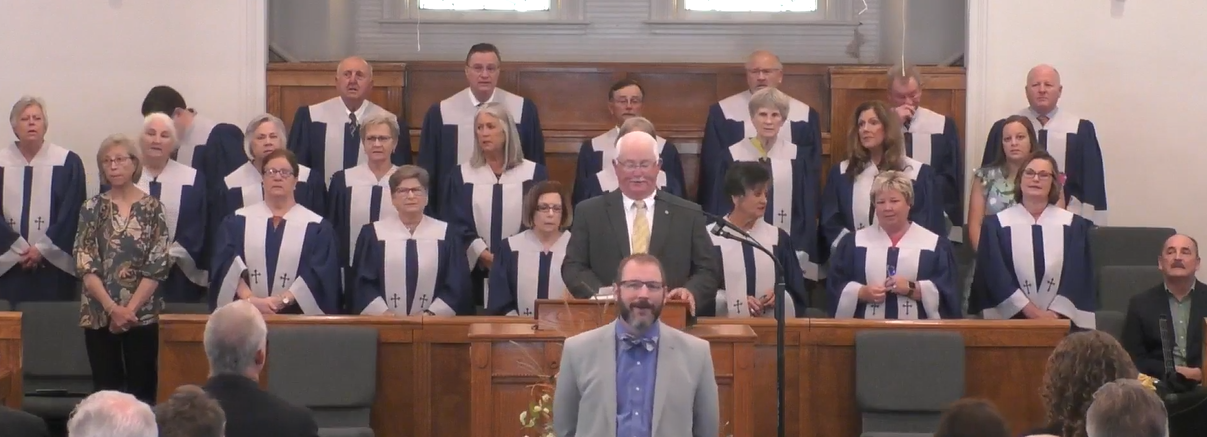
“Come back, come back repentant, come back ready for renewal, come back. And if you do that today, I’m pretty sure if these walls could talk, they would say, welcome home.” — Pastor Ron Cava
ROCKY HOCK — The air inside Rocky Hock Baptist Church was thick with a blend of history, melody, and spiritual reflection as the congregation celebrated its 190th Homecoming and Anniversary on a glorious Sunday morning, Oct. 12.
The service, which marked nearly two centuries of continuous ministry dating back to 1835, was more than a nostalgic look at the past. It was, as current Pastor Matthew Dupuy put it, a moment to view the church’s longevity not as “190 years of what Rocky Hock Baptist Church has done,” but as “190 years of the providential care of an almighty God through a church that He has united together as a body of believers.”
A small but growing gallery of photos appears at the end of this story.
The heart of the celebration beat strongest in the featured message by former Senior Pastor Dr. Ron Cava, who served the church from 1995 to 2002. His sermon, which focused on the concept of spiritual homecoming, challenged the assembled crowd—which included many former pastors and music leaders—to return not just to a building, but to the defining moment of their faith.
A Holy Gathering: Music and Invocation
The service began with a rousing declaration by Music Director Steve Evans, who led the congregation and a talented choir and band in the hymn, “God’s Building A Church.”
“For 190 years here at Rocky Hock, God’s been building a church,” Evans declared, setting the tone for the morning.
Dupuy then framed the day’s significance. He emphasized that the anniversary wasn’t merely about history, but about seeking God’s will for the future. “He’s got a reason this church has been here for 190 years, and he has a reason for it to go forward,” Depuy said. “This isn’t just about what’s happened. It’s about what will happen.”
His opening prayer was a potent appeal for God’s presence, an acknowledgment that without it, even their best efforts were meaningless: “The truth is… if you meet with us now, then what we do is glorious and good. But if you’re not in our presence, then the best we can do this morning is vanity.”
Unearthing History: The Church’s Storied Past
Following the invocation, longtime member and historical committee member Sheila Evans took the pulpit to share captivating “tidbits” from the church’s ancient records, meticulously transcribed by former historian Ruth Evans Nixon from 1985 to 1998.

Evans acknowledged the core truth that remains unchanged: “Bottom line, we are all sinners saved by grace, by God’s grace, through the Lord Jesus Christ. And we’re called to be the light in this desperate world.”
Her historical review offered a peek into the evolving, yet surprisingly familiar, dynamics of the 19th and early 20th century congregation:
• Church Discipline and Decorum: From 1835 until the late 1950s, the monthly church conference was a venue for discussing “unbecoming conduct” like drunkenness, disorderly conduct, dancing, using profanity, and fighting. Members had the option of asking for forgiveness or facing excommunication. A resolution was even written in 1902—before Prohibition—that members should not make their own wine and liquor, with a committee tasked to visit those who did.
• A Call for 100% Attendance: Early records from 1835 until the 1950s documented a monthly roll call for men at the Saturday morning church conference, with a goal of 100% participation, not merely a quorum.
• Financial Scrutiny and Charity: Minutes from 1893 showed that members could expect a visit from the brethren if they missed three consecutive meetings while also failing to pay their tithe. Yet, the church also collected money for the poor, helping one sister with a tooth extraction and a brother with the removal of a cancer from his lip—acts of community compassion before modern social safety nets.
• Building Committee Debates: Evans noted that some things truly never change by recounting the building debates of 1900. Discussions began to either remodel the existing church or build a new one. A decision was made to build, only to be reversed the following month. Subsequent meetings then focused on paint color, floor carpet, a door hinge, and the desire for a chandelier, before finally agreeing to a new structure in 1903.
Voices from the Past: Former Leaders Speak
The service welcomed numerous “voices of the past” through letters and personal greetings, demonstrating the wide reach of Rocky Hock’s ministry.
• Former Associate Pastor Reverend Tony Moore sent a letter, read by Steve Evans, expressing his regret at missing the celebration but treasuring memories of the mid-1980s adult Bible study and the “mischievous shenanigans of the youth group.” He ended with a playful jab: “But I can’t honestly say that I miss your world famous gnats.”
• Former Music Minister Jonathan Rose praised the enduring talent of the choir, recalling the “big endeavors” and “plenty of challenges” he gave the singers, who always “took those challenges and… ran with it.”
• Mrs. Betty Garrett, wife of the late Pastor Meredith Garrett, shared greetings via a letter read by Steve Evans, fondly recalling “revival services, baptisms down at the river… fish fries, barbecues, ball games, and youth events.”
• Pastor Robert Young, who served at nearby Macedonia Baptist Church for 32 years, offered a powerful personal tribute to Dr. Cavender. Young recalled the moment his own mother died in 2000, noting, “the first man on my doorstep was Ron Cava… I’m very close to the place of forgetting everything. But I haven’t forgotten that.”
• Former Student Pastor Tracy Smith of Ratcliff Cove Baptist Church returned to sing the hymn “Midnight Cry” and expressed deep gratitude for the church’s investment in his life and family, noting his granddaughter’s middle name, Audrey, was a memorial to beloved member Ms. Audrey Bunch, who had “impacted her life in such a huge way.”
Dr. Cava Challenge: A Homecoming to God
When Pastor Cava took the pulpit, the atmosphere shifted to one of intense spiritual focus. After a moving presentation of a prayer shawl from the church’s ministry, Cava set aside the celebration lunch—noting he “won’t stand between you and it for too long”—to deliver his central message.
He spoke first of the sacred nature of the building: “If these walls could talk… they would speak of grief and they would speak of grace.” The church, he said, is where the “most intimate, important, and decisive moments of our lives often happen.”
Yet, the purpose of Homecoming, he argued, was not merely nostalgia or obligation. “We should be here this morning for one reason and one reason only, and that is to come back to God.”
Cava anchored his sermon in the biblical account of Jacob returning to Bethel (Genesis 35), the place where God had first found and renamed him.
The Limp and the New Name
He likened a spiritual homecoming to Jacob’s defining encounter, where God blessed him but also marked him with a permanent injury.
“The Bible says that Jacob limped away from that encounter… because when God meets us, when God claims us, God renames us, and God marks us,” Cava preached.
The message challenged the congregation to return to the moment of their transformation, asking: “What happens over time? Sadly, is we… leave the limp behind.”
“We get a little full of ourselves,” he continued. “We get to thinking that we’ve made it, our journey’s done, can’t get any better than this… And over time, we have wandered so far away from that moment we first met God that we no longer bear the mark and we no longer remember our new identity in Christ.”
The Parable of the Lost Son
Dr. Cava then connected Jacob’s story to the parable of the lost son, focusing on the moment the son “came to himself.”
“Sometimes we have to come to ourselves. That means to get real with ourselves,” he stated, reminding the listeners that the prodigal son was not met with punishment but with the overwhelming grace of a waiting father.
“That same Father runs down the lane and grabs him and says, ‘Stop your babbling, boy.’ He throws his arms around him and he embraces them and he calls out, ‘My son who was lost has come home. My son who was dead is alive.’ That’s homecoming. That’s real homecoming, my friend.”
In his conclusion, Cava urged those in the community who were “not involved” to “pray about coming home. Not to a person, not to a building, not to friends, but to a purpose, a holy purpose.”
He extended an invitation for those needing renewal: “Come back. With a limp, come back, come back repentant, come back ready for renewal, come back. And if you do that today, I’m pretty sure if these walls could talk, they would say, welcome home.”
Continuing the Work
As the service drew to a close, a representative gave instructions for the highly anticipated celebratory meal in the multi-purpose building, humorously warning against using the outside doors to avoid attracting the “10 million gnats that are right there knocking at the door.”
In his closing, Pastor Dupuy offered a blessing over the food, but more importantly, a final prayer for the future of the congregation: “May we have renewed within our hearts the first love that we had for your [God].”
The 190th Anniversary and Homecoming ended with the singing of the hymn “Gracious Father,” a unifying expression of faith and fellowship, ensuring that the legacy of Rocky Hock Baptist Church—a legacy built on God’s providential care—will continue to unfold.


