BY NICOLE BOWMAN-LAYTON
The Chowan Arts Council welcomed visitors on Sept. 12, 2025, to experience a unique artistic journey that spans continents and cultures through the work of Mike Lane, whose latest exhibit runs through Sept. 30. Lane’s paintings, executed in the traditional Chinese Sumi-e style, offer an unexpected but deeply resonant perspective on the coastal marshlands of Eastern North Carolina.
A Path from Portsmouth to China and Back
Lane is from Portsmouth, but had traced his family back to the Gibbs family in Hyde County, where he has an art studio.
His artistic journey began later in life. “I never painted until I was in my 50s,” Lane shared during the opening reception, standing near a demonstration table.
His transformation from English teacher to accomplished artist began in 1981 when he and his wife ventured to Wuhan, China, as English educators.
What started as a teaching mission evolved into a three-decade immersion in Chinese culture. Lane’s career in China was as varied as it was extensive — running a coffee house for ten years, providing business consulting, and even working with telecommunications giant Huawei for five years, helping them navigate cultural adaptations for international markets. But it was his attraction to Chinese artists and their ancient traditions that would ultimately define his creative path.

Master and Apprentice: Learning the Ancient Way
Rather than formal classroom instruction, Lane embraced the traditional Chinese master-apprentice relationship.
“You kind of attach yourself to somebody you really respect and they kind of take responsibility for your learning,” he explained.
This relationship proved both nurturing and demanding. Lane recalled how his teacher could instantly recognize work that wasn’t authentically his own. Masters often measured their own success by their apprentice’s accomplishments and how they progressed under their master’s tutelage.
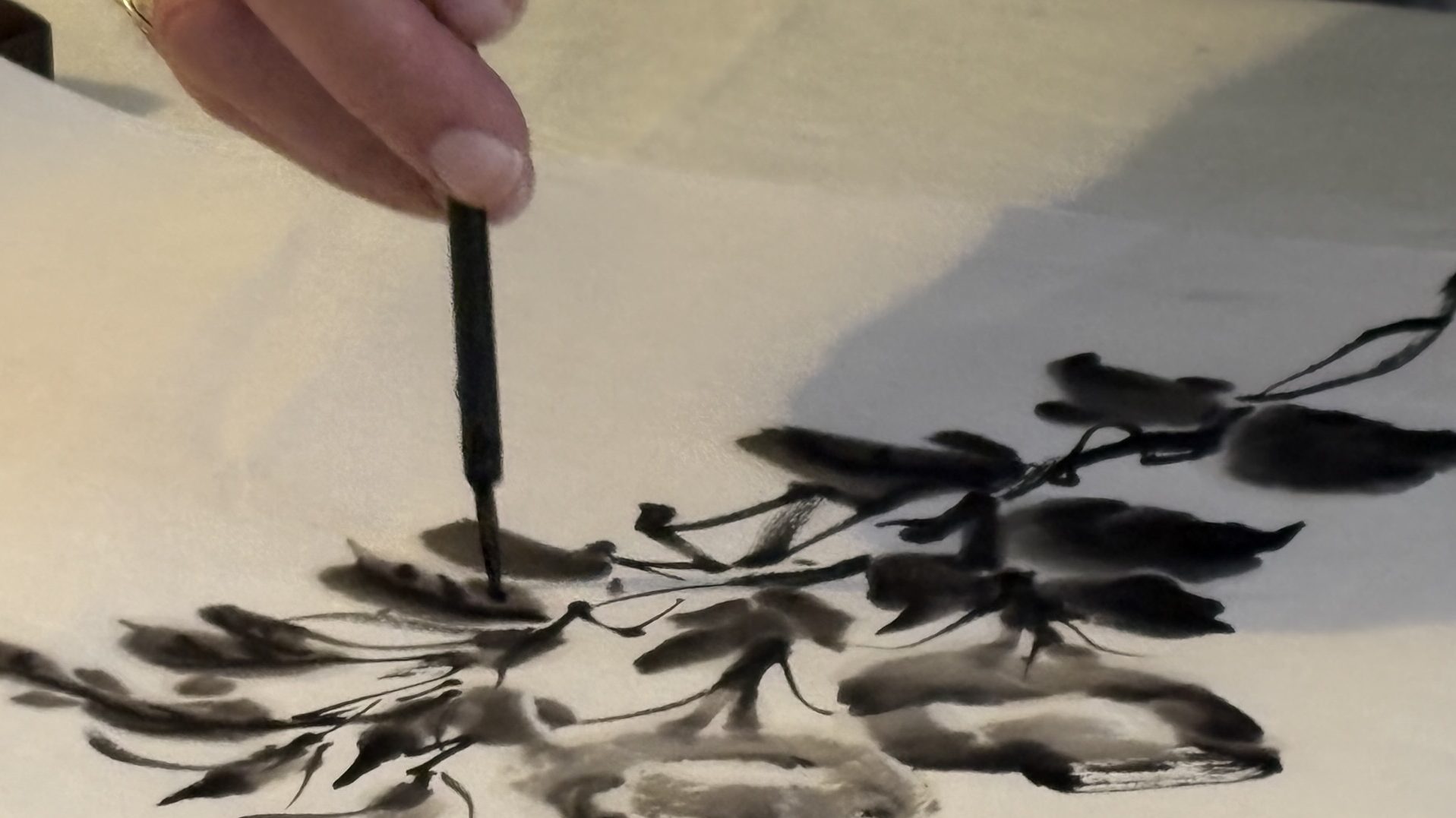
Lane gave an example of the difference between Eastern and Western art styles, noting the subtle differences in what is called “the Chinese line” — a distinctive brushstroke technique that begins in childhood.
“When kids are about five or six years old, they put a brush in their hand and they start trying to learn how to use the brush,” Lane demonstrated, showing how the Chinese line differs from Western techniques.
Chinese lines are drawn by hiding the tip, a subtle twist that makes lines look a little more like nubs in a bamboo stalk rather than straight with a clearly visible beginning and end.

The Tools of Tradition
Lane’s commitment to authenticity extends to his materials. His brushes, crafted from goat hair on the outside and darker bristles within, serve specific purposes.
“The outside holds more water and the inside gives it the stiffness,” he explained, handling brushes made from combinations of goat, weasel, wolf, and sometimes horse tail hair.
Each brush type suits different subjects — some better for flowers, others for the flowing lines of his signature marsh scenes.
The artist maintains the traditional Sumi-e emphasis on ink, standing 99% of the time at a raised table while working.
“The ink is all black,” he noted, explaining how some Sumi-e exhibitions often require a certain percentage of ink to qualify for inclusion. While he incorporates watercolors — mineral-based pigments like malachite for greens and indigo for blues — the foundational black ink remains central to his work.

Where Art Meets Music
The opening reception featured an unexpected collaboration that exemplified Lane’s innovative spirit within traditional forms. A guitarist performed in front of one of Lane’s paintings that was inspired by the song “White Flower.” The artwork is part of a creative partnership where Lane painted while listening to the musician’s compositions. The piece demonstrated how Lane translates rhythm and melody into visual form — a modern interpretation of artistic principles.


A Love Letter to the Marshlands
Lane’s studio in Engelhard, Hyde County, sits in a restored 1916 farmhouse that he rehabilitated with his own hands. From this marsh studio, he creates paintings that serve as both artistic expression and environmental advocacy.
“My heart is that I’ll be able to use them to try to get people to understand the value… we have precious treasures there,” he said, referring to the marshlands that inspire his work.
His paintings capture what he calls “that place where we negotiate land and water,” depicting mud flats that change dramatically between high and low tide, abandoned buildings that tell stories of changing communities, and the delicate ecosystem that exists on the edge between land and sea. Some works feature hidden details all done with a brush — like two frogs carefully placed within a larger composition, rewarding careful observation.
The Intersection of Cultures
Lane’s work represents a fascinating cultural intersection — ancient Chinese artistic traditions applied to distinctly American landscapes. His marsh scenes, painted with traditional bamboo techniques and mineral pigments, create a visual dialogue between East and West. The result is art that feels both timeless and immediately relevant, capturing the fragile beauty of coastal North Carolina through the lens of centuries-old artistic wisdom.
The exhibit at the Chowan Arts Council offers viewers a chance to experience this unique fusion firsthand. Lane’s paintings invite contemplation of both artistic tradition and environmental stewardship, rendered in the flowing lines and subtle gradations that define Sumi-e. Whether depicting a Japanese anemone heavy with ink or the changing tides of the coastal marshes, each piece reflects the artist’s deep respect for both his adopted technique and his chosen subject matter.
Visiting the Exhibit
The exhibit continues through September 30th at the Chowan Arts Council, offering visitors a chance to experience Lane’s unique artistic vision and perhaps gain a new appreciation for both the ancient art of Sumi-e and the timeless beauty of North Carolina’s coastal marshlands. The artwork from other local artists is visible throughout the building.
The Chowan Arts Council is at 112 W. Water St,. Edenton. The hours of operation at 10 a.m. to 5 p.m. Mondays through Fridays and 11 a.m. to 4 p.m. Saturdays.

One response to “Where East Meets Coastal Carolina: Mike Lane’s Sumi-e Exhibit Captures the Soul of the Marshlands”
Kudos to Nicole Bowman-Layton for learning things about Mike Lane and his art that I never knew in years of friendship with him.