Editor’s note: This is the first article in a series of stories regarding the NC Department of Public Instruction’s recent release of the school report cards. We will look at other districts in the region and, individually, at some schools in future articles.
BY MILES AND NICOLE LAYTON
EDENTON – When Superintendent Tammi Ward first opened the embargoed state report card data for Edenton-Chowan Schools, her heart sank.
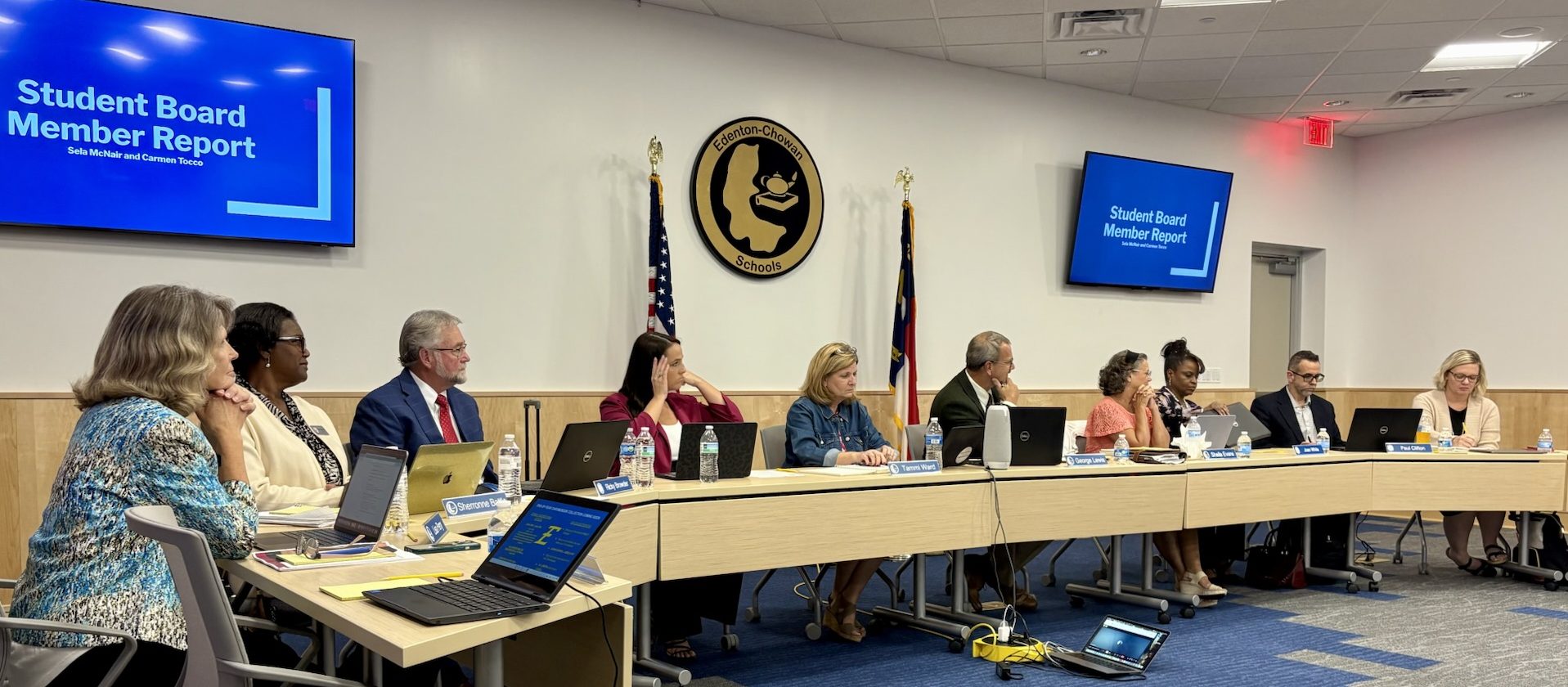
“At first glance, I was disheartened to see that our school letter grades had not changed,” Ward admitted at Tuesday night’s (Sept. 9, 2025) Board of Education meeting. “I know how much dedication and effort our educators, staff, and students put into the 2024-25 school year. What the public sees are those letter grades, and they don’t tell the whole story.”
The grades, released annually by the North Carolina Department of Public Instruction, measure student performance based on standardized test scores, growth data, and graduation rates. By state formula, 80 percent of a school’s performance grade comes from proficiency — the percentage of questions answered correctly — while only 20 percent comes from growth, or how much students improve academically from one year to the next.
In the Edenton-Chowan district, three schools receive performance grades: John A. Holmes High School, Chowan Middle School, and D.F. Walker Elementary. White Oak Elementary, which serves grades K-2, is not included because its students do not take end-of-grade tests.
Despite steady improvements in many areas, the 2025 grades leave Edenton-Chowan as a “low performing district” by state definition. Ward, however, insisted the numbers reveal a more hopeful story once examined closely.
“As I began to dig deeper into the data, I saw many encouraging outcomes that aren’t captured by the letter grades alone,” she told the Albemarle Observer. “I am incredibly proud of the significant student growth, the performance of our subgroups, and the steady improvement in proficiency levels in the past three years — all achieved despite a challenging number of teacher vacancies at the start of the 2024-25 school year.”
Board Vice Chair Sheila Evans noted that she appreciated Ward’s comprehensive look at the direction and change that needs to happen.
“You’ve hit everything. Curriculum instruction, the environment, the teachers. And I thank you for putting all that together,” Evans said. “Because you’ve been talking about it throughout the summer, different pieces, but it just came all together tonight, thank you.”

Holmes High: A Step Toward Stability
At John A. Holmes High School, growth has been a roller coaster over the past three years.
- 2022–23: Performance grade of 62, growth index of –1.92, “met growth.”
- 2023–24: Performance grade of 62, growth index –4.27, “did not meet growth.”
- 2024–25: Performance grade rose to 67, growth index improved to 0.42, “met growth.”
Graduation rates also improved before dipping slightly: from 84.4 percent in 2022-23 to 89.7 percent in 2023-24, then settling at 87.4 percent in 2024-25.
Ward told the board the high school came within three points of earning a “B” this year and is now outperforming state averages in most subject areas. “That’s an incredible achievement for our students and teachers,” she said.

Chowan Middle: Signs of Growth Amid Challenges
Chowan Middle School’s numbers show modest but significant progress.
- 2022–23: Grade 45, growth index –6.54, “did not meet growth.”
- 2023–24: Grade 53, growth index –1.72, “met growth.”
- 2024–25: Grade 50, growth index –1.73, “met growth.”
Overall proficiency (GLP) hovered between 43 and 48 percent over the three years.
Ward highlighted the importance of the growth metric for ELA. “Last year, ELA had a negative 3.67 growth index,” she explained. “This year, it was a positive 1.62. That’s an incredible turnaround, but it wasn’t enough to change the letter grade.”
Sixth-grade math also rose to 46 percent proficiency — a gain Ward described as “huge” given statewide struggles in mathematics.
But she warned about the challenges with maintaining that progress. Each year, groups of students advance from one school to the next. Each class of students performs differently on tests. “That’s the challenge — you can make great progress one year, but the group coming in the next year can change the whole picture.”

D.F. Walker: Edging Toward a Higher Grade
At D.F. Walker Elementary, proficiency has remained steady, though growth patterns are more encouraging.
- 2022-23: Grade 47, growth index –6.90, “did not meet growth.”
- 2023-24: Grade 54, growth index 0.74, “met growth.”
- 2024-25: Grade 53, growth index –0.02, “met growth.”
While the school’s grade stayed in the D range, Ward pointed out it is only two points away from a C.
“Walker went from being on the negative side of growth to the positive side,” she said. “That shows we’re moving in the right direction, even if it isn’t reflected in the performance grade yet.”
The Science Factor
Ward said one unexpected blow came from science testing at the middle school. In 2023-24, Chowan Middle posted an 81 percent proficiency rate in science. But in 2024-25, the score dropped into the 50s following a change in state curriculum, a new test and the loss of a veteran teacher.
“That 81 percent was a big piece of our proficiency average,” Ward explained. “When you replace that with a 50, even if you maintain your other scores your performance grade will go down. This accounts for the decrease from 53 to 50.”
She added that historically, the state has given schools a one-year grace period for assessments for new curriculum. “This time, they didn’t. And it cost us.”
The Growth Puzzle
Ward has become a strong advocate for emphasizing growth over raw proficiency. She explained the state’s model defines “meeting growth” as hitting a target range around zero, with a margin of ±2.
“To me, learning is about the growth,” she said. “If you keep growing somebody, they’re eventually going to get there. But when 80 percent of your grade is based on proficiency, it doesn’t give schools enough credit for helping students improve.”
That frustration led the district to adopt a new motto for 2025-26: “Exceed to Achieve.” “Meeting growth means a child has learned what’s expected in one year of school. But if we want to climb out of low-performing status, we can’t just meet growth — we have to exceed it,” Ward told the board.
Subgroup Success Stories
Ward highlighted subgroup data as a point of pride.
“Every single subgroup in our district met growth, except for one, across all schools,” she said. “That’s phenomenal. Our students with disabilities, in particular, showed extremely positive results. That’s worth celebrating.”
COVID-19’s Lingering Shadow
Ward also acknowledged the pandemic’s continuing effects.
“When COVID hit, many of the kids who are now at D.F. Walker and Chowan Middle lost critical early learning years,” she said. “Students missed out on foundational skills such as phonics when we held virtual instruction, and when returning, masks didn’t allow students to see the teacher’s mouth formation. That set back reading skills significantly.”
She compared the disruption to an extended “summer slide” and said teachers are using structured curriculum, scaffolding and interventions to rebuild conceptual understanding.
Staffing Gains Bring Hope
One major advantage heading into 2025-26 is staffing. In 2024–25 the district started the year with 13 classroom teacher vacancies; this fall that number dropped to just two—an 84.6 percent decrease. “Every classroom opened this year with a licensed teacher in place,” Ward said proudly. “That’s a game changer.”
Building Rigor, Relevance, and Resilience
Ward said the district will focus on three “R’s” this year: rigor, relevance and resilience. “Too often, when things get hard, we’ve developed a culture where people just quit,” she said. “We want to bring back the idea of productive struggle—helping students push through challenges, not give up.”
That means more hands-on, engaging instruction: projects, group work and problem solving, with teachers explicitly modeling collaboration skills.
During the Board of Education meeting, Ward pointed out that success will come from the entire community working to support the students.
“I also wanna point out, none of us can accomplish this by ourselves. There’s not one teacher, there’s not one principal, there’s not one superintendent, there’s not one board member or one parent that’s gonna be able to accomplish exceeding that we need to do in our community,” she said. “It’s all of us working together and all of us encouraging our students.
The students also play a role in the schools’ successes. “Students that are here tonight, it’s up to you too. We can’t do it for you. You’re the ones that are going to have to achieve and we know that you can. We want to provide you with that environment where that you are capable of doing that.”
Safe Schools and Daily Attendance
Ward identified three essential elements for improving results: teachers, safe environments, and attendance.
“If our kids don’t feel safe inside the school building, they’re not going to learn as much as they possibly could,” she said. “And if we can’t get our students to school every day, on time, and staying all day, we can’t teach them.” She urged families to prioritize attendance.
Fighting the “Low Performing” Label
Ward said what frustrates her most is the state’s definition of “low performing.”
“Here’s the thing — when you just look at it, we’re two D’s and a C. And we’re still labeled low performing. But we are moving the ball forward,” she said.
By state law, even a school that meets growth but earns a D is still considered low performing; only schools that exceed growth or earn a C or higher avoid the label.
Community’s Role
Ward stressed that education cannot rest solely on schools.
“There are 16 other hours in a student’s day when they’re not with us,” she said. “If we’re not all pulling together — families, community, businesses — then schools are just a small fraction trying to convince kids that education matters.”
She highlighted the district’s renewed emphasis on internships with local employers to show students pathways to careers.
Board Chair George Lewis noted that the district is where it wants to be in terms of the report card.
“But wow, wow. In all areas, the sustained growth that we have seen, you can feel the fleet turning and pointing in the right direction,” he said. “We thank you for that. We thank the board members and the efforts you’ve made in the organizations and resourcing and all those kind of things.”
He noted that improving education performance is a community effort. “I think the community will see success and will pile on the success. And I’m just excited and I couldn’t be more thankful. And just want to say congratulations. We’ve got a long way to go, but we’re going in the right direction.”
Looking Ahead
While Ward concedes the low-performing label stings, she remains optimistic.
“It’s like preparing for a marathon and not quite finishing where you wanted. It hurts. But the real story is the growth we’re seeing — and growth means progress,” she said. With more stable staffing and an instructional focus on rigor, the district hopes to keep climbing.
“We’re not complacent. We’re not satisfied with where we are,” Ward said. “But I am incredibly proud of our educators and students. We are growing, and if we keep exceeding growth, we will achieve.”


One response to “Edenton-Chowan Schools Sees Growth, But State Report Cards Keep ‘Low Performing’ Label”
[…] Also during the meeting, Superintendent Tammi Ward discussed the school report cards released by the North Carolina Department of Public Instruction. For coverage of that part of the meeting, click on the link here. […]