BY MILES LAYTON
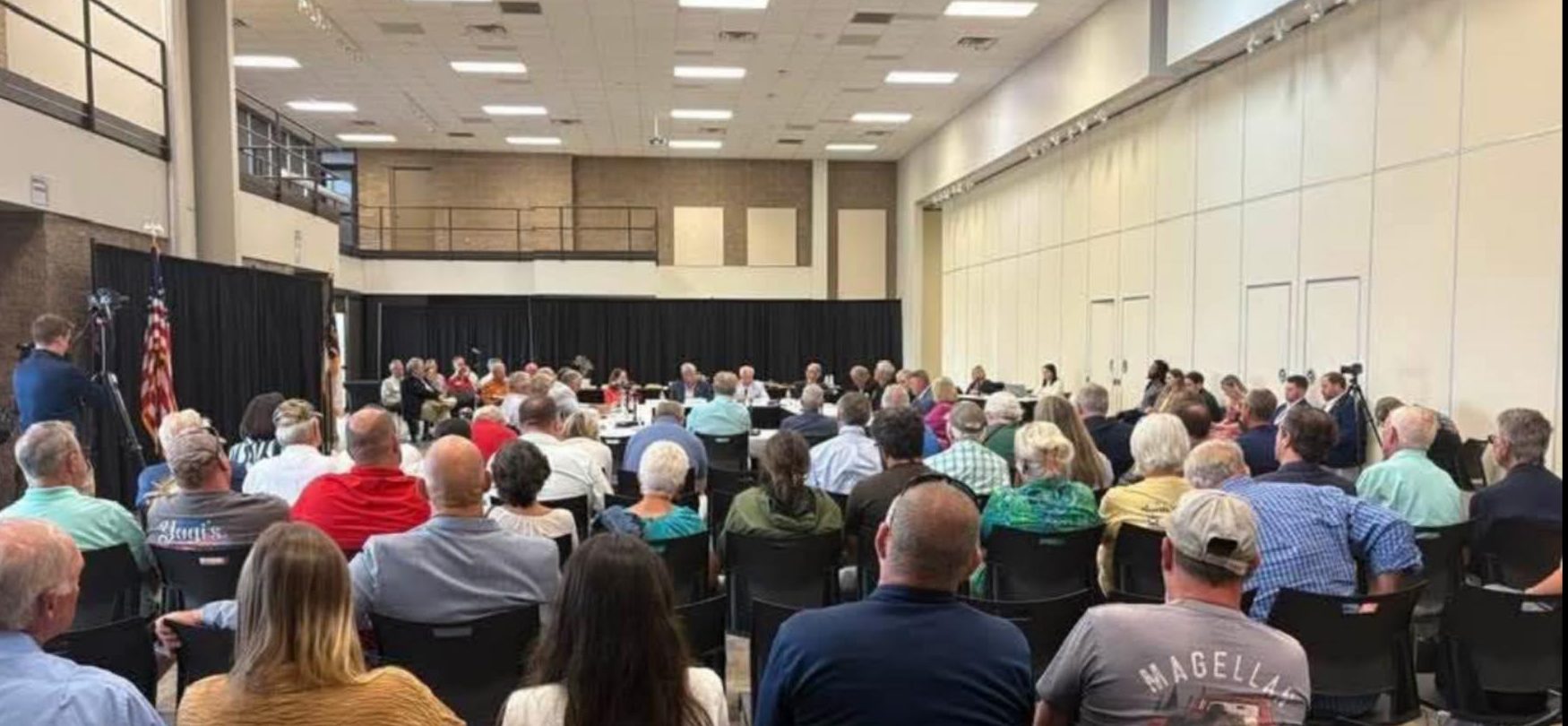
MOREHEAD CITY — County leaders from across eastern North Carolina gathered Tuesday at the Crystal Coast Civic Center in Morehead City for the inaugural meeting of the Coastal Counties Fisheries Coalition, an effort born out of mounting concern over legislative attempts to restrict or eliminate shrimp trawling in state waters.
Formed to bring together commissioners and county officials from coastal regions, the Coalition aims to protect North Carolina’s commercial fishing industry and provide a coordinated voice in Raleigh — especially in the face of recent efforts in the state Senate to pass a ban on shrimp trawling.
Chowan County Commissioner Bob Kirby, one of the coalition’s earliest supporters, said the group’s formation was a direct response to the NC Senate’s recent maneuvering to pass the trawling ban—something he and others in attendance believe will return soon.
“It’s not a question of if this comes back,” Kirby warned. “It’s a question of when. They’re going to try to get it through however they can. That’s why this coalition matters. We have to be ready.”
Albemarle Commission Council of Governments Interim Executive Director David Whitmer was also in attendance, along with almost a hundred other onlookers.
“Being in that room for the first meeting of the Coastal Counties Fisheries Coalition was powerful. You could feel the passion and urgency from every coastal county represented,” Whitmer said. “For us in the Albemarle region, fishing isn’t just an industry – it’s a way of life, a part of our identity, and the backbone of our local economy. The proposed shrimp-trawling ban in HB 442 would have devastated families and communities who’ve worked these waters for generations. I’m proud the Albemarle Commission took a stand, and I’m grateful to (Dare County) Commissioner (Bob) Woodard for bringing everyone together to fight for the future of our coast.”
Lawmakers in Attendance, Harsh Criticism of Senate Leadership
Several eastern North Carolina lawmakers attended Tuesday’s meeting, including Senator Norm Sanderson, Representative Ed Goodwin, Senator Bobby Hanig, and Representative Keith Kidwell.
Sanderson did not hold back in his remarks, sharply criticizing Senate leadership for their attempt to push the trawling ban through the chamber earlier this summer.
“He was extremely critical of the way the Senate leadership did it,” Kirby recounted. “He all but said it was underhanded. He said they were nasty about it.”

Hanig, though a junior member of the Senate, reportedly worked hard to stall or kill the bill through procedural moves, including attempts to table the motion and delay the vote.
Kirby and others noted the importance of having these legislators on board as allies, especially should another attempt to ban shrimp trawling emerge in the next session. Now, coalition members say, they’ll be more ready to mount an immediate, coordinated response.
Herring Ban Still Haunts Chowan County
For Kirby, the proposed shrimp trawling ban hit close to home—reviving painful memories of what happened to the river herring fishery in Chowan County two decades ago.
“Herring fishing used to be huge here,” Kirby said. “It was a real industry. There were fish houses all along the Chowan River — Harris Landing, White’s Landing, Rocky Hock. That was people’s livelihood.”
But in the early 2000s, the state’s Marine Resources Commission shut the herring fishery down, declaring it overfished. The closure, which happened around 2004 or 2005, remains in place to this day.
“Twenty years later, it’s still shut down,” Kirby said. “That fishery is gone forever. They shut it down, and the people who used to fish for herring — they moved on. They had to. You can’t just stop for 20 years and pick it back up. They sold their gear; they changed professions.”
Kirby pointed out the irony of North Carolina banning the fishing of herring while South Carolina allows it, saying, “The fish don’t know the difference between state lines. The habitat’s the same.”
More troubling, he added, is the penalty structure that remains. “If you catch a herring and you keep it? That’s a $500 fine. It’s unbelievable.”
Commercial Fishing Culture: Vanishing History?
Kirby also took time during the meeting to explain the cultural and economic role commercial fishing has played in his community, describing how pound net fishing along the Chowan River supported generations.
“I’ve got trees along my driveway where they drove spikes in to stretch the pound nets,” he said. “You probably know that boat in the Down East Preservation Woodworks yard on North Broad Street — that’s one of the boats they used to fish the river. That’s how people here in Rocky Hock made their living.”
One of Kirby’s neighbors, used to repair nets in a trailer on her property. “It was a whole production,” Kirby said. “And it’s gone. That fishery is just gone.”
He fears shrimp trawling is next.
“If we don’t stand up and fight, they’ll do the same thing to the shrimpers that they did to the herring fishers,” he said.
A Call to Mobilize
Kirby emphasized that the coalition’s value will come from its ability to act quickly and decisively when future threats emerge.
State Senators attempted to push the shrimp trawling ban by adding it as an amendment to a House Bill that intended to extend the recreational fishing season for flounder and red snapper.
“They tried to sneak this one through under the radar, but we stopped them this time,” Kirby said. “Next time, we’ll be ready. We’ll know who to call. We’ll be able to mobilize shrimpers, mobilize fishermen, and nip it in the bud.”
Still, he conceded that once a fishery is shut down, reviving it is nearly impossible. “Even if they lifted the moratorium tomorrow, nobody would go back to (fishing) herring. It’s gone.”
Politics and Money
While many attendees focused on the regulatory and economic impacts, Jerry Schill, a longtime commercial fishing advocate — 38 years before he retired — pointed to a deeper issue at play — money.
“This meeting was a great first step,” Schill said, “but if we think educating legislators is enough, we’re missing the real threat.”
Schill alleged that money was the driving force behind the Senate leadership’s push to ban shrimp trawling — not science or conservation.
“What drove this is money that was promised to the Republican caucus by well-heeled groups and individuals as payment for getting it done,” Schill said. “That’s not just wrong, it’s evil. Facts or science made no difference. Leadership took the money.”
Schill said the Coalition must confront this reality head-on if it hopes to be effective.
“Any solution based on a false premise is doomed to fail. If the premise is just to educate, it will fail. The money issue must be discussed,” he insisted.
Advisory-Only Role for Advocacy Groups
One procedural decision was made during the meeting: Commercial fishing advocacy groups, like the NC Fisheries Association, will serve in an advisory capacity rather than as official members of the Coalition.
Schill supported the move, noting it maintains the Coalition’s credibility as a body of elected officials.
“It’s a good decision,” he said. “It helps ensure the group is seen as an official voice of the counties, not just another special interest.”
Washington County Joins the Fight
Washington County Commissioner John Spruill praised the group’s efforts to unify coastal counties and defend their fishing industries.
“As a lifelong resident of Eastern North Carolina and a strong supporter of our commercial fishermen, I am honored to be part of this important effort,” Spruill said.
Spruill emphasized the need for “sound, science-based fisheries management that balances sustainability with economic opportunity.”
He added, “It’s time coastal counties have a stronger, united voice in Raleigh. I look forward to working with my fellow commissioners to stand up for the men and women who work our waters and feed our communities.”
Eyes on Raleigh — and the Future
As the meeting concluded, attendees expressed optimism that the Coalition will provide long-overdue organization and leadership for coastal communities.
“There’s power in unity,” Kirby said. “And this time, we’re not waiting until it’s too late.”
The next meeting of the Coastal Counties Fisheries Coalition is scheduled for Sept. 16. Whitmer said they plan to meet on a quarterly basis, or as needed depending on what’s going on in the Legislature.
“The biggest challenge,” Schill noted, “is keeping the momentum going. We start with a bang, and then the emotion fades. But if we let this effort fizzle, they’ll win.”