
Thompson casts lone vote against FY 25-26 budget
BY NICOLE BOWMAN-LAYTON
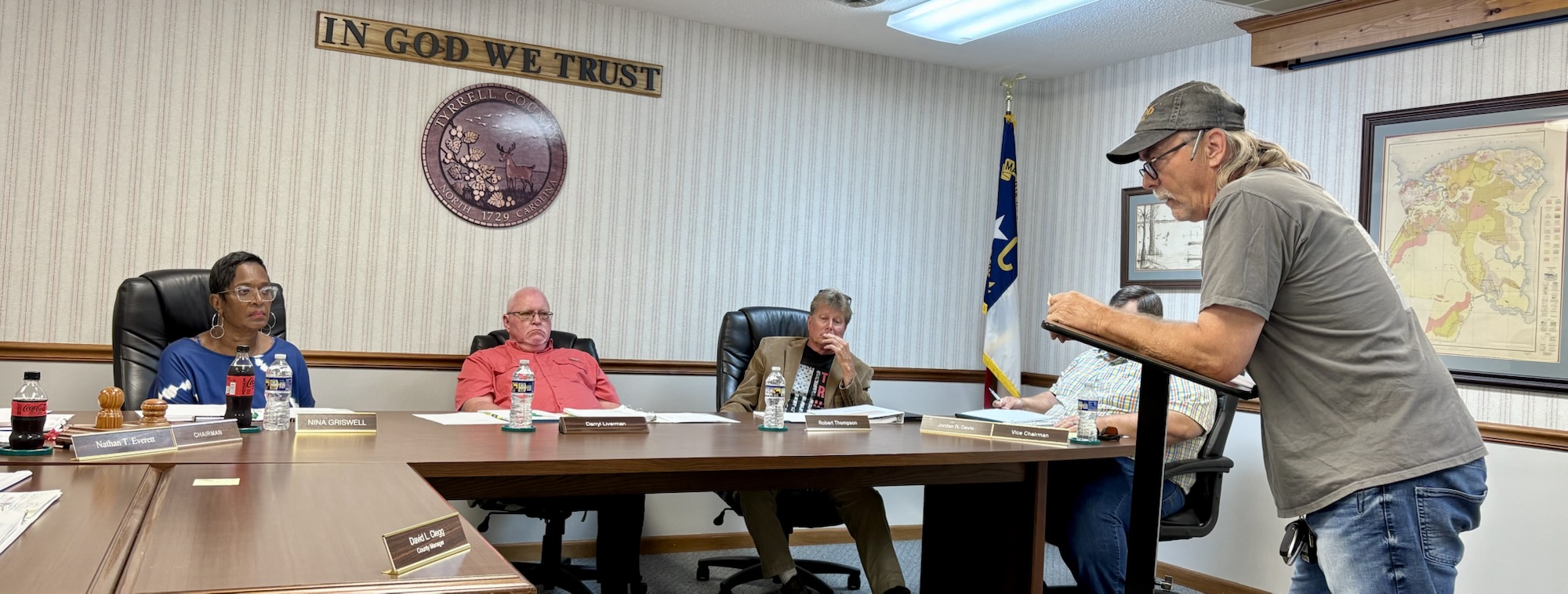
Tyrrell County Commissioner Robert Thompson was removed from Monday’s meeting after repeatedly interrupting residents’ comments during a public hearing on the fiscal year 2025-26 budget. After returning, Thompson cast the lone vote against approving the county’s budget, which passed 4-1.
The budget set the property tax rate at 87 cents per $100 valuation, for a total of $9,417,739.
Thompson, who has frequently challenged Chair Nathan Everett during recent commission meetings, began speaking over citizens during the public comment period, prompting Everett to warn him about his possible removal. When Thompson refused to yield, Everett instructed a sheriff’s deputy to escort Thompson from the room. A video of that moment appears below, further down in the story.
“I don’t want to have to do this, but we have rules here,” Everett said before the removal. “This is the citizens’ time to speak.”

Thompson returned to the meeting later and continued to clash with Everett, accusing the county officials of hiding details about federal COVID-19 relief spending and questioning the county’s reserve fund.


Citizens Call for Transparency, Public Input
Four residents addressed the board during public comment, each expressing concerns about transparency, budget communication, and public involvement in county decisions.

Like the previous meeting, the audience overflowed into a nearby hallway. But unlike that meeting, there were about five people waiting in the hall and not as many people seemed to be willing to speak.
John Thorne was the first to speak, asking the board to better communicate budget processes and decisions with the public.
“You’ve got to let the people know what’s going on,” Thorne said, urging the commissioners to hold community meetings and post clear explanations of expenditures on the county’s website. “We pay the taxes, and we need to know where it’s going.”

Thorne also suggested that the tax decrease from 95 cents to 87 cents isn’t really a decrease because the property revaluations have gone up.
Thorne shared a livestream of the meeting on Facebook, which can be viewed by clicking here.

Leroy Spivey, a former Tyrrell County commissioner, praised the commissioners and the county officials for their work on the budget, noting it’s not an easy task.
“I’ve been in your seat, and I know it’s tough. Whatever you do, somebody’s not going to be happy,” Spivey said.
Spivey said that the county has the smallest budget of any county in the state. The town of Edenton’s budget is roughly the same size.
“I just want to thank all the commissioners for your time and effort that you put forth on this,” he said.
Thompson interrupted Spivey, several times, prompting Everett to give Thompson a warning not to interupt.
Edith Deltgen noted that the county should not just play along to get along, rather it should work on not overspending and should make do with what funds it has.
She later asked about the county’s “offshore account,” which is the reserve fund. County officials noted that some county funds are held in a New York bank, one of only two banks in the country that deal with such accounts.
The officials, at her and others’ request, also read all the balances of the current budget’s line items as of Monday afternoon.


Tommy Anderson criticized the commissioners for failing to solicit community priorities before finalizing the budget. He noted that many people work and are unable to make it to commission meetings.
He noted that while the property tax rate is being lowered from 95 cents to 87 cents, due to recent revaluations, property taxes are actually increasing. His property value doubled compared to the last time.
“I wish that we had some way of monitoring what is going on with the budget every single year, as opposed to just when we get together for the budget,” Anderson said.
He noted that the county is putting itself at risk when it doesn’t include the public in the decision-making process.
Noting the turnout at the last meeting, he said that the meeting would have been a great opportunity to gather public input. No public comment period was held because it was a continuation of a work session, Everett said.
Thompson interrupted saying that he invited the public to the June 18 meeting. “The problem is, if you don’t let the people be part of the process, (they’re) not going to be part of the outcome. … We’re passing (the budget) today. (The citizens) haven’t had a part in it. This is taxation without representation.”
Everett asked Thompson to be quiet so the public hearing could conclude. Thompson noted that people won’t understand what the county’s budget problems are if they aren’t explained to them.
Everett replied that Thompson misinformed the public. Thompson then asked if the county had a Reserve Fund balance, noting that the previous auditor said the county had 45% of its reserve fund balance. But at a previous meeting, Everett said they had the full amount at the moment of the audit.
Everett asked Thompson to stop again. Thompson continued, asking County Manager and Attorney David Clegg whether he recommended “using money that we weren’t supposed to use.”
“God forbid you let the truth out,” he said as a sheriff’s deputy came closer to him.
“You come on,” Thompson said to the deputy. “Arrest me for telling the truth.”
Everett then had Thompson removed under North Carolina General Statute 143-318.17, which addresses disruptions of official public meetings. It states that a person who willfully interrupts, disturbs, or disrupts an official meeting and refuses to leave after being directed to do so by the presiding officer is guilty of a Class 2 misdemeanor according to the North Carolina General Assembly.
Everett directed that Thompson be removed until he cools down. Thompson returned to the meeting a few minutes later.
What Goes Down, Can Go Up
Also during the public hearing, Bill Alexander asked the Commissioners whether they would raise or lower taxes in the future. He also asked whether the county’s population was growing or decreasing.
Everett noted that the population seems to be growing, as Dare County residents have started to move to the county.
About 53% of the land of Tyrrell County is not taxable as it is owned by the federal or state government. Sometimes those entities give the county a big stipend, sometimes they don’t. The lack of taxable land is among the issues the county faces in gathering operating funds.
“About 75% to 80% of our budget, we don’t have any control over,” Everett said. “It’s mandatory stuff passed down by the federal government or by the state. … It’s services that we’re required to provide that we don’t have the ability to provide.”
Such services include search and rescue along the approximately 400 miles of canals in federal- and state-owned land that can no longer be done by the understaffed US Fish and Wildlife Service.
Everett said that if a large business or development were to come into the county, taxes would probably be lowered.
“I’ve been living here a long time. I’ve seen a lot of things that we thought were gonna happen, and they’ve fizzled,” he said. “So we try to be as (fiscally) conservative as we possibly can.”
After some debate on how much money the county would get from the property taxes with the new revaluations in place, it was asked what was going to happen with the excess money. The money would go into the reserve fund.


Thompson Questions COVID Spending, Reserve Use
Before the vote, Thompson questioned how the county used federal CARES Act funds and why reserves were used to cover expenses, while the county had previously reported a strong fund balance.
“How do we end up spending our reserve fund balance if we got a balanced budget?” Thompson asked. “And why do we take the CARES money to put into payroll and move the payroll over to make it look like we had reserve fund balance?”
Clegg and Everett explained that federal funds — part of the American Rescue Plan Act of 2021 — were legally used to support law enforcement, EMS, and other payroll during the pandemic, helping the county avoid service cuts. They also noted that since the funds were used in a proper manner, they did not have to be repaid.
“We are no longer in the COVID fund business,” Clegg said.
Since the ARPA funds helped cover payroll and no longer available, the new budget includes funds to cover those expenses.
Everett clarified that the reserve fund is used to maintain operations between tax collections and during emergencies, such as hurricanes that have impacted Tyrrell County in recent years.
The state gathers taxes and then distributes them to counties and municipalities. They can come in months after they are collected.
“Sometimes we reserve fund balances for emergencies, and there are times when we have to enter it,” Everett said. “It’s not something that we like to do.”


