
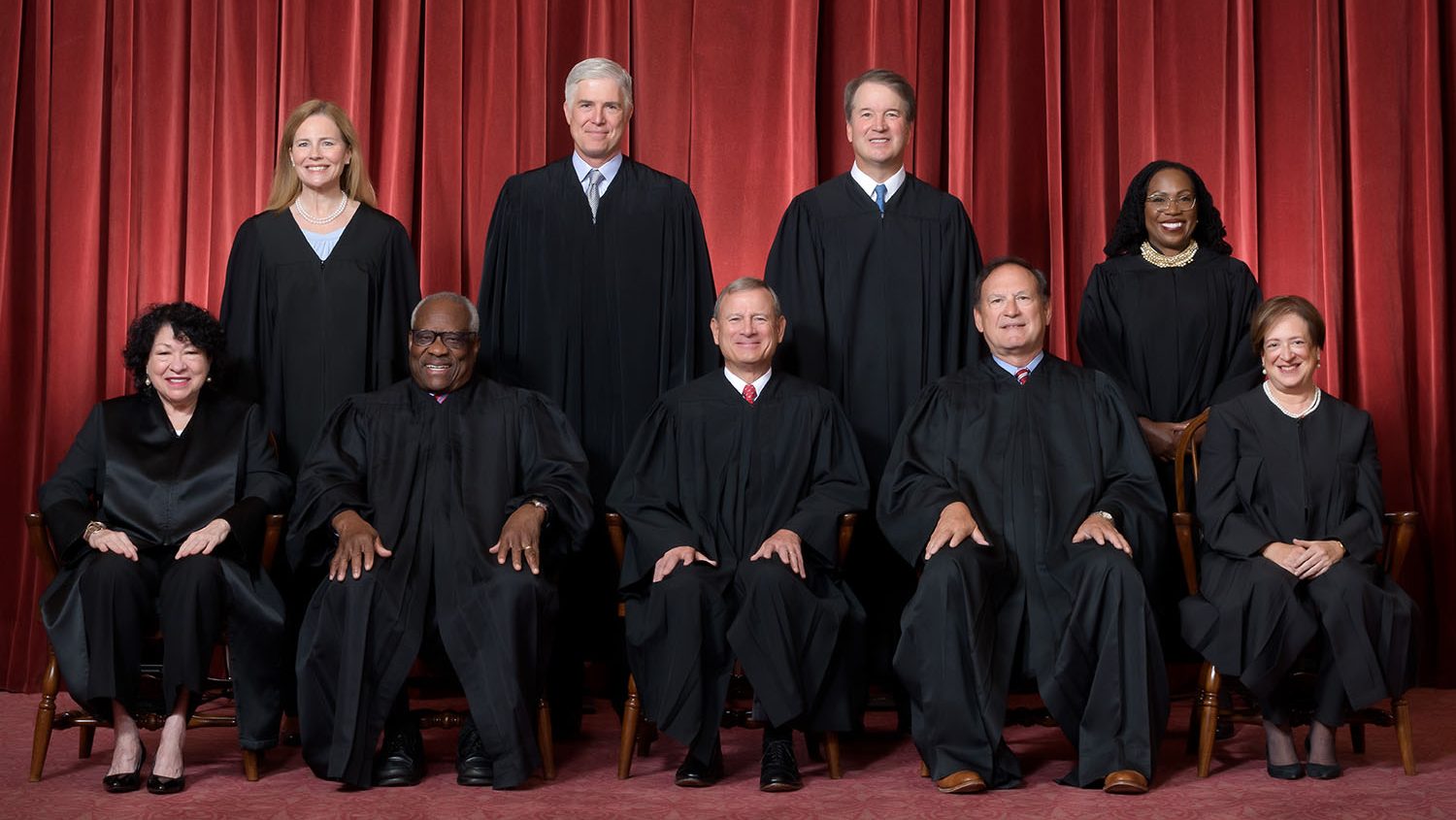
Supreme Court Ruling in President of the United States v. Casa Draws Sharp Words from Justice Barrett Toward Justice Jackson
Love this quote from Justice Amy Coney Barrett — see page 23 within the majority opinion that’s posted, along with the dissent, at the end of this story — We will not dwell on JUSTICE JACKSON’s argument, which is at odds with more than two centuries’ worth of precedent, not to mention the Constitution itself. We observe only this: JUSTICE JACKSON decries an imperial Executive while embracing an imperial Judiciary. To paraphrase Chris Tucker from the movie Friday — Dammn!!!
Let’s back up — In a landmark 6–3 decision Friday, the U.S. Supreme Court ruled in favor of the executive branch in President of the United States v. Casa, affirming broad presidential authority over immigration enforcement, particularly in cases challenging a Trump administration Executive Order that aimed to restrict birthright citizenship. The Court’s decision in this case effectively eliminated the ability of lower courts to issue nationwide injunctions, except in class action suits.
Not only did this case rule on border policy to give President Trump a HUGE victory over judicial overreach, it provided some insight into how the justices, two of them anyway, are getting along.
In Justice Thomas’ concurring opinion, in which Justice Neil Gorsuch joined, he wrote that the ruling “puts an end to the ‘increasingly common’ practice of federal courts issuing universal injunctions.”

“The Court also makes clear that the complete relief principle provides a ceiling on federal courts’ authority, which must be applied alongside other ‘principles of equity’ and our holding that universal injunctions are impermissible,” Thomas wrote. “Lower courts should carefully heed this Court’s guidance and cabin their grants of injunctive relief in light of historical equitable limits. If they cannot do so, this Court will continue to be ‘dutybound’ to intervene.”

Justice Jackson authored a forceful dissent, joined by Justices Sotomayor and Elena Kagan, accusing the majority of “abandoning judicial scrutiny in the face of executive overreach.” Jackson’s opinion warned that the Court had “effectively sanctioned the circumvention of decades of asylum protections through bureaucratic fiat.”

Sotomayor authored the primary dissenting opinion.
“The gamesmanship in this request is apparent and the Government makes no attempt to hide it. Yet, shamefully, this Court plays along,” Sotomayor wrote. “The majority holds that, absent cumbersome class-action litigation, courts cannot completely enjoin even such plainly unlawful policies unless doing so is necessary to afford the formal parties complete relief. That holding renders constitutional guarantees meaningful in name only for any individuals who are not parties to a lawsuit. Because I will not be complicit in so grave an attack on our system of law, I dissent.”
But while the ruling itself made waves across legal and political circles, it was an unexpected and stinging exchange between two justices—Barrett and Ketanji Brown Jackson—that quickly drew national attention.
Since you’re probably not going to read it anywhere else locally, maybe regionally — Barrett’s quote at the beginning of this story and subsequent remarks are the equivalent of a body slam WWE style — click this link to understand what that iconic wrestling move looks like.
Court observers quickly noted the rare intra-court friction. While justices frequently disagree on legal theory, direct criticism of one another’s style or integrity is uncommon.
As pointed as conservative Justices Thomas and Antonin Scalia (RIP) could be when writing their opinions, certainly the same can be said of Justices Sotomayer and Ruth Bader Ginsburg (RIP), no one ever would accuse any of these justices of body slamming the opposition publicly with words.
In a sharp rebuke directed squarely at Justice Jackson’s dissent, Barrett wrote:
“The principal dissent focuses on conventional legal terrain, like the Judiciary Act of 1789 and our cases on equity. Justice Jackson, however, chooses a startling line of attack that is tethered neither to these sources nor, frankly, to any doctrine whatsoever. Waving away attention to the limits on judicial power as a “mind-numbingly technical query,” (dissenting opinion), she offers a vision of the judicial role that would make even the most ardent defender of judicial supremacy blush.”
Barrett continued, “In her telling, the fundamental role of courts is to “order everyone (including the Executive) to follow the law—full stop.” (“[T]he function of the courts—both in theory and in practice—necessarily includes announcing what the law requires in . . . suits for the benefit of all who are protected by the Constitution, not merely doling out relief to injured private parties”) And, she warns, if courts lack the power to “require the Executive to adhere to law universally,” courts will leave a “gash in the basic tenets of our founding charter that could turn out to be a mortal wound.”
Jackson did not address Barrett in her dissent, but she offered a powerful argument in her own right.
“It is important to recognize that the Executive’s bid to vanquish so-called ‘universal injunctions’ is, at bottom, a request for this Court’s permission to engage in unlawful behavior,” she wrote. “When the Government says ‘do not allow the lower courts to enjoin executive action universally as a remedy for unconstitutional conduct,’ what it is actually saying is that the Executive wants to continue doing something that a court has determined violates the Constitution— please allow this. That is some solicitation. With its ruling today, the majority largely grants the Government’s wish. But, in my view, if this country is going to persist as a Nation of laws and not men, the Judiciary has no choice but to deny it.”
The case now sets a significant precedent for presidential authority in border policy and will likely shape the legal terrain heading into the 2026 midterm elections.
Meanwhile, legal scholars and political strategists are parsing not just the implications of the ruling—but the tone of a Court increasingly willing to show its inner tensions in public.


