BY MILES LAYTON
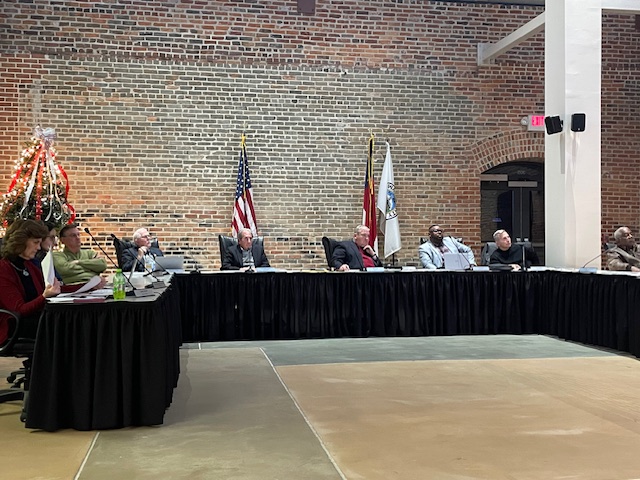
Chowan County Commission – even though last week was filled with snow day holidays, here are a few things that need a little bit of ink.
This article discusses commissioners questioning contractors while making prudent decisions safeguarding taxpayer dollars.
During Monday’s meeting, commissioners discussed plans to design and install a $1.7 million HVAC system at White Oak/DF Walker schools. The money to pay for this change order will come from different “pots” with $5 million in funding available.
County Manager Kevin Howard said he plans to talk to Edenton-Chowan Schools Superintendent Tammi Ward about funding mechanisms for the project – how the bill for the work will be split between the county and school system – so the matter is tabled for now.
Long and short of it, as the outdated HVAC system was being replaced, contractors, after consulting with the county for input, opted not to replace certain parts that, while not broken, were obsolete. Yes, it saved the county money in the short term, but in the long term, these parts/issues will need to be addressed as the project moves forward.
To apply an analogy to this common scenario, it’s like when you need car repairs and the mechanic asks you if you want to install “X” because he says you may eventually need to do that. You say “not at this time” because the car seems to be working OK and perhaps it’s some computer chip that costs 10 cents to purchase, but $200 to install. A few months later when you see the engine light is on nonstop, you know it’s time to install the part.
Chris Brabble, director of maintenance at Edenton-Chowan Schools, explained it this way.
“So the wording in the estimate was that we got, for the people who did the work, to make sure all the makeup, air units were working properly. They did not, they did not put new units in. They just were to make sure those were all working properly at the completion of the system. Long story short, when we got to the issues in April and May of 2024 where we were dealing with some humidity issues and moisture issues, we got talking with the contractor, the comment was made that the makeup air units are running, but they are not working these makeup air units.”
Brabble continued, “They’re basically five-foot heat transfer wheels systems. They’re a thing of the past. Long story short, they’re no longer used. They were apparently the thing to do when they were first introduced.”
Now this is eye opening.
“So basically we were taking 95 degree air with 85% humidity, and we were cooling it down to 88 degrees and pumping it into a 72 degree classroom, which created the issue that caused us to have to spend some $600+ thousand dollars to have mold remediation and the schools professionally cleaned back in late August, which delayed the start of school by three days,” Brabble said.
After discussing whether the contractor would do this work, Brabble said another contractor has submitted a less expensive bid to do what’s needed.
”This is — we have no choice. We got to get it done,” Brabble said. “We’re at the mercy of the commissioners to fund this because April and May is coming in 90% humidity and we’re gonna be right back in the same boat again.”
Commissioners seemed very receptive to getting the project done.
In other commission news, there were two change orders for ongoing work at the future John A. Holmes High School that required the commission’s attention. Rather than regurgitating the engineering/architectural specifics as part of this story, commissioners grappled with costs for the work that weren’t necessarily part of the building plans.
Again, applying an analogy to this problem, you ask the contractor to upgrade the electrical system on your sailboat so that it’s reasonably modern, not a 1970s Brady Bunch house antique grid. The contractor quotes you a price and then later discovers that you need to replace your ignition starter – so why wasn’t that part of the bid for the job? More importantly, who’s going to eat the cost – you or the contractor?
A representative from the project’s general contractor MB Kahn Construction explained that as the construction is taking place, architects gain more knowledge about specific systems being put in place – sort of you can’t plan something until you know more about what’s needed – these things are revealed as you are working under the hood. Anyone who has ever built a new house or refurbished an old farmhouse knows this.
Hidden truth – a project’s cost going in may not necessarily be the same as the project’s total cost coming out.
However, commissioners weren’t too keen on the taxpayers footing the bill for additional work that suddenly appeared in the building plans, so who will be eating the cost?
Kirby asked, “How many more of these do you think he might find along the way?”
MB Kahn’s representative answered, “Well at this point that we’re in the job, I would think there would be less.”
Kirby interjected, “I thought we were already beyond that myself.”
Commissioner Chris Evans said, “I thought we signed some kind of an
agreement where the responsibility was not on us if there were problems found.”
Howard explained that in some cases, the county would need to absorb additional costs, while in others, the architect/engineer/contractor would pay for cost overruns depending on the situation.
MB Kahn’s representative said there’s a contingency fund – money set aside for any unforeseen/additional work.
To which Kirby countered, “Guess what, if we don’t use that contingency you know what happens to it? It goes back to the taxpayer, it goes back to the people that are out there – goes back to the taxpayer.”
MB Kahn’s representative responded, “Where we are on right now with the project, you know we had a couple hundred thousand dollars of unsuitable soil, which I don’t think anyone argues with. But the issues that we’ve had with this architect up to here are extremely minor” with the bulk of the building near completion.
Commissioner Tony Shaffer observed, “The question I have then – the moment you make a change, my experience having to do some contracting, building stuff overseas for some of our locations, once one item is changed, everything gets offset in some form. Is there gonna be other offsets that this is going to affect that we don’t understand yet?”
MB Kahn’s representative answered, “No sir.”
More or less over a barrel at the mercy of a fast-moving river as this project nears completion toward completing a new high school for the Aces, commissioners approved the change orders, and they remain intent on keeping an eye on costs.
In other business, Hicks Field’s grandstand and office roofs are being replaced as part of renovations planned for the ballpark. The money to pay for these roofs comes from savings associated with ongoing work to improve the park.
Also, commissioners approved renewing the third year of the county’s 3-year contract with the auditing firm of Thompson, Price, Scott, Adams and Company of Wilmington – cost to taxpayers will not exceed $57,000. Firm conducts an annual audit to make sure Chowan County doesn’t become like the federal government.
And, commissioners approved $263,000 to replace the surveillance system at Chowan Middle School – broken down, that money comes from $200,000 from the county’s capital outlay fund with $49,000 from lottery funds and the remaining more than $14,000 from state money.

2 responses to “Cost Oversight: Understanding Change Orders in Chowan County Projects”
Why did you have to add that ridiculous jab, “so the county doesn’t become like the federal govt”?
Mixing information from a local govt meeting with immature insults against our federal govt are just not necessary.
Thx — forgot to add the hyperlink — https://www.whitehouse.gov/articles/2025/02/at-usaid-waste-and-abuse-runs-deep/