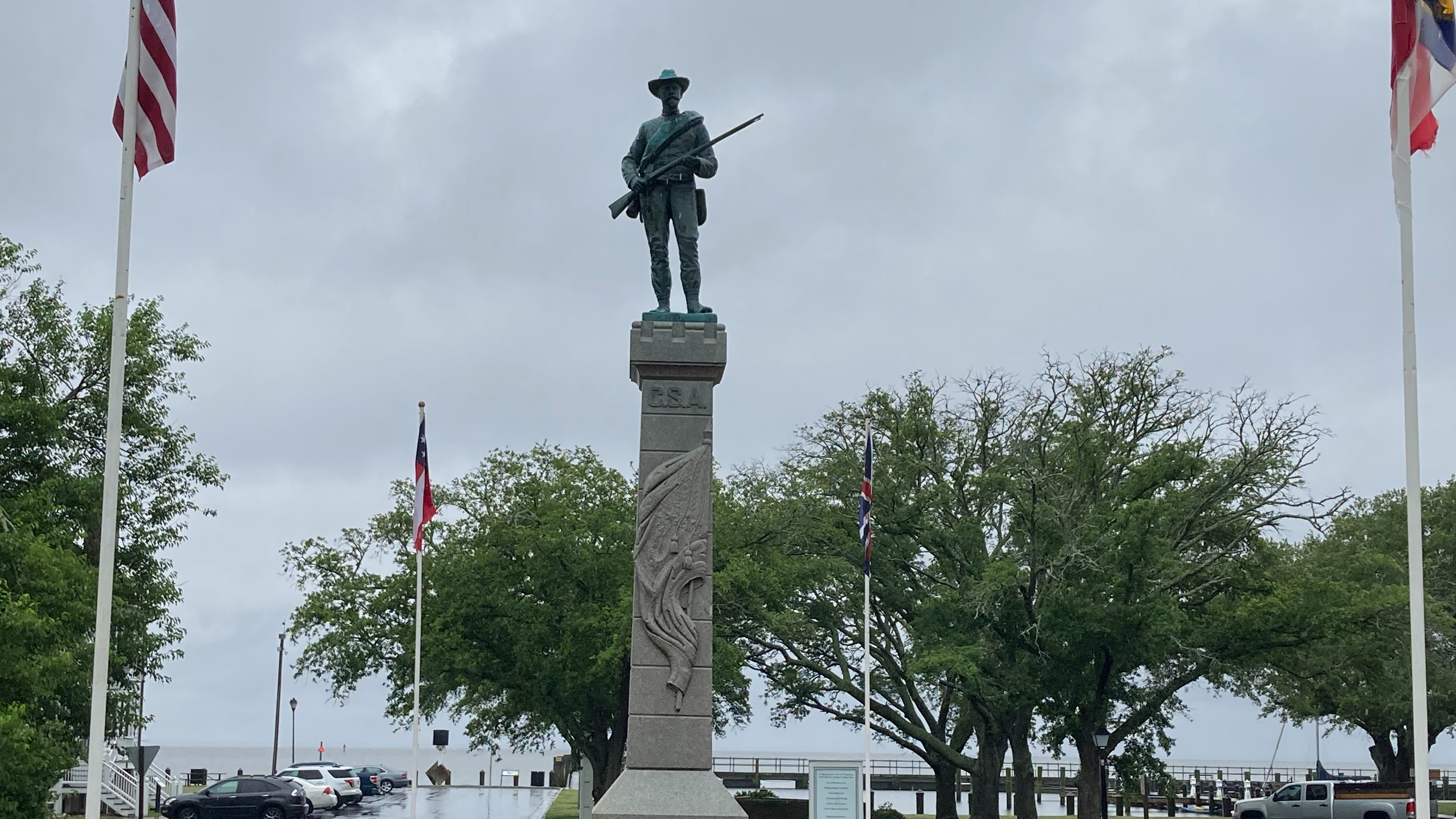
EDITOR’S NOTE: Rather than talk about the weather — boy, did it storm last night — here are three columns to read that may inspire some thoughts and perhaps fire up a few letters to the editor — send to albemarle.observer@gmail.com
Scott Perry, a local businessman, defends Confederate monuments while Professor Jonathan Tobias talks about USAID’s humanitarian values and Keith Throckmorton speaks to the virtues of military services, veterans.
The Battle Over Confederate Monuments in North Carolina, A Fight for Law and Order
BY SCOTT PERRY
In North Carolina, the debate surrounding Confederate monuments is not just about the monuments themselves—it is about something much more extensive and concerning. At its core, this battle concerns the integrity of local governance, the rule of law, and the responsibilities of elected officials.

Many citizens express frustration that politicians campaign on promises yet fail to deliver. The reality is that most elected officials, however well-intentioned, find themselves navigating commissions and councils where multiple interests are at play. The art of governance is often one of compromise, but that compromise must occur within the law’s boundaries. In many cases, when it came to removing Confederate monuments, local governments did not follow legal procedures but instead acted out of political expediency or personal passion.
North Carolina has laws to protect historical monuments. The state’s Monument Protection Act explicitly restricts removing or relocating such monuments without due process. The North Carolina Historical Commission enforces this law. However, the previous governor and the former attorney general—now the current governor—failed to implement it. As a result, enforcement fell to activist citizens who had to pursue legal action through the courts to uphold the law.
This raises a troubling question: If government officials can choose which laws to follow based on political convenience, what does that say about the integrity of our system? This issue extends beyond Confederate monuments. It reflects a broader breakdown in the processes that ensure just governance. Local officials should always ask two critical questions before making decisions: Is this legal? And is this just? If passions run too high, the responsible action is to table the issue until a more rational discussion occurs.
To those who believe the removal of Confederate monuments is the end goal, history suggests otherwise. Activist groups have already set their sights on other historical landmarks. Members of American Legion Post 84 can attest that similar activists challenged the placement of Seth Perry’s grave on the courthouse lawn in Pasquotank County. Another group successfully voted to change the name of Veteran’s Park in Elizabeth City to “General Protector Park.” These actions demonstrate that this movement is not about addressing specific grievances but about reshaping public history to fit a particular narrative.
This debate is not just about monuments; it is about the foundation of law and order. If laws can be ignored in one instance, where does it stop? Imagine if local governments misallocated funds in their budgets—many would dismiss it as bureaucratic mismanagement. However, when a monument is removed, it is a visible and emotional act that forces people to confront the consequences of selective law enforcement.
Yes, we are fighting for the Confederate monuments, but more importantly, we are fighting for the rule of law. The real danger is the erasure of history and the erosion of legal governance itself. Suppose we allow government officials to disregard laws whenever they suit them. In that case, we risk far more than the loss of a monument—we risk losing the very principles that sustain our democracy.
Scott Perry is a successful business owner and longtime resident of Edenton.
Headline: Who Will Mourn For Tresja?
BY JONATHAN TOBIAS
Who will mourn for Tresja? I know who will not: the federal government, no longer.
There was a list of 99 USAID workers who lost their lives while working overseas in foreign aid and disaster relief. The USAID memorial wall that was taken down two weekends (and also the memorial page on the USAID website) bore these names. The last name on that list is Tresja Denysenko.

Her widowed husband, Nicholas, has been a friend of mine for over 20 years.
All these people gave their lives in service to their fellow man, and for the “better angels” of our nation’s ideals. And in hopes for a better world.
Tresja died in 2021, in Haiti while doing disaster relief in the aftermath of devastating earthquakes.
Tresja first joined the USAID in 2005, and was a mainstay in USAID’s disaster and humanitarian responses over the past sixteen years. She served in Haiti once before, following the 2010 earthquake. She deployed to West Africa to help countries contain and ultimately end the Ebola outbreak in 2014. She responded to the political crisis in Venezuela, the Civil War in South Sudan, and recently to the conflict and humanitarian disaster in the Tigray region of Ethiopia.
Tresja stood for the best of America’s relations with the world. For her, there was no region too difficult to reach, no assignment too risky, no challenge too great. When people needed help, she went.
USAID has been targeted for some time by partisan opponents, who — without real evidence — accused the agency of pursuing leftwing causes. It is true that the principles of USAID (started in 1961 by JFK), have not aligned with “America First” objectives, but for that matter, neither do Jesus’ principles. The agency’s work against corruption in other countries and its relief efforts in Ukraine may have been the trigger, but who knows? Humanitarianism on a government level has long been the target for authoritarian and libertarian partisans.
In all likelihood, the alarm raised by USAID about Musk’s cutting off Starlink’s satellite phone service to Ukraine was the straw that broke the camel’s back.
So now, the termination of USAID is a fait accompli. I don’t think we have appreciated the work that USAID has done. For over half a century, they’ve set up nutrition centers and clinics in out of the way places that other agencies (like Samaritan’s Purse and World Vision) simply cannot get to. They’ve dug wells to provide fresh water in places ridden with cholera. They’ve brought food to starving people in the deathly centers of famine, such as Ethiopia. They’ve provided food and shelter for victims in natural disasters around the world. They’ve worked closely with the Carter Center in helping third world countries fight polio, blindness, guinea worm disease, and corrupt elections. They’ve helped thousands of orphans and widows in Ukraine, which has been ravaged by Putin’s invasion.
I know a number of missionaries (some of whom are my family) who have worked in bleak, horrid places with USAID. They all say that USAID’s work was life-saving and irreplaceable.
When USAID goes away, or when it fades and disappears because of imposed top-down modifications of its mission, people will suffer. Poor, powerless and desperate people will die.
This seems to be part of a theme nowadays. Other humanitarian institutions have been put on the chopping block. Even religious relief agencies and charitable organizations, like Lutheran Social Services in Ohio and Catholic Charities in Wisconsin) have been targeted and persecuted – by national and state governments. All because someone called them cheap names like “leftist,” “woke,” or simply not American enough. Nevermind that they were simply being Christian, in the old-fashioned sense of the word.
Back to Tresja. Her widowed husband, Nicholas, sent me this note just days ago: “The humiliation of a widower, who lost his spouse in service to his country, learning that the wall honoring her memory (along with others) has been taken down.”
I do not understand why it was necessary to take down a memorial wall of humanitarians who never fired a shot, but worked tirelessly and heroically for love, peace, and ministry, who died giving their life in the name of love. What heartlessness. What cruelty. There’s cowardice. Then there’s vindictive cowardice.
I wonder if those who stand so persistently for a Civil War memorial statue will be consistent enough to protest the taking down of Tresja’s memorial wall? Is this not history too? A history that should be remembered too?
The day that Tresja died in Haiti was August 19th, which is, poignantly, Humanitarian Day.
Who will mourn for Tresja?
Nicholas will. Her children will. All the friends of Nicholas and Tresja will, and that includes me. Her family and church will. Nicholas is a deacon in the OCA (Orthodox Church of America, Diocese of the Midwest), and Tresja was a fully committed Orthodox Christian there, who lived out her faith in full measure.
Real Americans will remember.
And God remembers, and always will.
Memorial walls in federal buildings may be torn down by despots and cruel men. Names can be stricken from official records. Partisans will have their day, but tomorrow will come eventually, inevitably. Though the mills of God grind slowly, it is said, they grind exceeding fine.
Tresja’s work will stand forever.
The day after I got Nicholas’ note about the federal erasure of his dead wife’s name, we sang on Sunday morning, “I want to walk as a child of the light, I want to follow Jesus. In Him there is no darkness at all. The night and the day are both alike. The Lamb is the light of the city of God. Shine in my heart, Lord Jesus.”
Tresja walked as a child of the light, and now she’s in the city where that light will never fade. She walked and worked, and her name is written there. In the name of love, world without end. Amen.
Jonathan Tobias is a longtime resident of Edenton, college professor and avid gardener.
Headline: Reflection on Our Military and My Heroes
BY KEITH THROCKMORTON
Jesus spoke, as recorded in Matthew 24:6 KJV, regarding signs of the end of this age. He said, “And ye shall hear of wars and rumors of wars: see that ye not be troubled: for all these things must come to pass, but the end is not yet.” David lamented in his warrior’s Psalm 144:1-2 KJV, “Blessed Be the Lord my strength, which teacheth my hands to war, and my fingers to fight. My goodness and my fortress; my high tower, and my deliverer; my shield, and he in whom I trust; who subdueth my people under me.”

Keith Throckmorton, Fairfax County Police (Retired and Chaplain), Hertford, NC
My heroes are our military, law enforcement, firefighters, EMS (all first responders), and of course, our health care providers. Our military and law enforcement are currently not as respected and stable as the others mentioned. Many are leaving the police profession as they have no desire to work in the continuing deplorable work environments they face today.
Our military cannot leave at will. They are obligated to complete their enlistments or commitments. They serve to protect us from our enemies abroad. Our military is prepared to make the ultimate sacrifice in doing so. They leave their families behind while serving in a foreign country for long periods. Some never come home (deemed missing in action) or choose to stay out of the country.
Their Oaths of Allegiance is as follows:
I, (NAME), do solemnly swear (or affirm) that I will support and defend the Constitution of the United States against all enemies, foreign and domestic; that I will bear true faith and allegiance to the same; and that I will obey the orders of the President of the United States and the orders of the officers appointed over me, according to regulations and the Uniform Code of Military Justice.
They must memorize and repeat on command:
THE CODE OF CONDUCT
1. I am an American, fighting in the forces which guard my country and our way of life. I am prepared to give my life in their defense.
2. I will never surrender of my own free will. If in command, I will never surrender the members of my command while they still have the means to resist.
3. If I am captured, I will continue to resist by all means available. I will make every effort to escape and aid others to escape. I will accept neither parole nor special favors from the enemy.
4. If I become a prisoner of war, I will keep faith with my fellow prisoners. I will give no information or take part in any action which might be harmful to my comrades. If I am senior, I will take command. If not, I will obey the lawful orders of those appointed over me and will back them up in every way.
5. When questioned, should I become a prisoner of war, I am required to give name, rank, service number, and date of birth. I will evade answering further questions to the utmost of my ability. I will make no oral or written statements disloyal to my country and its allies or harmful to their cause.
6. I will never forget that I am an American fighting for freedom, responsible for my action, and dedicated to the principles which made my country free. I will trust in my God and in the United States of America.
Over history, these heroes have paid the following sacrifices for our freedom:
• Total Casualties, Wounded and Death (All Wars) 2,852,901+
• Missing In Action (All Wars) 40,031+
• Prisoners of War (All Wars and Catagories) 406,849
Our military personnel have more than earned and deserve the best of benefits, respect, and care that our country can provide. Sadly, this is not the case. Monies and services that they should receive go elsewhere. One prime example is homeless veterans living on the street while illegal immigrants are being housed and provided care. Veterans should receive monies, educational benefits, housing, and any other assistance necessary.
Recently at the disturbances at the capital, our military personnel were forced to stay in a parking garage. Illegal immigrants are staying in nice living quarters and big-box hotels. Sadly, the political pursuits are providing entitlements to others over our veterans. Such poor prioritization is insanity and a slap in the face of our military heroes.
Our armed forces deserve the same treatment as those previously mentioned. Our military was recently assigned to pick up trash and garbage left behind by illegal immigrants entering our country. Such is disgraceful and disrespectful to those serving in our military. As a patriotic American, I feel their pain. All of this is unacceptable.
Professionally, as a police criminal investigator, supervisor, and as federal background investigator, my responsibilities required my presence at four different military installations. They were Fort Belvoir (Army), Quantico (Marine), Camp Lejeune (Marine), Cherry Point (Marine), and the United States Coast Guard Base (Elizabeth City).
Each time I visited and left these installations, I felt that I had been back in the real America I once knew. I was always treated with the utmost respect and courtesy. The atmosphere and appearance of these installations and personnel demonstrated loyalty to our nation. All of this brought back memories of my time in the Navy.
On many occasions in my career, I responded to neighborhoods made up of military personnel. As neighbors, they were close and looked after each other’s interests. They were always ready to assist in any way that they could. By contrast, in civilian neighborhoods, citizens did not know each other than casual waving and speaking.
Professionally, military installations were ever willing to serve in their communities. I was honored to serve as the Fairfax County Police liaison with Fort Belvoir. In this capacity, I responded to specific requests from them. Likewise, they were there for us.
There was an occasion when we had a blizzard, making it impossible for our officers to drive back and forth to work. The Fort Belvoir Military Police came and stayed in our conference room. They used special vehicles to transport police officers to and from work until travel could be made safely. It represented community partnership at its best. On a recent occasion locally, military personnel assisted our EMS by administering COVID 19 vaccinations.
The Fort Belvoir Provost Marshal Office (PMO) requested to be advised on any occasion when any person arrested disgraced the uniform of service by their conduct. There was an occasion when a full colonel was arrested for Driving While Intoxicated. He was belligerent and disrespectful to everyone present. Four privates were charged earlier for being Drunk In Public.
They were waiting to be released. When the colonel was brought into the cellblock, where they were, he screamed at them and scolded them for not coming to attention when he entered. One of the privates responded to him,
“You might be a colonel, but right now, you are a $#@% jailbird, just like us.”
Upon receiving a call placed to the PMO office, a lieutenant General (3 Stars) arrived, very respectful and polite. He spoke with our magistrate, and the colonel was released. The general marched the colonel out of our station in silence. It reminded me of basic training. The general apologized to all of us for the colonel’s behavior.
There was an occasion that I responded to Quantico to interview a person of interest regarding an investigation that I was conducting. I went to the Naval Criminal Investigation Office and made my request known. My person of interest was marched in by a Marine Second Lieutenant. He requested that I let him know when I had finished. After completing my interview, the lieutenant came back and marched the person of interest out. I was always impressed with military discipline.
Of particular pleasure was going to Camp Lejeune on federal background investigations. Camp Lejeune is 246 square miles, so it took some time to find my way around. On my initial visit (the purpose was for background investigation work for the Department of Defense), not sure of the requirements to enter the base. I was driving my personal vehicle, not a government-issued one. I stopped at the visitor building outside of the main gate off Western Blvd., produced my identification, and enquired if a pass was needed. The sergeant was unsure and referred me to the main gate Military Police (MP) for this information. He advised that he would contact the main entrance and announce that I was en route.
It took 3 minutes to arrive at one of the main gate entrances and was met by a uniformed MP. Again, I asked if a pass was necessary to enter the gate. Before he could answer, a plainclothes MP yelled at him from the adjacent entrance, criticizing the young MP loudly, saying to him, “You idiot! You were told that this man could go anywhere on base that he wished.” Even though I was embarrassed for the young MP, it was impressive that there was still discipline in the world. Upon thanking the young man for his service, my investigation commenced.
On another occasion, I interviewed a sergeant major during his off-work time in a local restaurant in the privacy of a booth. When I entered the establishment, I immediately recognized him even though he was not in uniform. His command presence, posture, all clothing pressed and neat made it evident of his position. He was respectful, straightforward, thorough, and confident with all answers during the interview. When appropriate, all answers were “yes sir” or “no sir.” Upon leaving Camp Lejeune that evening, it was apparent that I had been in the presence of a true American hero in every way. The sergeant-major represented the very best of our military.
There was a time that I interviewed a captain and a first sergeant at the Intelligence Unit at Camp Lejeune. The building had no windows and was well off the main drag. The captain met me, and we went to the interview location on the inside. Several junior enlisted marines were working at their desks. I was surprised to see them somewhat unkempt with shaggy hair.
I jokingly ask the captain about this deviation from the always sharp marines on base. He promptly advised that he was an infantry officer and was not used to this. He had only worked there a week. As “intel” folks, they were not required to look the “spit-shined” role as their counterparts. The captain informed me, most seriously, that he would like take them into the field for a week and make marines out of them; this made me chuckle.
Although there are countless other experiences that I could share, my point is this. I love our armed forces, honor their sacrifices and who they are in real life. I trust that all Americans share my feelings. Please, thank them for their service when you encounter them. I salute and thank all who have served. Remember those who made the ultimate sacrifice or never returned.
Deuteronomy 20:1-4 KJV: “When thou goest out to battle against thine enemies, and seest horses, and chariots, and people more than thou, be not afraid of them: for the Lord, thy God is with thee, which brought thee out of the land of Egypt. And it shall be when ye are come into battle, that the priest shall approach and speak unto the people, And shall say unto them, Hear, O Israel, ye approach this day unto battle against your enemies: let not your heart faint, fear not, and do not tremble, neither be ye terrified because of them; For the Lord, your God is he that goeth with you, to fight for you against your enemies, to save you.”
God bless all of you.