BY MILES LAYTON
Editor’s NOTE: This story has been updated to include Sons of Confederate Veterans attorney James Wilson’s comments refuting Town Attorney Hood Ellis’ letter to the Chowan County Commission.
*****
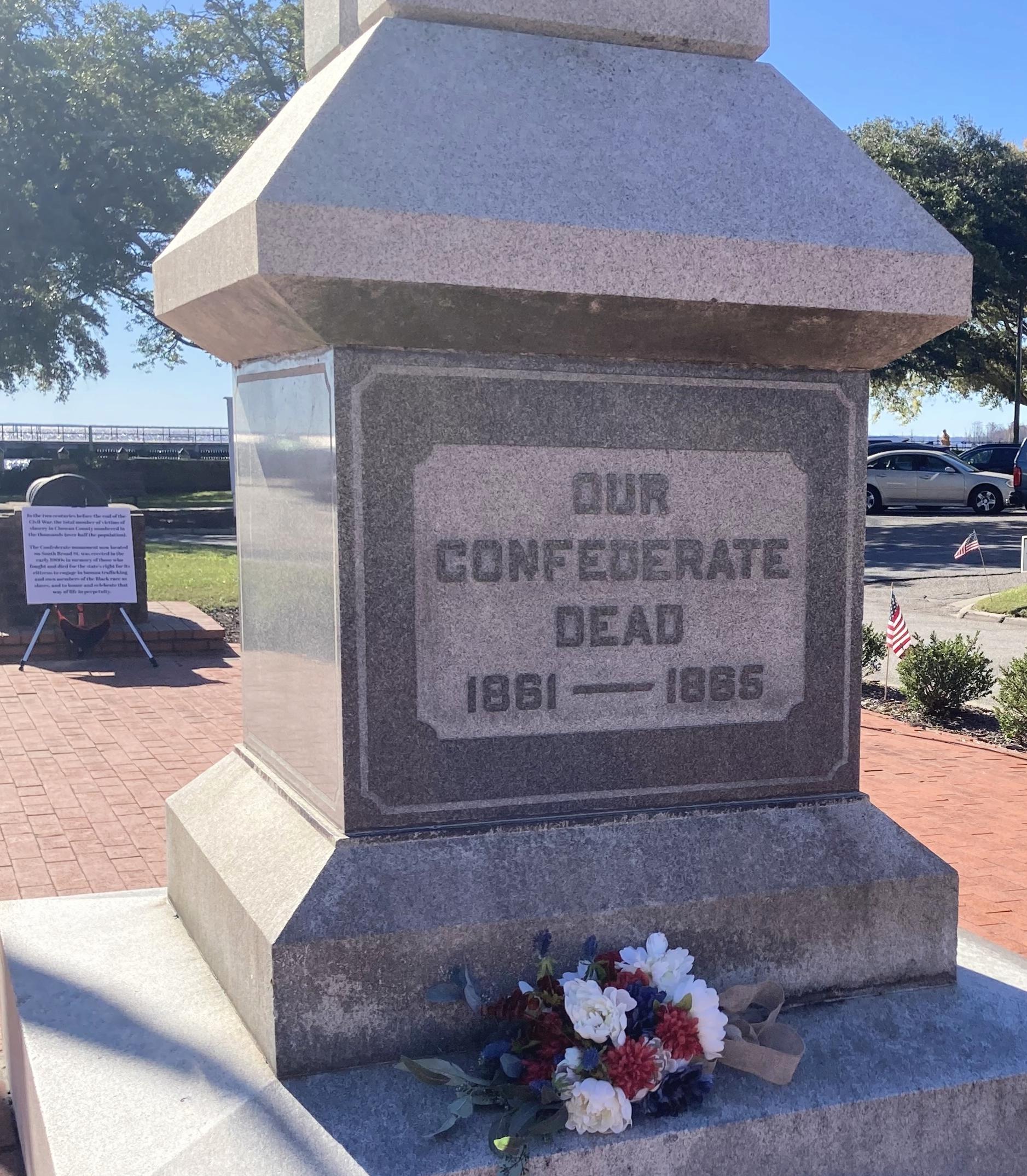
A key condition for an agreement between Chowan County and the Town of Edenton to move the Confederate monument has not been met, meaning the statue will remain at its location on South Broad Street for now.
The Chowan County Board of Commissioners read a letter announcing the dissolution of the town and county’s Memorandum of Understanding (MOU) during Monday’s meeting at the county public safety building.
The MOU, approved by the Town Council and county Commissioners in November, aimed to transfer ownership of the monument from the town to the county within 30 days of the settlement of a civil action against the town. Under the agreement, Edenton would cover the costs of relocating the statue and accompanying landscaping features from South Broad Street to a site behind the Chowan County Courthouse, near the veterans’ memorial and the Chowan County Detention Center.
The relocation effort faced a significant legal hurdle as the MOU required consent from plaintiffs involved in a civil action against moving the monument. Filed in 2022, the plaintiffs include the United Daughters of the Confederacy, North Carolina Division of the Sons of Confederate Veterans Inc. and two other groups.
According to a letter from Hood Ellis, the attorney representing the Town of Edenton, James Barrett Wilson Jr., the new attorney for the Sons of Confederate Veterans, refused to sign the previously approved Consent Judgment. This judgment had been agreed upon by the organization’s former attorney, Edward Phillips.
Wilson refutes Ellis’ statement, saying the organization never gave the lawyers authorization to sign off.
“We who are amenable to compromise,” he said. “The idea that the NC Division SCV would sign away its members’ rights to defend the Memorial against future attempts to move it for a third time in the future is unreasonable. Furthermore, contrary to the information in the article, the NC Division SCV did not authorize either of its attorneys to sign the Consent Judgment containing such language.”
Wilson continued, “Our members are residents and taxpayers in the Town and County and, therefore, have rights we are not willing to sign away. We do agree with the article in that the Town and County should meet again and communicate with all stakeholders to fashion an Agreement we can all live with. We will do our part to engage in a positive way with these discussions.”
Editor’s NOTE: The article that Wilson is referring to was a short brief announcing the news about the MOU following Monday’s Chowan County Commission meeting — that story was expanded with this version of the story.
Wilson, a Winston-Salem-based attorney, has represented similar organizations in legal disputes regarding Confederate monuments throughout North Carolina. His refusal to approve the agreement effectively nullified the relocation plan.
“Thus, the condition precedent (entry of a Consent Judgment) triggering the relocation of the Confederate Monument can no longer be satisfied because Mr. Wilson will not approve same,” Ellis wrote.
Ellis’ letter to the Chowan County Commissioners further asked whether the county would like to schedule a joint meeting to discuss negotiating a new MOU.
Follow-up
In a comment on a previous version of this story, Scott Perry, who represents the Sons of the Confederacy as a plaintiff the 2022 civil action, said that a MOU was the best chance for a compromise.
Under North Carolina General Statute § 100-2.1, which governs the protection of monuments, memorials, and works of art, a monument may be relocated if necessary for the preservation, renovation, or construction of public property. The statute provides strict guidelines for relocation, ensuring that any move must be to a site of equal prominence, honor, visibility, and access. This law, enacted in 2015, restricts the removal, relocation, or alteration of objects of remembrance owned by the state or located on public property. However, it includes exceptions under which a monument can be moved.
A county or municipality may relocate a monument under this statute only if:
- The move is necessary to construct, renovate, or preserve the public property where the monument is located.
- The monument is relocated to a place of equal prominence, honor, visibility, and access.
- The move does not result in permanent removal or destruction.
This means a monument cannot be removed simply for political or social reasons. Still, suppose a legitimate construction or renovation project requires relocation. In that case, the county or municipality has the authority to move it as long as it is placed in a location of equal significance. In 2019, the City of Winston-Salem removed a Confederate monument from its downtown area, citing public safety concerns and the property’s private ownership status. The United Daughters of the Confederacy (UDC) filed a lawsuit against the city, arguing that the removal violated G.S. § 100-2.1. The court ruled in favor of the city, determining that the monument’s location on private property and the public safety concerns justified its removal. This case highlighted that G.S. § 100-2.1 applies primarily to monuments on public property and that exceptions exist when public safety is at risk.
The NAACP and other groups sued Alamance County Commissioners, seeking the removal of a Confederate monument from downtown Graham, arguing that it violated constitutional principles and posed public safety concerns. In March 2024, the North Carolina Court of Appeals ruled that the county lacked the authority to remove the monument due to G.S. § 100-2.1, emphasizing the statute’s restrictions on removing or relocating public monuments.
The Vance Monument, a Confederate memorial in Asheville, became the subject of legal disputes over its removal. The city argued for its removal based on public safety concerns and changing public sentiment. After legal challenges, including a lawsuit by the 26th North Carolina Regiment, the North Carolina Supreme Court ruled in March 2024 that the city did not breach its contract, allowing for the monument’s removal.
The situation in Edenton, North Carolina, provides an example of how North Carolina General Statute § 100-2.1 is applied in relocating monuments. In 1909, the United Daughters of the Confederacy erected a Confederate monument before Edenton’s courthouse. In 1961, the memorial was moved to the town’s waterfront, where it currently stands. Over the years, the memorial has become a focal point of debate within the community.
In March 2023, the Edenton Town Council unanimously voted to relocate the Confederate monument from its prominent waterfront location to Hollowell Park on West Queen Street. This decision addressed community concerns while adhering to G.S. § 100-2.1 stipulations, which mandate that relocated monuments be placed in areas of “similar prominence, honor, visibility, availability, and access.”
This case underscores municipalities’ complexities when attempting to relocate monuments under G.S. § 100-2.1. Even when local governments move a memorial to a site they believe meets the statute’s requirements, legal challenges can arise, leading to prolonged disputes and delays.
In Edenton’s case, the town’s effort to balance community concerns with legal obligations has led to ongoing litigation, showcasing the challenges inherent in interpreting and applying monument protection laws in North Carolina. Edenton’s new stance is to renovate the waterfront. Under the current statute, Edenton can move the monument to a place of equal or similar prominence if the city council agrees.
The memorandum of understanding (MOU) agreed upon by the Edenton City Council and Chowan County Commissioners is the best path to preserve the memorial for future generations to remember their veterans and ancestors. Is MOU perfect? No! Is a compromise as our entire government was founded on? Yes! If you’re a citizen and want to preserve the monument, then the MOU is your only shining path forward.
Other Lawsuit Still Pending
The monument’s future remains uncertain, as the MOU’s dissolution raises questions about a separate lawsuit filed by local residents earlier this year. Plaintiffs Sherronne Battle, Stella Brothers, Debra Miller, Rod Phillips and John Shannon contend that the relocation agreement violated the state’s open meeting law and infringed on residents’ rights to equal protection.
A request for comment as to whether this lawsuit will continue from the plaintiffs’ attorney, Jacob Sussman with the Southern Coalition for Social Justice, had not been answered at the time of this article’s publication.
Background
In December 2022, The United Daughters of the Confederacy, Sons of the Confederacy, and two other groups filed the civil action in an attempt to prevent the town from moving the statue to Hollowell Park, a place recommended by Edenton’s Human Relations Commission in 2021.
The Confederate monument, erected in 1909, has been a fixture of Edenton’s historic downtown district since being moved there the 1960s. While Edenton has long embraced its heritage as a draw for tourism, the monument has become a focal point of contention in recent years. Weekly protests both for and against the monument have been held for over three years.
The debate mirrors broader national discussions over Confederate symbols and their place in public spaces. Supporters of the monument view it as an important historical marker, while opponents argue that it represents a legacy of racial injustice and does not reflect the inclusive values the town seeks to promote today.
3 responses to “Future Uncertain for Confederate Monument”
[…] First up, the Commission received a letter Monday from the Edenton Town Attorney Hood Ellis to County Attorney Lauren Arizaga-Womble announcing the nullification between Chowan County and Edenton to move the Confederate Memorial has not been met, meaning the statue will stay at its location on South Broad Street for now. Since that is a separate story — click this link. […]
[…] from our other stories about the Confederate Memorial, please see the Albemarle Observer’s previous story on these matters about the placement and future of the […]
[…] Future Uncertain for Confederate Monument […]