
Editor’s NOTE: In the days of yore when I was growing up, my parents had a subscription to the local newspaper, so — since I had to stay close to home after church — I spent my time after Sunday’s lunch reading the opinion section to learn more about the world.
Today’s columnists are Jonathan Tobias and Keith Throckmorton. If you haven’t read their columns before, Tobias of Edenton is a professor and an award winning columnist, while Throckmorton of Hertford is a retired lawman and police chaplain from Fairfax County, Virginia, Police.

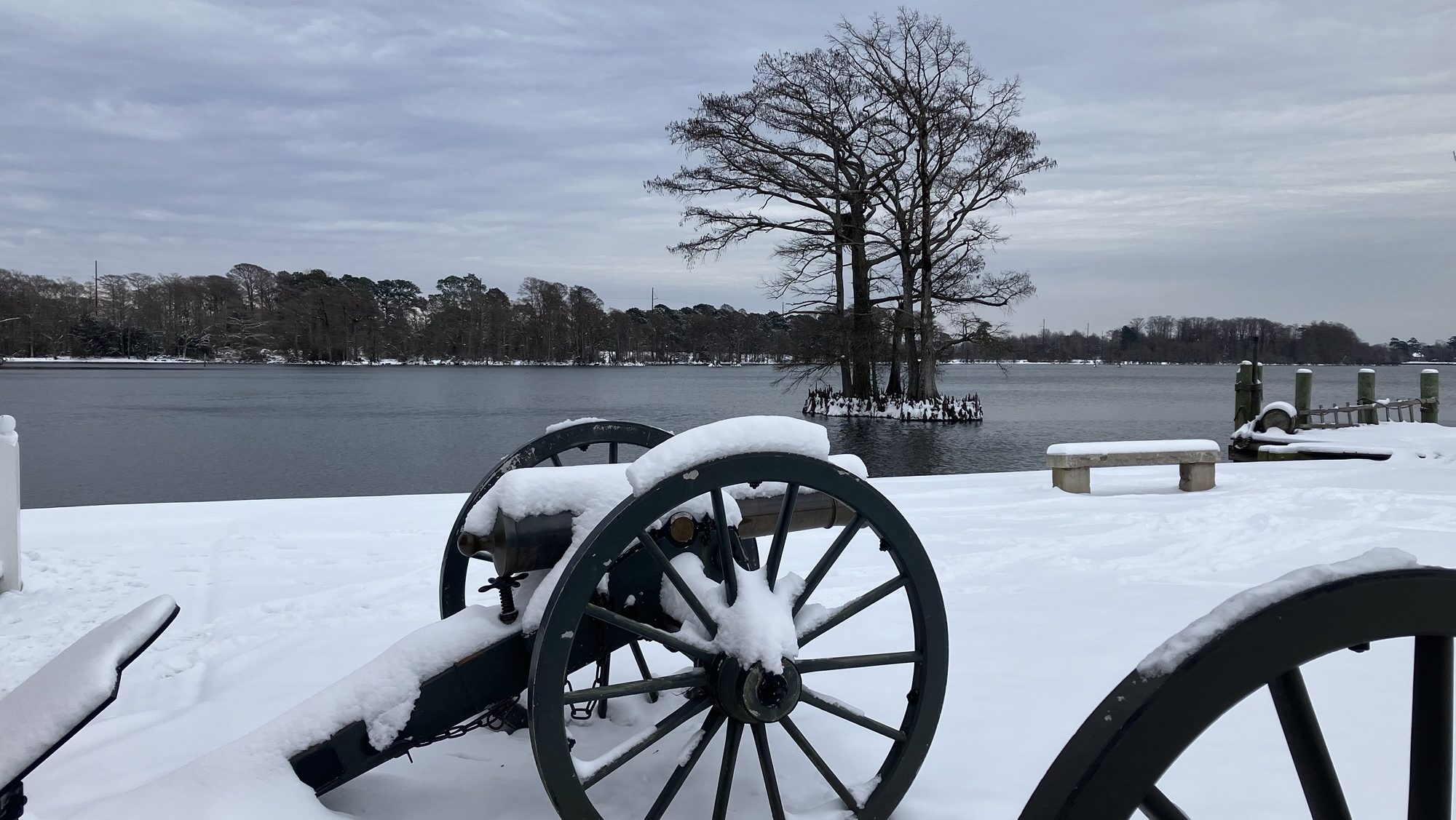
Snowfall
By Jonathan Tobias

The door opened onto a white-silver glistening morning. His jaw dropped, eyes wide with strange amazement. An intense, mystical experience descended upon his white furry face.
It was the very first sight of snow for Wendell Berry, my three-year-old West Highland White Terrier.

He set his front right paw gingerly in the frozen sheen. He sniffed and tasted the cold confection. He surveyed the blanketed yard, the mounds of whiteness on the deck, the tufted crystals hanging precariously on the bay leaf and the rosemary.

Then he leapt into an untrodden drift and bounded away, jumping from one hillock to another, in an exultant leaping-lord ballet whose choreography is known only to the blessed canine race.

That was last Wednesday, of course. The day before was wrapped in cold and clammy gray. You could feel something was coming, a foreboding that gripped your uncovered face with icy tendrils that burrowed up coat sleeves and down the collar. You were persuaded that snow clouds were well on their way up, oddly enough, from the Gulf of Mexico where it had never come from before. You could sense the pressure, the weight of the slate clouds.
We all took pictures on Tuesday night, didn’t we? The flakes showered down like a cascade of silver butterflies. Swirls of opal gossamer danced around the streetlight, looking for all the world like the lamp post in wintry Narnia that greeted Lucy as she emerged from the wardrobe. I almost went out to see if a faun might show up, Mr Tumnus scurrying off for his tea and crumpets, rethinking and regretting his ill-timed allegiance to Jadis, the false and ice-hearted Winter Queen.
But Wednesday morning dawned onto an opalescent world, sparkling frost glistening below and poignant azure above, deepening, infinitely, into the submarine indigo of an endless sky. Flashes of silver in the snow seemed to reflect the gleam of the myriad stars. When the sun finally rose, the crimson gold gleamed with heartbreaking beauty, like a reminder that a blessed assurance that goodness still could be found, that peace and joy were still wrapped in hope, waiting for a better morning.
This snowfall was not the work of a cruel ice tyrant like Jadis. This was all a gift, and a gratuitous one at that. It was all beauteous mystery. We Southerners have a poignant childlike fascination with snowfall since it’s so rare. Even though a mere inch brings everything to a halt, we all, like Wendell, gaze with startled wonder, and like Linus of Peanuts fame, we try to catch a single snowflake on our tongue, savoring the frozen quantum of the sea and the air.
But it doesn’t last. Snow is ephemeral, especially down here. Signs of beauty come and go in this mutable age. What we once thought was permanent turns out to be, after all, fragile and temporal. “The grass withereth, the flower fadeth: but the word of our God shall stand for ever” (Isaiah 40.8). The snow falls and drapes the dull brown earth in a cryolite veil, sparkling with diamond ice for a day or two. But then the white silver curtain is drawn back as the year goes round again.
“You’ll see,” Wendell prophesied, “Spring will come again. And it will be okay.”
He had just come back inside, my little hybrid of polar bear and baby seal. He shook, and snow flew in a radiant spray. He’s right: the snow falls and melts. Then it rises as a cloud and ascends to heaven. And then it descends as rain to water the Spring earth.
It will be okay. It will be hard, and things might get tough. But still, as Julian of Norwich said, “All shall be well, and all manner of things shall be well.”
The snow falls, but Spring will rise again.
Take Charge of Your Community
By Keith Throckmorton

Most citizens believe that it is the responsibility of the police to keep their neighborhoods safe. They do not understand that citizens and the police have active roles in ensuring a safe community. Citizens can be their neighborhoods’ eyes and ears, while the officers are responsible for enforcement actions and other services to their communities.
An active neighborhood watch is a must. In larger police departments, a formal plan may be mandated with established procedures. In smaller departments, community watch may be less formal or nonexistent.
First of all, get to know your neighbors. As a Federal Background Investigator, I was required to go into neighborhoods and interview neighbors. I found it so sad that neighbors did not know each other on many occasions, just informal and casual waving once or twice a month.
Making law enforcement a part of your mission is a must. The first step to consider is a meeting of all of the residents. A clubhouse, civic association building, church, or other public location is recommended. Announce the intention by telephone, door hangers, or newspaper, and contact your Chief of Police or Sheriff, inviting them or their representative to attend. They will always welcome the opportunity to see the citizens wanting to do their part in keeping their communities safe. Include Highway Patrol and other law enforcement agencies in the county, including judges. Ask for a regular contact person if one is available. Ask for Community Watch signs for your community from your local law enforcement.
Assure to continue with monthly meetings, provide updates, and any training or information available. Serve refreshments, and make it an enjoyable social time. Arrange for guest speakers from the law enforcement community or others from the criminal justice community. These meetings ensure that your Community Watch program is sincere, ongoing, and a deterrent for potential criminal acts.
Respect from your law enforcement is crucial. Most importantly, you are respected by your local police and how you serve your communities in this capacity. Never brandish any weapon. The last thing that any program would want would be the police calling on those participating in your community watch.
The first and foremost important rule is just being a good neighbor. Secondly, your safety comes first, which is a cardinal rule for law enforcement. Please do not take it upon yourself to challenge people. You do not know what danger they may be to you. That is not your job in a Community Watch Program. You are eyes and ears for your police and nothing more.
You know the people that live in your communities. A pencil and paper are your most important weapons, excluding your eyes. When you see strange vehicles, especially at night, roaming around your streets, or maybe just sitting, do what you can to get a tag number, description of the vehicle, and occupants. Write down this information with a date and time, which is very important. Notify law enforcement with this information if you seriously believe that this vehicle may be casing your neighborhood. Such information may be most important in enabling law enforcement to obtain a search warrant. People quickly blame the police for not making arrests at specific addresses, especially for drugs. Information provided by the citizen may be the link needed to obtain the search warrant.
When on vacation, ensure that a friend or neighbor regularly checks your home. Your Neighborhood Watch program may have a schedule for members to accomplish this. It would be necessary for them to walk around your home, check all of the doors and windows, and for signs of criminal activity. Also, check any detached buildings or storage areas. Assure that you leave your contact information with someone if illegal activity is discovered and you need to be contacted.
Timeliness is most important for follow-up investigations by law enforcement. Over time, any evidence can and probably will be destroyed or contaminated. Others having access to the area would have to be eliminated as suspects. Neighborhood canvasses (identifying potential witnesses) by law enforcement would be seriously jeopardized. People start forgetting anything they saw or heard 24 hours after an incident. After 48 hours, they have probably forgotten any specific details. That also ties in with keeping detailed notes on suspicious vehicles, persons, importantly, the date and time of such.
If someone in your program is prior law enforcement and available, solicit them to be an information link. If you have information to pass on, do not have law enforcement come to your residence. Meet the officer at a location away from your neighborhood. That is to protect you and your family from being a target of the perpetrator. That leaves them guessing when confronted or arrested by law enforcement. Always understand criminals do not trust each other. They most always confide in some miscreant confidant.
Your mission is to be the eyes and ears of your community. You may walk, ride bicycles, or drive through your neighborhood while on patrol. Having another neighbor with you is a great way to establish comraderies and friendships with your neighbors.


