By Miles Layton
Let’s start Monday off with a look back at a Palm Sunday service at Plymouth United Methodist Church.
Why cover a worship service? Because celebrating faith is part and parcel of our culture in Northeast North Carolina.
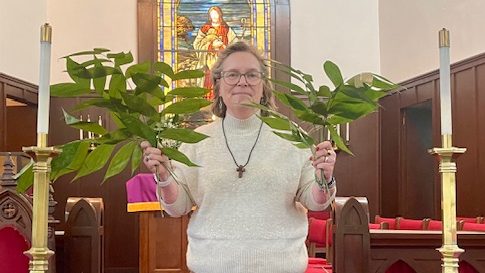
On Sunday, my wife and I met Reverend Vickie Woolard, who gave us a warm welcome and an introduction to her inviting church. She and her husband, Barry, live in Columbia — so that was a bonus, as I’ve always been partial to the people in rural places such as Tyrrell and Hyde counties. Another bonus, our family has a tradition that after church, we buy a dozen doughnuts — Plymouth now has a Dunkin’ Donuts!
Being that it’s Holy Week, here’s our story featuring Woolard’s sermon. Another version of this story will appear in this week’s edition of the Plymouth Beacon.
If you have church news, send it this way — mileslayton1969@gmail.com — we’re hoping to connect with Trey Rogers, the new Senior Pastor at Rocky Hock Baptist Church, and maybe cover a Cross Walk in Plymouth or Hertford later this week.
PLYMOUTH — The Rev. Vickie Woolard stood before her congregation at Plymouth United Methodist Church on Palm Sunday and delivered a message she said lies at the very heart of the Christian gospel: no matter who you are, no matter what you have done, there is always a chance to start over.
Drawing from the 21st chapter of Matthew, Woolard painted a vivid portrait of the first Palm Sunday — a holiday crowd gathered at the gates of Jerusalem, palm branches waving, cloaks thrown into the dusty street — and invited her congregation to find themselves in that ancient scene.
“After all the dark days of this Lent we’ve been through, after all the days of walking with Jesus through Israel, of walking through Judea, of walking through Samaria, of walking through his own valley of the shadow of death, Jesus and his disciples have finally reached Jerusalem,” Woolard said.
The sermon, titled “A Time of New Beginnings,” was delivered at Plymouth UMC, a congregation with roots stretching nearly two centuries into Washington County history.

Records indicate that William J. Waller was appointed pastor of what was then called Plymouth Methodist Episcopal Church on February 15, 1826. The first building was constructed in 1832. The church cemetery predates even that structure — the earliest grave on the grounds dates to 1808.
Woolard, who lives in Columbia with her husband, Barry, serves the Plymouth congregation with a warmth evident from the moment she welcomed visitors before the service. In her sermon, that same warmth carried through as she described the disciples’ anticipation ahead of the Passover celebration.
“They intend to eat and drink, to see old friends and family and maybe to make new friends,” she said. “They want to sing songs and tell the story of how they were once slaves in the land of Egypt.”
Woolard walked her listeners through the journey step by step: the disciples borrowing a donkey, the small group beginning the short climb up to the Holy City, the warm spring day she imagined might have felt something like her own morning out on her deck. When Jesus arrived at the city gates, she said, recognition rippled through the crowd.
“Almost everybody knows who Jesus is,” she said. “He is a famous teacher. He tells stories that get in your head, stories that you just can’t forget. Jesus makes you think about things you don’t want to think about, about forgiving everyone who hurts you, about turning the other cheek, about loving your enemies, about how it’s more important to be kind than it is to be right.”
And then there were the miracles. Woolard described a crowd trading stories about blind men restored to sight, deaf people who could hear, and lepers finally able to return home to their families. “They even tell stories about dead men who returned to life,” she said. “And the more they talked, the more excited they get.”
The energy in her retelling built toward what she called an extraordinary afternoon — one of those rare moments when everything seemed, briefly, to be as it should be. She quoted Robert Browning’s poem “Pippa’s Song”: “God’s in his Heaven — All’s right with the world.”
“And for just one afternoon, everything was right with the world,” she said.
What followed was one of the most striking passages of the sermon, as Woolard personalized the Palm Sunday scene for people carrying the invisible weight of ordinary life. She described the woman standing on the side of the road who had always been lonely. The middle-aged man whose business was failing, whose house was in foreclosure, whose wife had walked out and taken the children.
“Because there was Jesus, and he knew that somehow, somehow, everything would be alright again,” Woolard said. “So he threw down the palm branch that he held in his hand.”
She described an old woman whose children never visited anymore, whose stories no one wanted to hear, whose garden no one helped her plant. An old man who could no longer work from sunup to sundown, whose back wouldn’t straighten, who couldn’t walk without creaking.
“Because, there was Jesus, riding into Jerusalem on a little donkey,” she said. “So they threw down the palm branches that they held in their hands.”
Even the most crushing burdens of public life — taxes, drought, famine, fear, war — fell away in that moment.
“Drought and famine and fear and war and even global pandemics didn’t matter,” she said. “Because there was Jesus. There he was.”
But Woolard was careful not to let the Palm Sunday celebration stand as its own conclusion. The crowd’s joy, she reminded her listeners, was not the end of the story. And neither, she argued, is whatever wilderness a person may find themselves in today.
“The good news of our Christian faith is that the wilderness is never our final destination, and hope is alive even when we find ourselves walking through dark and desolate territory,” she said.
She invoked Dante’s “Inferno” and the words written over the gates of hell — “Abandon hope, all ye who enter here” — and acknowledged that people walking through their own dark seasons are often tempted to believe those words apply to them as well.
“But hear these words,” she said. “At the heart of the gospel message is a new beginning. Following this Jesus gives us a new beginning.”
Woolard returned to the message Jesus carried out of his forty days in the desert: repent and believe the gospel. She unpacked that word — repent — with simplicity and directness.
“Repent. Turn around. Begin again. Start over,” she said. “No matter who we are or what we’ve done, no matter whether we made the wilderness we’re wandering through or whether someone else drove us there, God is in that wilderness with us. And God can lead us through that wilderness. And God can lead us out of that wilderness.”
She closed the theological argument with the Apostle Paul’s second letter to the Corinthians: “So if anyone is in Christ, there is a new creation: everything old has passed away; see, everything has become new! All this is from God.”
“The good news of Christ, the good news I want you to remember today, is this,” Woolard said. “No matter who you are, no matter what you have done, there is always, always, always, always, a chance for a new beginning.”
Her final words were both a challenge and an invitation, calling the congregation to step out of whatever wilderness they had been carrying into the sanctuary that morning.
“We don’t live in the desert,” she said. “We were never meant to live in the wilderness. We are meant to live here, in the world, with each other, in community with each other.”
She acknowledged the ways communities fracture — the small cruelties, the moments when people are made to feel small or inadequate or unimportant — but circled back one final time to the core of the Palm Sunday message.
“Remember, always remember the good news Jesus preached to us,” she said. “Repent. Turn around. Begin again. Start over.”
Plymouth United Methodist Church holds services at its historic downtown location. Woolard has served the congregation as its pastor and, on this Palm Sunday morning, sent them into Holy Week with a simple, ancient promise — that the road through Jerusalem does not end in the dark, and that new beginnings are always, still, possible. To be fair, due to an email mix-up, this is a “previously delivered” Palm Sunday sermon from Woolard, but we both agreed that the Palm Sunday message remains the same.
Subscribe — it’s free!

Let us know what you think by leaving a comment. Comments are subject to approval.