By Miles Layton
EDENTON — A Chowan County resident, Kristy LaLonde, delivered an impassioned plea to county commissioners Wednesday night, urging them to consider the human cost of the county’s latest property tax revaluation before setting a new tax rate, while commissioners and county staff defended the process and stressed that no new tax bill has been issued yet.
Toward the tail end of the meeting, during the time set aside for commissioners to talk, perhaps address matters from public comment, Commission Chairman Bob Kirby responded with County Manager Kevin Howard explaining the revaluation. On that note, for a quick video about revaluation, click here.
A revaluation — sometimes called a reappraisal — is the process of updating all real property in the county to reflect current market value as of a specific date. For this cycle, that date is Jan. 1, 2026.
Per the revaluation, countywide property values will increase by 38% to 42% compared to 2022. But officials stressed that a higher property value does not automatically mean taxes will increase by that same percentage.
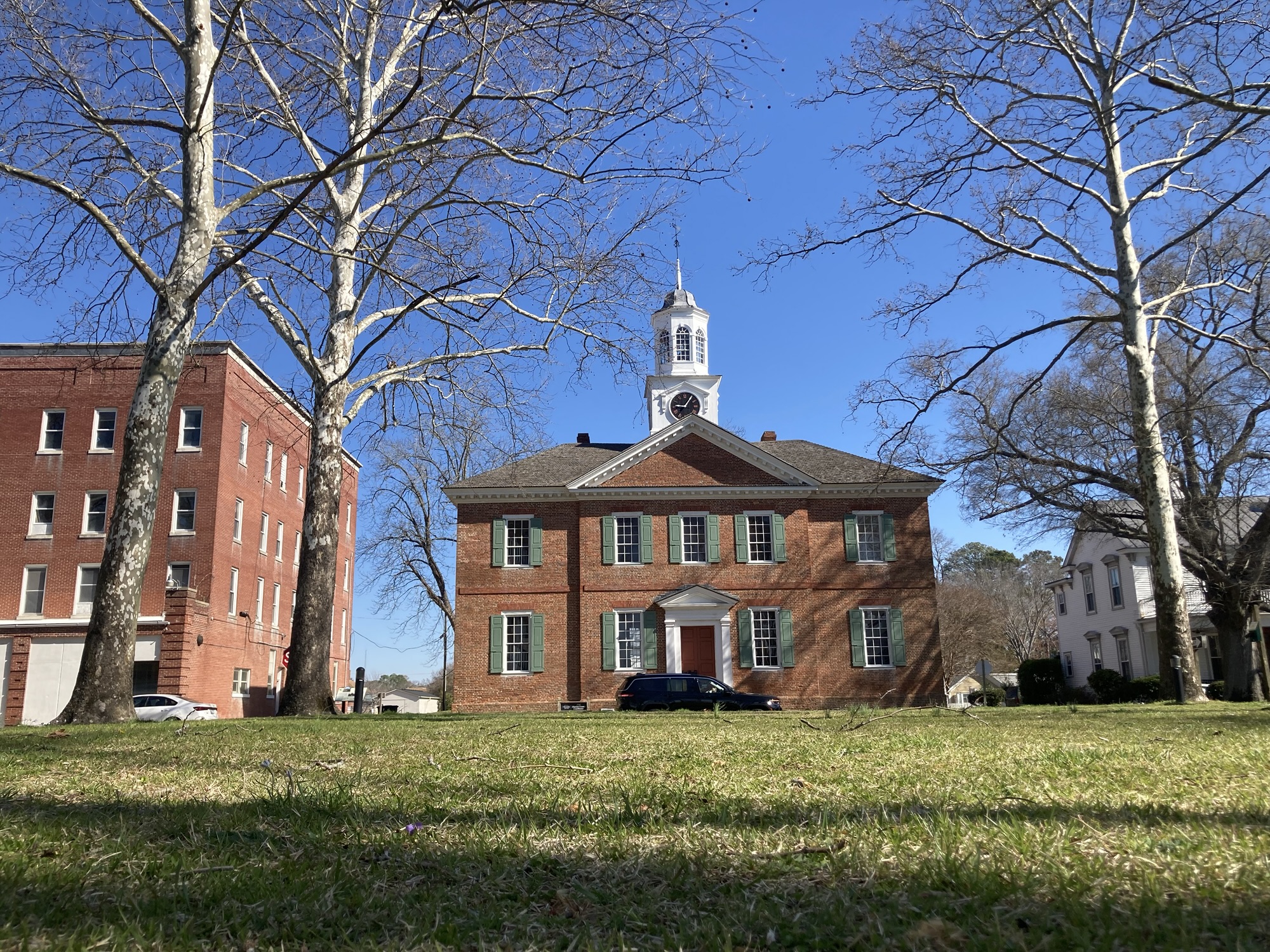
Per the feature photo with this story, rather than using the standard boring photo of county commissioners sitting around a table, let’s highlight a pretty piece of property — the historic Chowan County Courthouse.
Subscribe — it’s free!
Back to the commission meeting — LaLonde stepped to the podium during public comment and spoke directly to the board about what she described as a growing affordability crisis facing working families, elderly residents, disabled veterans, and retired first responders across Chowan County.
“I wanted to talk to you guys tonight about the latest tax revaluation and the very real impact it’s having on the people who live here,” said LaLonde, also a candidate for Chowan County Sheriff. “For many residents, this discussion is not about property values on paper. It’s about whether we can realistically afford to stay in our homes.”
LaLonde reminded the board that the county had already undergone a 2022 revaluation that sharply increased property taxes for many homeowners — an experience she said she felt personally.
“Since purchasing mine in 2012, my mortgage has doubled,” she said. “My interest rate is fixed, so that has nothing to do with that. It’s all about insurance and tax increases.”
She painted a broad picture of financial pressure facing county residents, arguing that wages in the area have not kept pace with the rising cost of everyday necessities.
“The cost of living continues to rise, while wages in our communities do not keep pace,” LaLonde said. “Families are struggling to afford groceries, utilities, medical care and housing. When property taxes increase again, it adds yet another burden to households that are already stretched thin.”
LaLonde also challenged what she called an uneven playing field among county residents, suggesting that some voices in the community may not fully understand the financial realities facing most families.
“It’s important to remember that not everyone in this county has the same financial starting point,” she said. “Some individuals who claim to speak for our communities may have been fortunate enough to begin life with advantages, but the majority of the people who live here were not born with those advantages. And most of us work hard every day, simply to maintain a stable life for our families.”
Her remarks grew more pointed when she turned to the county’s most vulnerable residents — those she said have the least ability to absorb higher tax bills.
“We have elderly citizens, disabled veterans, disabled individuals and retired first responders who dedicated decades of their lives, serving and protecting this very community,” LaLonde said. “Many of these individuals now live on fixed incomes. They cannot simply increase their earnings to keep up with rising property taxes. These are people who gave their working lives to this county. And now many of them are struggling to remain in the very communities they helped build and protect.”
LaLonde directly challenged the board to move beyond spreadsheets and consider the lived experiences of the people they represent.
“Property values may be increasing on paper, but that does not mean residents suddenly have more income in their bank accounts,” she said. “A higher valuation does not pay a higher tax bill. Leadership requires more than balancing a budget. It requires listening to the people you represent and making decisions that reflect the realities that they are living every day.”
She invoked the founding of the United States to underscore her point, drawing a parallel between the American Revolution and the current tax debate.
“The American Revolution began largely because people believed they were being taxed in ways that were disconnected from their realities and their voices,” LaLonde said. “While our situation today is very different, the principle remains important. Taxation must always be fair, responsible and mindful of the people who are expected to carry the burden.”
LaLonde closed with a direct appeal to the commissioners’ sense of duty to the people who elected them.
“You were elected to represent the people of this county, and many of those people are telling you they are struggling,” she said. “Please hear them, because at the end of the day, your decisions will determine whether longtime residents can continue to live in their homes and communities they helped build, or whether rising taxes slowly push them out. I ask you to choose policies that protect your citizens, preserve our community, and ensure that people who built this county can afford to remain there.”
Commission Chairman Kirby responded to LaLonde’s remarks directly, acknowledging her reference to the American Revolution while pushing back on the comparison.
“He talked about the fact that we fought a revolution over taxes, which were high taxes,” Kirby said. “And actually, I believe the whole crux of that was taxation without representation. And the representation is sitting right here. We’re ready anytime someone wants to come and talk to us. My picture’s on that dartboard there, and my phone number is right there anytime.”
Kirby said the board does not view the situation as taxation without representation and stressed that the revaluation itself does not determine what residents will owe.
“You haven’t been billed yet,” Kirby said. “This just tells you what it’s worth. Doesn’t tell you what taxes you are going to have to pay.”
He added that the board would take up the question of the tax rate during the budget process.
“You’ve got the revaluation, and we’re going to sit down at the appropriate time and develop a budget, which will yield a tax rate based upon the value of property in the county,” Kirby said.
County Manager Howard offered additional context, explaining the history behind Chowan County’s shift to a four-year revaluation cycle and why property values have climbed so dramatically.
“We were on an eight-year cycle when I got here in 2014,” Howard said. “We were just finishing up a rebuild that was a down year based on market prices. It was down in 2022 after that first eight-year cycle — did another rebuild. You had a down year, and then the housing market was taking off just as we finished that rebuild.”
Howard said the board made a strategic decision at that point to move to a shorter revaluation schedule, hoping to smooth out future spikes.
“At that time, knowing that, you all decided to do a four-year cycle, hoping that this one would lessen the impact of those values,” he said. “That’s what a lot of counties — most counties — see that kind of growth. They go to the four-year cycles or even less. A lot of the large counties, they’re constantly on revaluation mode, trying to keep everything level and fair across the board.”
The shorter cycle, Howard acknowledged, did not prevent values from continuing to climb.
“Unfortunately, the last four years has continued to go up, and that’s what we’re seeing now,” he said. “We are the only county with a four-year cycle.”
Howard also explained why homes in the moderate price range have seen some of the steepest increases.
“Some cycles, commercial property may go up tremendously and the residential property flatten,” he said. “The big thing that we see at this time was what’s called your affordable homes — in the $200,000 to $300,000 range — because that’s the biggest part of the market. You have more buyers there, so there is more competition, and that drove those prices up more than some others.”
Kirby echoed the point about frequency of revaluations, citing data from the North Carolina Association of County Commissioners.
“The data from the North Carolina Association of County Commissioners says that the more often you do your revaluation, the more even it is for everyone,” Kirby said, “because everything changes in value at different rates. Some things go up, some things go down.”
Audit Finds Clean Books, Healthy Reserves, But Repeats Medicaid Documentation Concerns
Also on Monday’s agenda, the board received the annual audit report for the fiscal year ended June 30, 2025, presented by Thompson, Price, Scott, Adams & Co., P.A., of Wilmington.
Auditors reported no material errors in Chowan County’s financial statements and said their work was not limited in any way. No significant deficiencies in internal controls were found in the county’s general financial operations, and there were no disagreements with county management.
The county’s General Fund closed the fiscal year in a strong position. Total revenues and other financing sources reached $25,126,665, while total expenditures and other financing uses came in at $24,720,204, producing a net change of $406,461. Ad valorem taxes were the dominant revenue source at $14,110,568, representing 56 percent of operating revenues. Public safety was the largest expenditure category at $5,672,049, or 25 percent of general fund spending, followed by education at $4,771,980, or 21 percent.
The county’s unassigned fund balance stood at $12,133,252, representing 58.13 percent of general fund expenditures — well above the 20 percent minimum recommended by the Local Government Commission, which would have required a balance of approximately $4,944,041. The tax collection rate came in at 98.15 percent.
The county’s solid waste and emergency medical services funds both operated at losses for the year. The EMS Fund saw operating revenues of $1,055,563 against operating expenses of $2,239,195, resulting in an operating loss of $1,183,632, partially offset by transfers in of $1,072,472. The fund ended the year with a net position of negative $1,136,072.
Auditors did flag two repeat findings related to the county’s administration of the federal Medicaid program, both carried over from the prior year’s audit.
The first finding identified 14 technical errors across a sample of 91 Medicaid cases reviewed out of more than 110,000 claims. The errors included cases lacking proper documentation, inaccurate resource or income calculations, one improperly forced case, and two cases with incorrect household size data. Auditors found no questioned costs and said there was no effect on participant eligibility, but noted the issues stemmed from ineffective record keeping, incomplete documentation, and incorrect application of eligibility rules.
A second finding identified one case in which an applicant received Medicaid benefits for which they were not eligible, resulting in questioned costs of $6.20.
Both findings are repeats from the 2024 audit. County officials agreed with the findings and said supervisors will conduct second-party file reviews, and workers will be retrained on documentation requirements and eligibility determination procedures.
Make a one-time donation
Make a monthly donation
Make a yearly donation
Choose an amount
Or enter a custom amount
Your contribution is appreciated.
Your contribution is appreciated.
Your contribution is appreciated.
DonateDonate monthlyDonate yearly
Let us know what you think by leaving a comment. Comments are subject to approval.