MID-CURRITUCK BRIDGE: KEY NUMBERS
2014 estimated cost: $411 million
Current estimated cost: $1.1–$1.2 billion
Bridge length: 4.7 miles across Currituck Sound
Toll financing capacity: About $195–$200 million
State funding currently reserved: $173 million
Already spent on planning and legal: About $60 million
Estimated funding gap: Up to $1 billion
The Albemarle Rural Planning Organization votes April 15 on how to proceed. NCDOT must be notified of the group’s decision by April 17.
By Nicole Bowman-Layton
HERTFORD — State Department of Transportation staff recently told a room of local elected leaders and citizens that the long-planned Mid-Currituck Bridge is not financially feasible as currently structured, and that the region has until April 17 to decide what to do with $173 million in state funds tied to the project.
The meeting, convened on Wednesday, March 11, 2026, by DOT and the Albemarle Rural Planning Organization at the Albemarle Commission office in Hertford, drew roughly 20 attendees: government officials from Dare and Currituck counties, town officials from Southern Shores and Duck, interested citizens from Tyrrell and other counties in the region and representatives of NC DOT and the Turnpike Authority. The session was the second in as many months on the bridge’s funding crisis, called after NC DOT’s February briefing to the Albemarle RPO left board members with more questions than answers.
“We’re not here to bash DOT or bash the MPOs or RPOs. We want general information that we can take back to our communities,” said Lloyd Griffin III, RPO chairman and Pasquotank County commissioner
The stakes are significant. The bridge project holds a large share of the transportation funding available to the 14-county Division 1 region. With cost estimates nearly tripling since 2014, planners say closing the funding gap will require a combination of federal grants, private investment and future state funding — none of which is guaranteed.

More than three decades in the making
The Mid-Currituck Bridge has been on the drawing board since at least 1989 — when, as Division 1 Engineer Ronnie Sawyer noted with a wry smile, he was a sophomore at N.C. State.
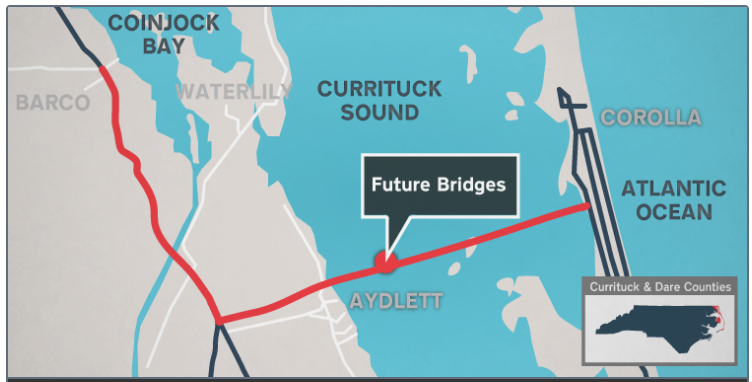
The proposed toll span would be 4.7 miles long, crossing the Currituck Sound and connecting the Currituck County mainland directly to the northern Outer Banks near Corolla. Supporters have long argued the bridge is essential to reducing chronic summer congestion on NC 12 through Dare County — currently the primary route to beach communities such as Corolla and Carova — and to providing an additional hurricane evacuation corridor for tens of thousands of seasonal visitors with no alternative exit.
The project cleared a major environmental hurdle in 2019, when the state issued a Record of Decision after completing a lengthy environmental review process. In fall 2025, NCDOT obtained the three remaining environmental permits it needed — from the N.C. Division of Water Resources, the N.C. Division of Coastal Management and the U.S. Army Corps of Engineers. A final permit application, to the U.S. Coast Guard, was submitted in December 2025.
But permits alone cannot build a bridge. About $60 million has already been spent on planning, engineering and legal costs over the life of the project, Sawyer confirmed — and the project still faces active litigation. The Southern Environmental Law Center has appealed the Coastal Management permit issued last fall, one of several legal challenges the project has navigated over the years.

David Wasserman, NCDOT’s deputy director for planning and programming, talks about the Mid-Currituck Bridge project at a meeting hosted by the Albemarle Rural Planning Organization on March 11, 2026, in Hertford.
How road projects get funded in North Carolina
To understand why a vote by a regional planning body matters to a bridge’s future, it helps to understand how North Carolina decides which roads and bridges get built.
Under the Strategic Transportation Investments law enacted in 2013, the state’s $32 billion, 10-year capital plan, called the State Transportation Improvement Program (STIP), divides funding into three tiers: statewide projects get 40% of funds, regional projects get 30%, and division-level projects share the remaining 30% equally among the state’s 14 highway divisions.
Projects compete for those dollars through a scoring process that weighs congestion relief, safety benefits and cost-effectiveness, updated every two years in what NCDOT calls a “prioritization” cycle. Local input matters: Regional planning organizations and division engineers can assign bonus points to their highest-priority projects. At the statewide level, scores are 100% data-driven; at the regional level they are 70% data and 30% local input; at the division level it is a 50-50 split.
Rural Planning Organizations — like the Albemarle RPO, which covers a 10-county area in northeastern North Carolina — are the designated bodies for assigning those local input points and advocating for their region’s needs. Metropolitan Planning Organizations serve the same function in more urbanized areas.
Division 1’s total share of the current 10-year STIP is roughly $700 million — covering all road, bridge, safety and other transportation needs across those 14 counties. The Mid-Currituck Bridge has held $173 million of that allocation since 2016: committed, but unspent, as a placeholder for a project that cannot yet advance to construction.
One point that caused confusion in the room: releasing that $173 million does not mean local leaders get to hand-pick where it goes. Sawyer was direct about that.
“That money, if it’s freed up, it still has to go right back into the STIP,” Sawyer said. “We can’t say, pick a project that we kind of want to happen. (The project) has to still be formally scored through the STIP process.”
From $411 million to more than $1 billion
When the bridge was first scored under the new STI law in 2014, the total project cost was estimated at $411 million. Toll revenues were projected to cover about $240 million of that, with roughly $173 million coming from state transportation funds.
A comparative analysis presented to regional leaders last month — required under federal law for any project exceeding $750 million that would use federal financing — revealed how dramatically the picture has changed. The bridge now carries a total estimated cost of $1.1 to $1.2 billion. Projected toll revenues, based on updated traffic and revenue modeling, are expected to support only about $195 to $200 million in financing capacity.
Note: NCDOT’s project website, last updated in January 2019, describes the cost as “near $1 billion.” That figure does not appear to reflect the updated $1.1 billion to $1.2 billion estimate presented to regional leaders in February and repeated at Wednesday’s meeting.
David Roy, director of innovative finance at the NC Turnpike Authority, explained several factors drove toll revenue projections down. Interest rates are near 10-year highs, reducing how much can be borrowed against future toll income. COVID-19 also changed travel patterns on the Outer Banks, spreading peak traffic across more days rather than concentrating it on summer Saturdays.
The tolls ranged from $14 during the offseason to $28 during the peak season, and they didn’t account for reduced toll rates for local residents. For comparison, the Chesapeake Bay Bridge-Tunnel, which spans almost 18 miles and connects mainland Virginia to the Eastern Shore, costs $16 off-season and $ 24 peak season.
Even on a busy Saturday in 2030, the bridge is projected to carry about 10,000 vehicles — a far cry from the 50,000 to 60,000 daily vehicles seen year-round on urban toll roads like the Triangle Expressway in the Raleigh area. That limited, seasonal traffic caps how much revenue the bridge can realistically generate.
The result: a funding gap approaching $1 billion, even after factoring in the $173 million already reserved. David Wasserman, NCDOT’s deputy director for planning and programming, was blunt.
“The project as it currently stands is not financially feasible without additional funds,” said Wasserman.
Two options, one April deadline
Transportation planners outlined two choices for the Albemarle RPO, which must act before NCDOT’s April 17 deadline.
Under Option 1 — the default if no action is taken — the $173 million stays reserved for the bridge. NCDOT would continue working through legal challenges and seeking federal grants, but the project could not advance to right-of-way acquisition or construction without closing the funding gap. The money would remain tied up in Division 1’s budget, unavailable for other projects, potentially for years.
Under Option 2, the RPO and Division 1 would agree to re-enter the bridge into the current prioritization cycle, known as Prioritization 8, or P8. The $173 million would be freed for other Division 1 projects. The bridge would compete for new funding based on updated scoring that reflects the full current cost estimate and — if it scores well enough — would likely be funded initially only for continued preliminary engineering, given the unresolved litigation. It would then need to compete again in a future cycle before construction could begin.
Wasserman offered a candid preview of how the bridge might score. A simulation using the previous prioritization cycle showed the bridge ranking 15th out of 124 projects in the regional category for Region A — the combined Division 1 and Division 4 area — assuming both the RPO and division assigned their maximum local input points. The statewide funding category, however, is unlikely to yield results: the bridge would compete with major Interstate corridors with far higher traffic volumes.
Even under the more favorable regional scenario, Region A is the smallest in the state, receiving only about 8% of regional funds — roughly $800 million across all projects over 10 years.
“There’s always going to be a gap,” Wasserman said. “The biggest challenge is finding the $900 million right now.”
Closing the gap will require what Roy called a “multi-pronged approach”: federal discretionary grants, potential public-private partnership financing and future prioritization funding over multiple cycles. The project has historically fared well in federal grant evaluations, Roy said, but unresolved litigation has been flagged as a concern by federal reviewers. The largest federal highway grant NCDOT has ever received on a single project was about $240 million, for the Cape Fear Crossing — a figure that underscores how far grants alone would fall short.
Communities feel the pressure
For officials from the northern Outer Banks, the funding debate is inseparable from daily quality-of-life concerns.
Paula Sherlock, of the Southern Shores Town Council, told the group that navigation apps and some roadside signs have redirected thousands of visitors through the town’s narrow residential streets as a shortcut between Currituck County and Corolla. Southern Shores spends about $1 million annually maintaining roads that are not state-maintained, receiving only about $100,000 back from the state.
“We are maintaining roads for people to travel from Currituck County to Corolla without spending one dime in Southern Shores,” said Sherlock.
Sherlock also challenged the meeting’s repeated references to pending litigation as a reason the project cannot move forward. The courts, she said, have consistently sided with NCDOT.
“None of this litigation has ever gone anywhere,” she said. “They’re primarily meritless suits that have been pretty quickly disposed of by every court who’s heard them. So I think the litigation thing is a bit of a red herring here.”
Then she pressed the harder question: if the bridge is not built, what is the alternative plan?
“Are you going to four-lane through Southern Shores and Duck? Are you going to give us some more money for our roads?” Sherlock asked. “And who has responsibility for deciding what is the tipping point with too many people on those northern beaches who cannot get out in the case of a natural disaster?”
No state official at the meeting offered a direct answer. Sawyer said he was not aware of any current projects pursuing alternative routes to the northern Outer Banks from the north or through Virginia.
Dare County Commissioner Mary Ellen Bounds and Board Chairman Bob Woodard also raised the region’s population dynamics: Dare County draws an estimated 3 million visitors annually, but the state’s project-scoring formula uses permanent resident population — a figure that does not capture the seasonal burden on the corridor. Officials said NCDOT does account for seasonal traffic volumes in its congestion scoring, a provision added specifically in response to similar concerns, but seasonal adjustments alone have not been enough to elevate the bridge to the top of statewide funding lists.
Broader regional competition for limited dollars
RPO Chairman Griffin, who has served on the board for 20 years, put the bridge decision in the context of everything else Division 1’s transportation pool must cover. The region has used its allocation over the years to fund four ferries, a dredge and a tugboat for coastal transportation needs across the Outer Banks and surrounding waterways.
“The bridge across the Currituck Sound is just as important to Currituck as it is to the other shores of Duck, Corolla and the north end of Dare County,” Griffin said. “But there’s a pot in there that has just as big an impact, whether it’s in Pasquotank, Chowan, Tyrrell or Hyde. They’re all competing for the same pot of money.”
He noted the Outer Banks, for all its traffic challenges, does have a road. Not every community in Division 1 can say the same.
“There’s a road you can get there, even though it’s a pain to get through there,” Griffin said. “Some places don’t — they only have a ferry or a washed-out road.”
One citizen in attendance argued that the financial case for the bridge has effectively collapsed and that the region should cut its losses. They pointed to a recent environmental study, which identified a package of road improvements — roundabouts, targeted widenings — as an alternative to a new bridge. Those, they said, could be funded incrementally.
“At what point do you just say the cost-benefit analysis failed miserably?” the person asked. “There’s just no way to build this because of the funding gap. When do you just cut your losses, give the $173 million to the projects around the entire 14 counties, instead of taking that money from them?”
Wasserman acknowledged that other projects across the state face similar cost escalation challenges, citing a long-delayed Interstate 26 project in western North Carolina where bids came in far above estimates. The department had to step back and re-scope the work. The Mid-Currituck Bridge is among a set of legacy projects that have been in the system for decades and now face the reckoning of modern cost realities.
What comes next
The Albemarle RPO is scheduled to vote April 15 — two days before the state deadline. Sawyer said Division 1 typically aligns with the RPO’s decision in cases like this, though both bodies must formally agree on a path.
As of Wednesday’s meeting, NCDOT had not yet held a public community meeting for Dare County and Outer Banks residents on the bridge’s funding situation. Officials in the room encouraged the department to reach out to affected municipalities before the vote.
If the RPO misses the deadline, the project defaults to Option 1 and the next opportunity to revisit the decision would come in Prioritization 9 — two years from now.
Whatever the board decides, transportation planners made clear the fundamental challenge does not change. A 4.7-mile bridge across the Currituck Sound will cost between $1.1 billion and $1.2 billion. Toll revenues will cover a fraction of that. The rest must come from somewhere, somehow.
“Funding will still remain the challenge regardless of what we do,” Wasserman said.


Let us know what you think by leaving a comment. Comments are subject to approval.