By Nicole Bowman-Layton
When a foster child in Camden County needs to be driven two hours for court or psychological services, it isn’t always a social worker making the trip — sometimes it’s the department director herself.
That’s the reality at the Camden County Department of Social Services, where a frozen social worker position has left the agency understaffed and struggling to keep up with growing caseloads involving vulnerable children and adults.
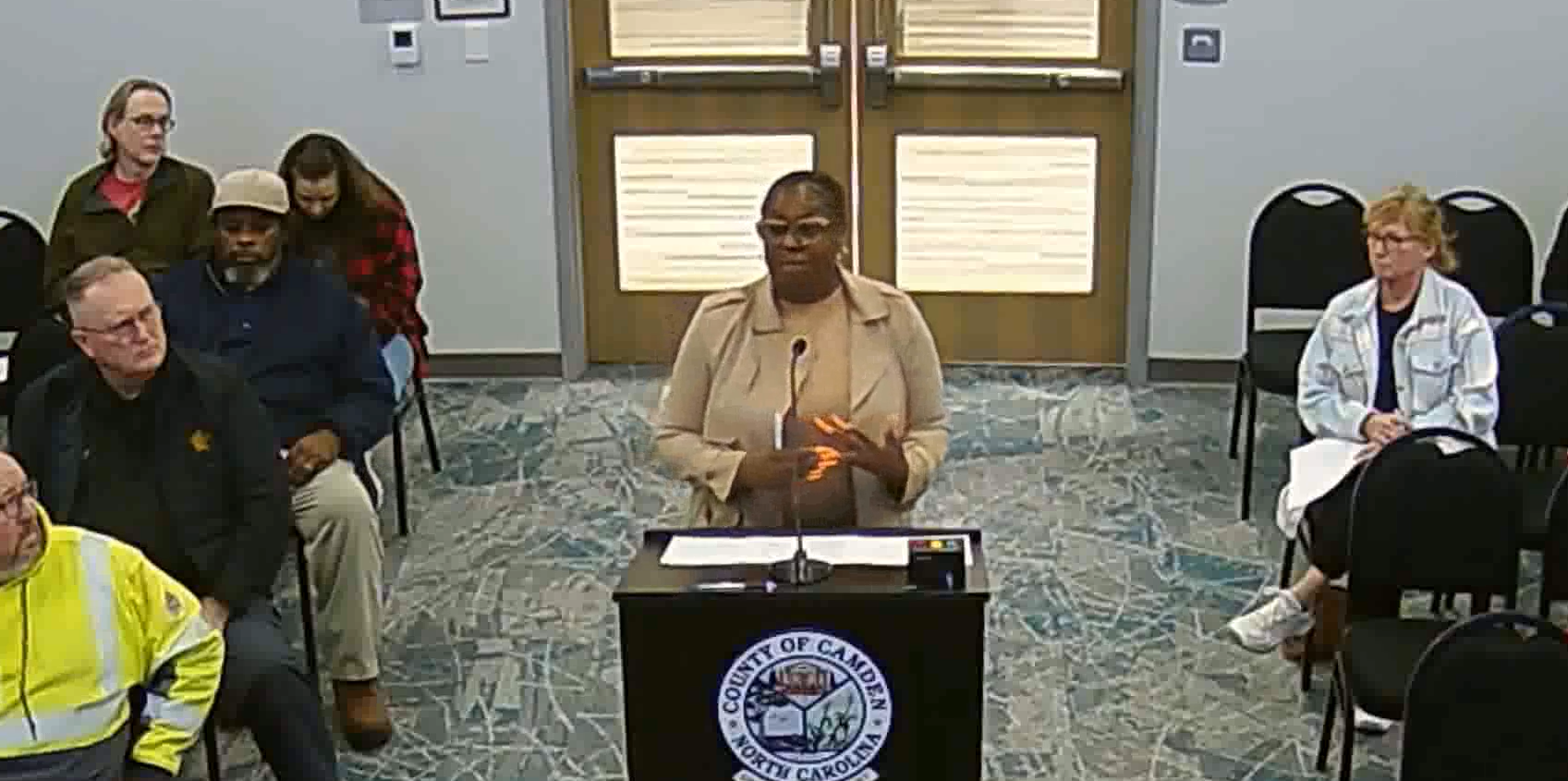
At the Jan. 5 meeting of the Camden County Board of Commissioners, DSS Director Stephanie Wyche urged officials to lift a hiring freeze on a Social Worker II position that has been vacant since May 2025, warning that continued delays put both staff and clients at risk.
“This position is a journey-level, fully qualified role that plays a critical function in our department,” Wyche told commissioners. “These are complex, high-risk cases that involve safety concerns, legal requirements, and individuals with significant needs.”
With only one social worker currently assigned to these duties, that employee is juggling five to 10 child protective services assessments at any given time, along with intensive six-month interventions for high-risk families. The worker also handles intake responsibilities and must conduct weekly visits for high-risk cases — twice the usual frequency.
“She wears many hats,” Wyche said, explaining that both she and the department’s social worker supervisor have stepped in to cover gaps, including taking foster children long distances for required services.
Unlike neighboring counties that assign social workers to specific program areas, Camden staff must manage child protective services, adult protective services, foster care, and facility monitoring simultaneously.
“I’m pleading to you all, I need this position back open,” Wyche said. “This is an investment in effective service delivery, workforce stability, and responsible risk management.”
Commissioners voted to table the request until their February meeting while they gather additional information.
A local example of a statewide issue
While Camden County DSS is a county agency, it operates under the oversight of the North Carolina Department of Health and Human Services — tying its staffing challenges to a broader statewide problem now detailed in a new transparency dashboard from the North Carolina State Auditor’s Office.
The dashboard, released in late December by State Auditor Dave Boliek’s Division of Accountability, Value, and Efficiency (DAVE), shows more than 8,800 state government positions have been vacant for six months or longer as of Aug. 6, 2025. Those vacancies account for $1.04 billion in lapsed salaries — funds budgeted but unused because positions remain unfilled.
“This new dashboard brings transparency to the dollars and cents behind vacancies in state government,” Boliek said in a statement. “The division will continue to evaluate areas where government can provide the best return on taxpayer dollars.”
The online tool breaks down vacancies by agency, funding source, and length of time unfilled, revealing staffing gaps across many critical services, including public safety, transportation, health, and social services.
Regional vacancies linger for years
Across northeastern North Carolina, long-term state vacancies have persisted for years, particularly in corrections, transportation, and public safety roles.
Pasquotank County has the highest impact in the region with 84 long-term vacant positions generating $7.19 million in lapsed salaries. The county’s vacancies average 620 days unfilled and include numerous corrections officers at the Pasquotank Correctional Institution, a Department of Health and Human Services rehabilitation counselor, and multiple Department of Transportation positions including highway patrol troopers and engineering technicians.
Bertie County follows with 142 vacant positions generating $11.83 million in lapsed salaries, with positions vacant an average of 639 days. The majority are corrections-related positions including corrections officers, HVAC mechanics, electricians, and trainee officers at local facilities.
Hyde County shows 51 positions vacant an average of 663 days, totaling $4.08 million in lapsed salaries. All are corrections officers and a corrections lieutenant at the Hyde Correctional Institution.
Tyrrell County shows 27 positions vacant an average of 632 days, with $2.05 million in lapsed salaries. All listed positions are corrections officers at facilities in Tyrrell County.
Dare County shows 24 long-term vacancies totaling nearly $3 million in lapsed salaries, with positions vacant an average of 1,019 days—more than two and a half years. These include machine operators at the Department of Agriculture’s Dare Bombing Range, career employment services consultants with the Department of Commerce, and a social research specialist with the Department of Environmental Quality.
Perquimans County has 18 positions vacant for an average of 594 days, generating $1.57 million in lapsed funds. Most are youth services behavioral specialists and school educators with the Department of Public Safety’s juvenile justice facilities, plus Department of Transportation engineering technicians and workers.
Martin County has 17 positions vacant for an average of 938 days, generating $1.81 million in lapsed funds. These include Department of Commerce career employment positions, Department of Agriculture maintenance construction technicians, and a Department of Health and Human Services business services coordinator.
Washington County has five positions vacant an average of 529 days, totaling $377,960 in lapsed funds. These include Department of Agriculture research and pesticide inspection positions, a Department of Public Safety juvenile court counselor, and Department of Transportation engineering technicians.
Currituck County has four positions vacant an average of 618 days, generating $500,880 in lapsed funds. These include a probation and parole officer, a marine fisheries officer with the Department of Environmental Quality, a juvenile court counselor, and a Department of Transportation engineer.
Camden County shows three positions vacant for an extraordinarily long average of 2,103 days — nearly six years — generating $732,870 in lapsed salaries. These include a Department of Commerce career employment services consultant, a Department of Natural and Cultural Resources maintenance supervisor, and a State Highway Patrol trooper.
Chowan County has two positions vacant an average of 789 days, with $264,830 in lapsed funds. Both are Department of Transportation positions: an engineering technician and an executive assistant.
Gates County shows two positions vacant an average of 312 days, generating $74,200 in lapsed salaries. These are a Department of Natural and Cultural Resources maintenance technician and a Department of Transportation worker.

Numbers meet reality
Statewide, the Department of Health and Human Services accounts for nearly 3,100 long-term vacancies and $375 million in lapsed salaries. The Department of Adult Correction follows with 2,800 vacancies totaling $229 million.
The auditor’s office notes that some vacant positions have never been advertised, while others may be slated for elimination. A more detailed agency-by-agency report is expected later this month (January) under Session Law 2025-89, which required publication of long-term vacancy data by Dec. 31.
For local agencies like Camden County DSS, the numbers reflect more than accounting figures.
“Complex cases require time, expertise, and careful decision-making,” Wyche said. “Prolonged staffing gaps increase the risk of burnout, errors, and staff fatigue.”
She emphasized that her request was not for expansion, but to fill an existing, budgeted position.
“This position is already funded,” she said. “Most important, it directly affects the community members who rely on our services — many of whom are facing urgent and complex challenges.”
As government officials continue to evaluate how vacant positions affect taxpayer dollars, departments on the ground continue navigating the daily reality of trying to meet critical needs with fewer workers than intended.


Let us know what you think by leaving a comment. Comments are subject to approval.