By Miles Layton
COLUMBIA — Tyrrell County teachers say they were notified late last summer when thousands of dollars in promised pay failed to appear in their checks, a decision educators describe as financially devastating and symptomatic of deeper transparency and trust issues in one of North Carolina’s smallest and poorest school districts.
To be clear, technically, this is not a pay cut; the complaint is regarding the local supplement freeze — nothing has been done to alter certified teacher pay.
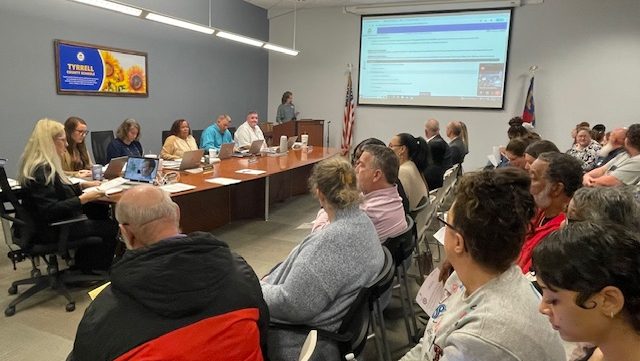
The feature photo with this story is from Tuesday’s Board of Education meeting — that’s not a bunch of angry teachers in the audience — more on what happened at that meeting will appear in a future article. Hint — Several architectural/engineering firms presented a broad overview to the BOE and the community, outlining what each firm hopes to accomplish if chosen to build a new $62 million pre-K to grade 13 school. Lot of good ideas and good news from the meeting!
Back to our story — The controversy centers on freezing local salary supplements and delaying payment of the State Low Wealth Supplement, funds intended to support educators in economically disadvantaged counties. Last year, this was paid in March and June, so technically, there has been no delay. Teachers say the decision came abruptly, with little warning, and directly contradicted written assurances they had received from district officials just days earlier. Teachers were notified 8/21/25. This contradicted a memo sent by the Interim CFO; however, upon further review of the district’s financial situation and the absence of a final audit, the Board of Education made the difficult decision to freeze local supplements and review at a later date, Superintendent Brianna Williams said.
Subscribe — it’s free!
On Aug. 21, 2025, Tyrrell County Schools issued a memo to staff announcing that local salary supplements would be frozen immediately. For many teachers, the notice came as a shock, particularly because it followed an email from the district’s finance office that appeared to promise payment.
Two days earlier, on Aug. 19, the interim finance officer emailed employees stating that “half of local-supplement will be paid in August paycheck.” Teachers say they relied on that statement when budgeting for rent, utilities, groceries and other basic household expenses.
“Relying on this official communication, many teachers planned their finances only to have that support withdrawn two days later,” one educator later wrote in correspondence to state and local officials.
The Aug. 21 memo framed the decision as a temporary, necessary measure amid financial uncertainty. In that message, then-Interim Superintendent Brianna S. Williams wrote, “Like many districts across the state, we are experiencing a decline in student enrollment. This trend, coupled with the absence of a fully approved state budget, presents significant challenges as we work to allocate resources in a responsible and strategic manner.”
Williams continued, “In response, and in alignment with our Reduction in Force (RIF) policy, we have made the difficult decision to temporarily freeze local salary supplements. This measure is not taken lightly. We understand and deeply value the commitment and contributions of every staff member.”
She described the freeze as “a proactive step to ensure financial stability and continuity of services,” adding, “Most importantly, it helps us maintain our focus on providing the highest-quality learning opportunities for our students.”
What the Aug. 21 memo did not mention, teachers say, was the status of the $5,000 State Low Wealth Supplement — a separate pool of state funding intended to bolster pay in counties with limited local tax bases.
Adding to their frustration, teachers say colleagues in neighboring districts confirmed that the State Low Wealth Supplement was being paid elsewhere.
For a teacher earning a base salary of $52,000, the combined loss of the $1,100 local supplement and the $5,000 state supplement amounts to $6,100 — more than 11 percent of annual income. In a rural county where salaries already lag behind state averages, teachers say the impact has been severe.
“In a district like ours, $6,100 is not extra money,” one teacher wrote. “It’s rent, groceries, and surviving the summer.”
The pay dispute has unfolded against the backdrop of significant structural changes in the school system. Just months earlier, the Tyrrell County Board of Education unanimously approved a sweeping consolidation plan to cut costs and address declining enrollment.
Beginning with the 2025–26 school year, the district reduced its footprint from three schools to two. Tyrrell Elementary now serves students in kindergarten through sixth grade, while Columbia High School houses grades seven through 12. Columbia Middle School’s 6th grade was moved to the elementary school, but we are still operating with three school numbers. The middle school population is located on the high school campus.
“We lost an allotment for a Principal, therefore the high school Principal also leads the middle school,” Williams said.
In an April message to staff announcing the consolidation, Interim Superintendent Dr. Michael Bracy said the move was unavoidable. Operating three schools, he wrote, was “no longer sustainable” given enrollment declines and rising operational costs. Consolidation, Bracy said, would allow the district to “focus our limited resources where they are needed most—on supporting students and teachers in the classrooms.”
Teachers now argue that freezing supplements directly contradicts that assurance.
“After achieving the ‘efficiency’ of consolidation, the first move made was to cut teacher pay,” one educator wrote in correspondence sent to legislators and county officials.
Williams clarifies that “Teacher pay was not cut. These are supplements, not salaries.”
District leaders have pointed to Reduction in Force policies as justification for financial decisions tied to consolidation. But teachers say those policies do not authorize the freezing of compensation that had already been promised.
Policy 7920 governs dismissals, demotions or reductions in force due to reorganization, declining enrollment or financial exigency. Educators note that the policy outlines procedures for staff reductions, not compensation freezes. Policy 7921 similarly addresses reductions for classified employees.
Teachers have also cited Policy 8300, Fiscal Management Standards, which requires that funds be managed “efficiently and effectively” and that the Board of Education be kept adequately informed about the district’s financial condition. Under the policy, expenditures must align with the board-approved budget.
Educators say the abrupt reversal on supplements raises questions about whether those standards are being applied consistently — and whether teachers are being asked to shoulder a disproportionate share of the district’s financial strain.
The timing of the pay freeze has compounded the hardship. Consolidation has increased workloads, teachers say, with staff traveling between campuses, covering additional duties and managing larger, combined student populations.
Williams counters that the TCS was employing more full-time teachers than the state allotment provided. She said the RIF policy and staffing reductions have allowed us to operate within the allotment constraints.
Despite those added responsibilities, teachers say they are now facing an unexpected pay cut at a time when inflation and rising living costs are already squeezing household budgets.
The situation has sparked fears of a looming retention crisis. Rural districts like Tyrrell County have long struggled to recruit and retain educators, and teachers warn that withholding supplements will push staff to neighboring counties offering higher pay and more stability.
“We cannot expect to retain the quality educators our students deserve if this is how teachers are treated,” one educator wrote.
Teachers have appealed directly to state and local leaders for help. Emails and letters have been sent to Rep. Keith Kidwell, Sen. Bobby Hanig, Sen. Norm Sanderson and the Tyrrell County Board of Commissioners, outlining what educators describe as the real-world consequences of the ongoing state budget impasse combined with local decision-making.
At the state level, teachers are urging lawmakers to pass a full budget that releases funds to school districts and includes salary step increases. Locally, they are asking the Board of Education and county commissioners to honor the $1,100 local supplement referenced in the Aug. 19 finance email and to provide clear assurances that the State Low Wealth Supplement will be paid.
They are also calling for a comprehensive review of district spending to ensure fiscal management standards are being applied fairly and transparently across all departments.
District leadership has defended its actions as necessary amid financial uncertainty. In a Jan. 5, 2026, letter to staff, Superintendent Brianna S. Williams addressed concerns about compensation and staffing adjustments following the consolidation.
“Tyrrell County Schools recognizes and deeply values the dedication of our educators, who remain the backbone of our community,” Williams wrote. “We are aware of the concerns regarding the disbursement of local and state low-wealth supplements, as well as the ongoing staffing adjustments following our recent school consolidations and financial realignment of resources.”
Williams said the district was still working through eligibility verification for state funding. “Regarding compensation, the district is currently working through the verification of eligibility for low wealth PRC 071 funding,” she wrote. “Historically, Tyrrell County Schools has paid this supplement in two increments in March and June. Our goal is to ensure that every eligible teacher receives the full $5,000 state low wealth supplement.”
She also referenced earlier communication about the local supplement freeze. “Communication was sent to staff August 21, 2025 regarding the freezing of the local supplements as we await the annual audit review,” Williams wrote. “This was a proactive step to ensure financial stability and continuity of services in Tyrrell County Schools.”
Addressing staffing concerns tied to consolidation, Williams acknowledged the toll on employees. “While school consolidation was a difficult but necessary step to ensure the long-term viability of our schools, we understand the anxiety caused by subsequent Reductions in Force (RIF),” she wrote. “These decisions are never made lightly. They are the result of shifting enrollment patterns and the expiration of Covid-era ESSR federal funding.”
Williams also pointed to recent capital funding secured by the district. “We feel fortunate to have been awarded the needs-based Capital Fund grant for $62 million to build a new school,” she wrote, emphasizing that “these funds are designated for capital projects only and may not be used for staffing or supplements.”
In the Jan. 5 letter, Williams stressed the district’s commitment to compliance and transparency. “We are committed to transparent financial processes that adheres strictly to Board Policy and state law, prioritizing the retention of high-quality instruction for our students,” she wrote.
She closed with an expression of gratitude to staff. “As Superintendent, I would like to thank our staff for the incredible resilience they have shown throughout this transition,” Williams wrote. “The Executive staff and Board of Education remains steadfast in our commitment to resolving these financial discrepancies and to supporting you, the staff as we move forward together. Again, we thank you for your understanding, and most of all, for your patience as we continue to navigate this process.”
For many teachers, however, the greatest damage may already be done. Educators say the lack of warning, the reversal of written assurances and the continued uncertainty have eroded trust in district leadership at a time when morale was already fragile.
As the new school year unfolds under the consolidated structure, teachers say they remain committed to their students and communities. But they also say dedication alone cannot offset the financial instability now hanging over their livelihoods.
The dispute highlights the challenges facing rural school systems caught between shrinking enrollments, expiring federal aid and delayed state budgets — and the human cost when financial decisions ripple directly into educators’ paychecks.


Let us know what you think by leaving a comment. Comments are subject to approval.