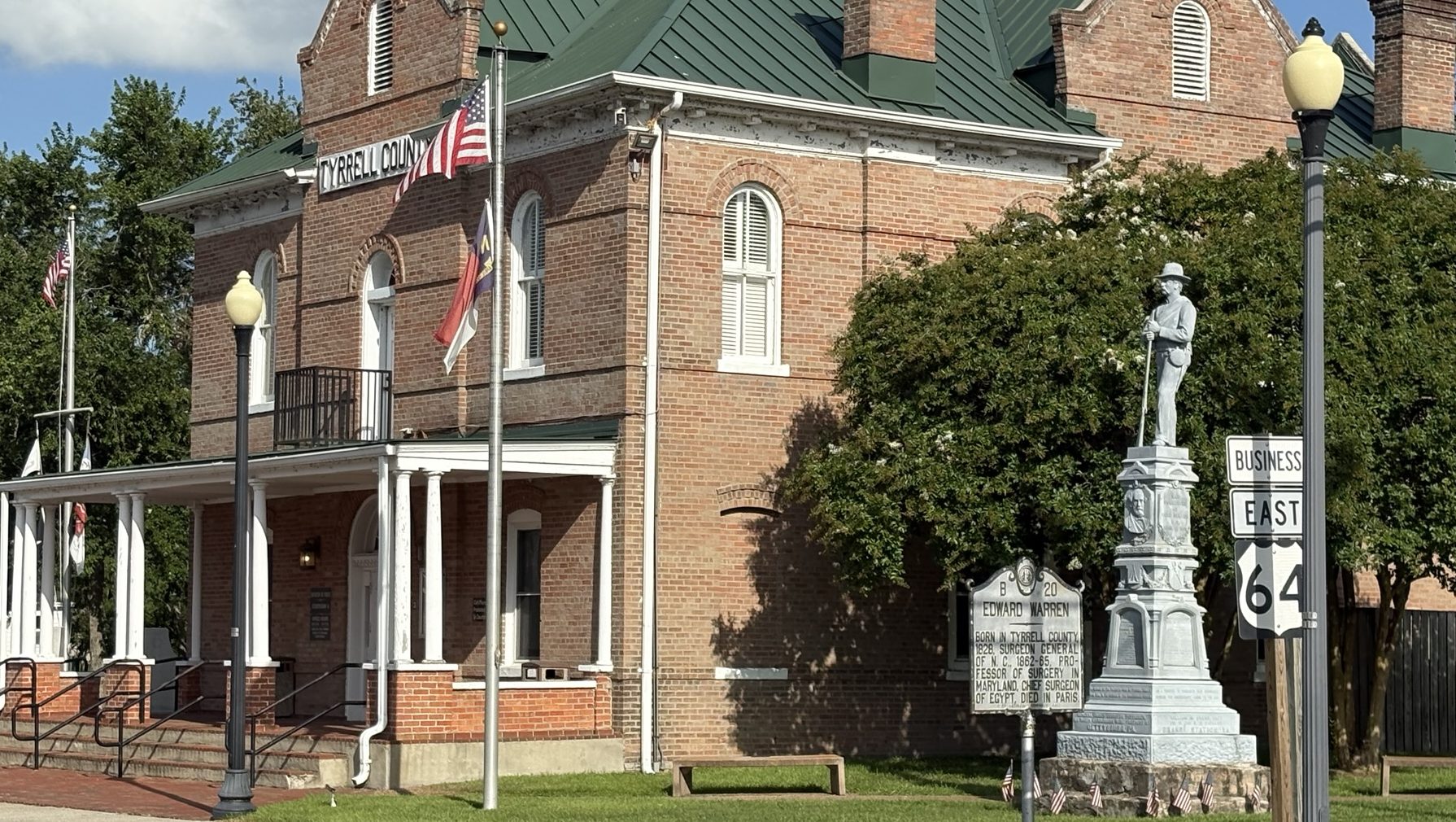
COLUMBIA — Tyrrell County commissioners are asking a federal judge to block efforts by monument critics to question current and former commissioners under oath in a lawsuit challenging a Confederate monument outside the county courthouse.
In a motion filed Monday, Jan. 5, 2026 (See at end of story), in U.S. District Court, the county asked Judge James Dever III to issue a protective order preventing depositions of commissioners in the case, arguing that their decisions regarding the monument are protected by legislative privilege.
“Now, plaintiffs seek to depose Tyrrell County commissioners regarding the monument,” county attorneys wrote in a memorandum supporting the motion. “The commissioners, however, have legislative privilege from testifying about their decisions regarding the monument because these decisions amount to core policymaking. And the commissioners have not waived this privilege.”
Subscribe — it’s free!
The lawsuit was filed in May 2024 by the Concerned Citizens of Tyrrell County, a group described in court filings as mostly “elderly Black residents.” The group challenges a phrase engraved on a Confederate monument erected in 1902 outside the county courthouse that reads, in part, “In Appreciation of our Faithful Slaves.”
The plaintiffs are not seeking the removal of the entire monument, but instead want the county to cover or alter the offending phrase, which they argue violates their constitutional rights.
The case has already survived one major hurdle. In May 2025, Dever allowed the lawsuit to proceed on a federal equal protection claim while dismissing a second claim related to property rights.
With the case now moving into the discovery phase, plaintiffs have sought to depose county commissioners about their handling of the monument. The county’s latest filing aims to stop those depositions before they occur.
“The Tyrrell County commissioners’ decisions regarding the monument are quintessentially legislative,” the county argued. “These decisions affect all county citizens. The decisions reflect ‘broad policy considerations’ following a deliberative process.”
County attorneys contend that legislative privilege shields lawmakers at all levels of government from being forced to testify about their legislative actions.
“Federal, state, and local legislators have absolute immunity from civil liability for their legislative acts,” the filing states, citing the U.S. Supreme Court’s decision in Bogan v. Scott-Harris. “This immunity also functions as an evidentiary and testimonial privilege.”
According to the county, decisions about whether to alter, cover or leave intact the monument involve broad policy judgments, not administrative actions targeting specific individuals.
“An action is legislative when it involves ‘broad policy considerations’ that affect ‘the larger population,’” the memorandum states. “The commissioners’ decisions regarding the monument are patently legislative.”
The county also argues that commissioners have not waived that privilege, even though they have discussed the monument publicly.
“The Tyrrell County commissioners have not testified ‘fully and completely’ regarding their policymaking decisions surrounding the monument,” the filing states. “Their comments at public meetings reflect ordinary legislative business that does not amount to waiver.”
Courts can find waiver only when there is an “explicit and unequivocal renunciation of the protection,” the county argued, adding that meeting with constituents or speaking publicly about an issue does not meet that standard.
Judge Dever’s earlier ruling set the stage for the current dispute.
In an order issued last spring, Dever allowed one portion of the lawsuit to move forward, concluding that the plaintiffs had plausibly alleged an equal protection violation.
“[P]laintiffs plausibly allege that the ‘faithful slaves’ engraving has a racially disproportionate impact on black residents of Tyrrell County,” Dever wrote. “Tyrrell County provides no contrary argument.”
The judge also found that the plaintiffs had plausibly alleged discriminatory intent.
“Plaintiffs also plausibly allege that an invidious discriminatory intent motivated Tyrrell County to install the ‘faithful slaves’ engraving in 1902,” Dever wrote.
At the same time, Dever rejected the county’s argument that a recent North Carolina Court of Appeals ruling involving a Confederate monument in Alamance County barred any relief in the Tyrrell case.
“The North Carolina Court of Appeals held that a county commission had no power to relocate Confederate Civil War monuments under North Carolina’s Monument Protection Law,” Dever wrote. “Here, plaintiffs challenge ‘Tyrrell County’s public, textual expression of appreciation for “Faithful Slaves” and nothing more.’”
He added that the Alamance County ruling “does not bar Tyrrell County from covering or altering the ‘faithful slaves’ engraving, which is plaintiffs’ requested relief.”
While allowing the equal protection claim to proceed, Dever made clear that the plaintiffs still face significant hurdles.
“Whether plaintiffs’ claim will survive summary judgment is a question for another day,” he wrote.
The judge dismissed the plaintiffs’ second claim, which alleged that the monument language impaired their equal right to hold property under federal law.
“[P]laintiffs fail to plausibly allege that Tyrrell County impaired a personally held property interest of Concerned Citizens or its members,” Dever wrote.
He noted that the U.S. Supreme Court has recognized equal-right-to-hold-property claims only when a defendant impairs a plaintiff’s own property interest.
“Plaintiffs fail to plausibly allege that they own a personally held property interest in the courthouse grounds,” Dever wrote.
The plaintiffs argued that the language on the monument caused them emotional harm and stigma.
“Here, plaintiffs contend that they are ‘demoralize[ed]’ and ‘stigmatiz[ed]’ by the ‘faithful slaves’ engraving because it is a ‘physical badge of slavery,’” Dever wrote.
But the judge concluded that those allegations were insufficient to support a property-rights claim.
“Plaintiffs, however, fail to plausibly allege that these harms rise to ‘more than an inconvenience’ or have more than a ‘minimal effect’ on their hypothetical property interests,” he wrote.
Dever also rejected a separate argument by the county that it was entitled to legislative immunity from the lawsuit itself.
“According to Tyrrell County, decisions concerning the ‘faithful slaves’ engraving are subject to ‘local legislative powers’ and deserve vicarious legislative immunity,” Dever wrote. “The Fourth Circuit squarely rejected this argument three decades ago.”
That ruling allowed the equal protection claim to continue against the county as an entity, even as individual commissioners now seek to avoid depositions based on legislative privilege.
In Monday’s filing, county attorneys emphasized that legislative privilege is personal to individual lawmakers and cannot be waived by the county itself.
“Legislative privilege ‘is personal: it belongs to the individual members of a local legislature, not the municipality as a whole,’” the memorandum states.
Because commissioners have not explicitly waived that protection, the county argues, plaintiffs must build their case without probing commissioners’ motives through sworn testimony.
“This privilege promotes the immunity’s purpose, which is to ensure that ‘legislators acting within the realm of legitimate legislative activity should not be required to be a party to a civil action concerning legislative activities, nor should they be required to testify regarding their actions,’” the filing states.
The county asked the court to prohibit depositions of “any past or present Tyrrell County commissioners regarding the monument” and to grant “such other relief as the Court deems just and proper.”
The motion was filed Jan. 5, 2026.
Judge Dever has not yet ruled on the request. If granted, the protective order would limit the scope of discovery and prevent plaintiffs from questioning commissioners directly about their decisions related to the monument.


Let us know what you think by leaving a comment. Comments are subject to approval.