By Nicole Bowman-Layton
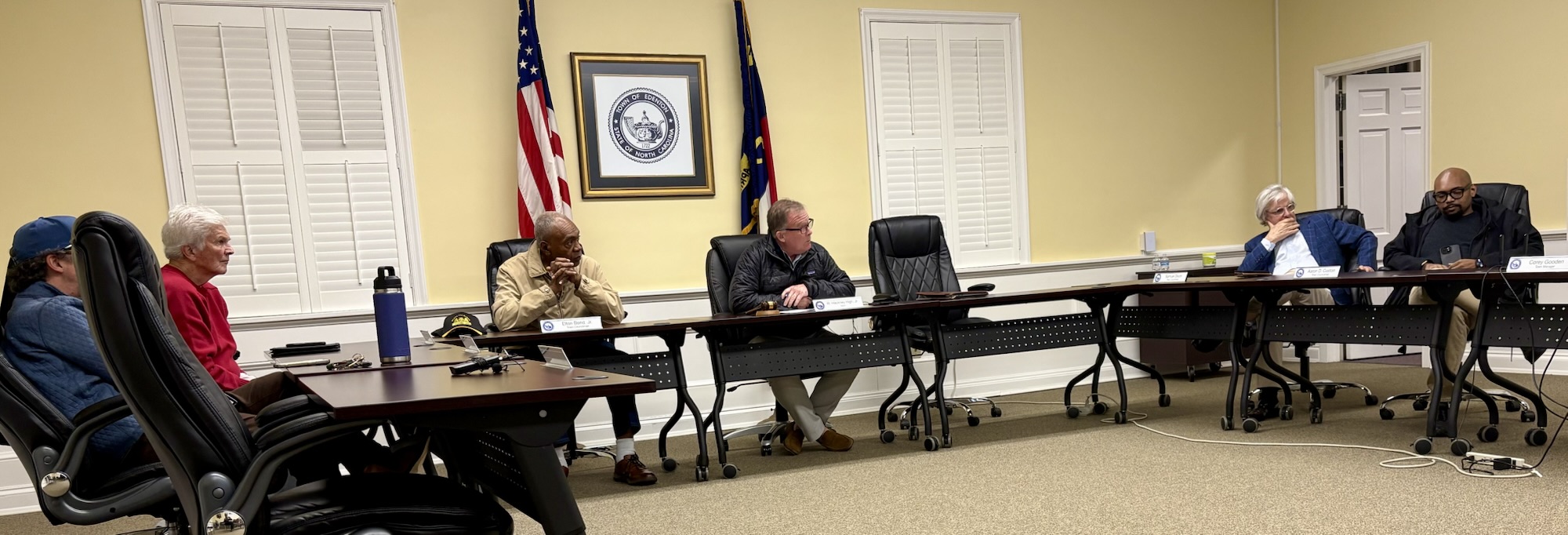
EDENTON – The Edenton Town Council unanimously approved a three-party agreement Monday, Dec. 22, 2025, that will preserve the Elizabeth Wozelka House while relocating North Carolina’s oldest house to West Eden Street in time for the town’s America 250 celebration.
The tripartite agreement among Southern Bank and Trust Company, the Edenton Historic Commission, and the Town of Edenton accomplishes several goals with a 12-month timeline. Council passed the proposal unanimously, with Council Member Bob Turner (1st Ward) being absent.
The council approved the agreement in principle, subject to final legal language review by Town Attorney Hood Ellis, who has been coordinating with the bank’s attorney, A. Travis Ellis of Ellis Law, PLLC. Both attorneys have had several conversations and are in general agreement on the changes, Town Manager Corey Gooden said. All parties must agree to the proposal by Dec. 31, 2025.
For the Wozelka House (103 W. Queen St.):
- The house will remain in its current location permanently
- Southern Bank will transfer ownership to the Edenton Historic Commission for $10 plus other considerations
- All existing covenants, restrictions, and the bank’s special use conditional permit remain in effect
- The Edenton Historic Commission will work toward eventually placing it under private, owner-occupied residential use (the situation is like how Main Street Edenton found a business for the former Sears Building)
- The house cannot be used for short-term or long-term rentals, per Southern Bank’s requirements
For the Lane House:
- North Carolina’s oldest house, dating to 1718-19 and currently located at 304 E. Queen St., will be relocated to West Eden Street
- The specific location on West Eden Street has not been finalized, according to town officials
- The move is planned as part of Edenton’s America 250 celebration
For the Town of Edenton: The town’s obligations are minimal, according to Mayor Hackney High. The town agrees to:
- Keep the parking lot between West Queen Street and West Eden Street open for public ingress and egress, including access for bank employees and customers (already the current practice)
- Provide four designated parking spaces for the bank during business hours
- Add a second commercial dumpster (eight-yard) to the existing one and provide screening (a fence) for both

Why the Wozelka House Must Stay
The preservation of the Wozelka House is not optional — it’s a legal requirement tied to the bank’s conditional use permit granted approximately 15 years ago, said longtime Council member Sambo Dixon (2nd Ward).
“At the time that (town council) allowed that bank to go in there, we said the Wozelka house cannot be torn down because the neighbors didn’t want businesses creeping toward their houses and further eroding the residential nature of Queen Street,” Dixon explained. “We spent weeks in negotiations with Southern Bank … and all of that and came up with this idea.”
Gooden confirmed that removing the house would void the bank’s conditional use permit and require the bank to close.
Council member Craig Miller (at-large) recalled that residents of West Queen Street appeared before the planning board 15 years ago specifically to oppose further business encroachment along the residential street.
“If we decided we were going to tear that house down, the bank would have to too, I mean, it wouldn’t have any zoning,” Dixon said. “(The house) can’t be torn down.”

The Historic Significance
The Wozelka House, designed by noted architect Lord Byron Perry (1870-1948), contains murals by Paul Olson, a local painter who also painted ceilings at Edenton Baptist Church.
“It’s got Paul Olson murals in it. He was a famous painter here,” Dixon said. “The Wozelka family were the bread folks. They had a bakery. And it’s a really important house.”
The house has five bedrooms, two bathrooms, and 2,164 square feet of finished space. It is valued between $345,300 and $402,800 according to real estate websites. Southern Bank purchased it on December 21, 2007, for $375,000.
What Happened to the Workforce Housing Plan?
Council member Aaron Coston (3rd Ward) questioned why a plan to use the Wozelka House for workforce housing for county and town employees was abandoned, noting that affordable housing remains a critical need in Chowan County.
“The plan was for workforce housing for employees,” Coston said. “We had an issue with finding housing or providing housing for employees. So how do we get to the point now to where we have another party involved in that, and that plan has just been completely derailed?”
Gooden explained that relocating the house to a different parcel became “cost-prohibitive.” Additionally, a legal review found that removing the house would violate the conditions of Southern Bank’s conditional-use permit.
“Not only did we hit a financial hard stop, but from a zoning and operating standpoint, it was another hard stop for the bank because that was not a viable option,” Gooden said.
Southern Bank also insisted on restrictions prohibiting any short-term or long-term residential rentals, citing security concerns about having different occupants near the bank.
“There were some additional concerns around security at the bank, and that was a big portion of what made it make more sense in their mind to have a long-term stable occupant there at that property. They can not see different people every 90 to 180 days or 360 days changing over and not knowing who could be there,” Gooden said.
Coston noted that the house had historically been rented to teachers when it was a duplex, which could have addressed another local need.

The Historic Commission’s Role
Robert Leath, Edenton Historic Commission director, described the situation that “no matter how you turned, it never quite found solution” due to competing interests among Southern Bank, the town, and preservation advocates.
“What I think we’re seeing now is we as a nonprofit, 501(c)(3), completely devoted to historic preservation, work with the Town of Edenton in a positive way to achieve its goals and work with Southern Bank in a positive way to help it achieve its goals,” Ruff said.
The commission will take ownership of the Wozelka House and work to restore it for eventual sale to a private owner-occupant, returning it to the town’s tax base while preserving its historic character.
“The vision is for the commission to be able to work with the town and work with Southern Bank to craft the perfect solution that threads the needle and gives the Town of Edenton a restored Elizabeth Wozelka House that is back under private ownership and contributing to the tax base and contributing to historic preservation in a positive way,” Ruff said.
When asked if the goal was to sell the property once restored, Ruff said, “We’re still working on the details. This is the first step of what would be ultimately multiple steps to get to where we would ultimately want to be.”
The Bank’s Lack of Interest in Repairs
Mayor Hack High asked whether the bank had any appetite for improving the house on its own.
“Because it’s just been sitting there, and a house that just sits there continues to deteriorate,” High said.
Gooden said there would be “very minimum interest in doing much beyond what the building’s currently required.”
One attendee noted, “Years ago, they were considering it as a storage facility for the bank, but that just petered out.”
Dixon added with a laugh, “Well, if they’re willing to give it to somebody, they’re not willing to fix it up. I mean, that’s the bottom line.”
Leath acknowledged that the building’s declining condition was a motivating factor: “We know the condition of the building has been in decline for quite some time. And if we can step in and prevent that from moving forward…”

The Lane House: Moving History
The Lane House is a one-and-a-half-story structure whose earliest parts date to Winter 1718-19, as announced on January 11, 2013, by dendrochronologist Michael Worthington of Oxford Tree-Ring Laboratory. Built before the town was even renamed Edenton in 1722, the house originally measured about 16 feet by 25 feet and was divided into two rooms on the first floor and two in the attic.
Historic preservation enthusiasts Steve and Linda Lane acquired the small residence for use as a rental property in 2009. During renovations, restoration carpenter Wayne Griffin and expert cabinetmaker Don Jordan discovered hand-hewn beams, wooden pegs, handmade nails, and oyster shell whitewash — all indications of 18th-century construction.
Archaeological investigations by East Carolina University established that the house does not sit in its original location, with research refining the date of its first relocation to between 1894-1910. The upcoming move to West Eden Street would mark the second time in the house’s 306-year history that it has been relocated.
The Lane House is currently on property owned by the Penelope Barker Foundation, according to Chowan County’s GIS.
In a comment on the preview story, Michael L. Marshall, who co-authored “Edenton’s 1718 House, Mr. Ogilby’s Tavern,” noted that the house was built by joiner Patrick Ogilby as a tavern and was used as a waterfront tavern throughout the 1700s. Its original site was at 205 E. Water St. before being moved around 1804 to its present site on East Queen Street.
Marshall expressed reservations about moving the house from “the oldest part of Edenton–the east side laid out into half-acre lots by Edward Moseley in 1712–to the west side of Edenton, where the lots date from 1722 and later.” He noted the house “has been on its present site on East Queen for more than 220 years since it was moved there and reconfigured internally as a tenant house.”
After the meeting, Gooden said the move would make the house more accessible to visitors and residents and potentially pave the way for it to serve as a museum or for other uses.

Let us know what you think by leaving a comment. Comments are subject to approval.