By Miles Layton
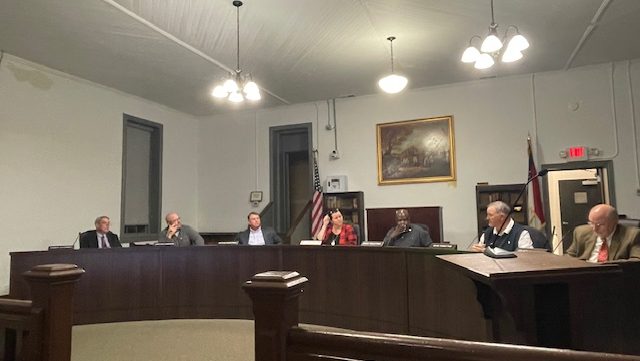
GATESVILLE — Faced with growing concern about the potential impacts of large-scale data centers, Gates County commissioners unanimously approved a one-year temporary moratorium Wednesday night following an emotional public hearing and an extended board discussion during a special-called meeting at the historic Gates County Courthouse.
Northeast NC — this issue is headed our way, so folks — you may want to give this a solid read. Data centers… well… maybe not what we want.
The moratorium halts development approvals for data centers and similar high-capacity facilities, giving county leaders time to research potential environmental, infrastructure and economic impacts and to consider whether future ordinances are needed to protect Gates County’s rural character and natural resources.
County officials emphasized that no data center proposal is currently before the county. However, growing regional interest and recent inquiries prompted commissioners to act quickly.
The issue first surfaced publicly during the Board of Commissioners’ Nov. 19 regular meeting, when Donna Phillips of NC East Alliance delivered a presentation on economic development topics that included data centers.
According to County Manager Scott Sauer, Gates County later received two inquiries — on Aug. 25 and Nov. 21 — from PACE, a firm that prepares ordinances and land-use regulations designed to promote data center development.
Sauer said the Gates County Planning Board met Dec. 2 to discuss the potential advantages and drawbacks associated with data centers and similar high-capacity uses. Commissioners then scheduled Wednesday’s special meeting to solicit public input and determine whether to adopt a temporary moratorium.
Before opening the public hearing, Vice Chairman Nathan Berryman outlined the purpose of the meeting and the proposed ordinance.
“Tonight is really just about passing a moratorium so that it allows the county to sit down, go through the process that we need to go through, and allows our zoning board to bring forth something that can protect the county in case something like this were to ever come up,” he said.
He stressed that the move was proactive rather than reactionary.
“There’s not been anyone to come to the county and say, ‘Hey, we want to build this and we want to build over here.’ Nothing like that has come up,” he said. “At the end of the day, we’re here to do the bidding of the citizens of Gates County.”
Public voices concerns
After a unanimous vote to open the public hearing, residents stepped forward one by one to voice strong opposition to data centers. Many speakers urged commissioners to go further than a temporary pause and enact a permanent ban.
Leanna Wingate of Hobbsville said her primary concern was the financial burden such a facility could place on local residents.
“My main concerns are for the people of Gates County if this were to happen, because as you know, Gates County, we’re not well-off people,” Windgood said. “People like myself, we’re struggling with the power bill and the water bill.”
She said a data center could drive residents out of the county and threaten wildlife by straining water resources.
“They couldn’t drink from the water,” she said. “It would probably cause them to run crossroads more often, causing more accidents because they have to seek out new sources of water.”
Wingate also raised concerns about noise, describing it as disruptive and constant. She compared the sound to “a constant conversation that never ends” or “a constant sound of a lawnmower resonating in your front yard.”
Marsha Parker followed, questioning how much residents truly understand about data centers and the moratorium itself.
“Half the people don’t know what it is,” Parker said. “The devil is in the details.”
She warned that data centers are closely tied to emerging technologies, including artificial intelligence and biometric data collection.
“It’s going to affect everybody down to your babies,” Parker said.
Diane Ring, whose family has lived in Gates County for more than 200 years, said she supported the moratorium but questioned whether one year would provide enough time to gather accurate information.
“There’s no information out there available to us as county constituents,” Ring said. “There’s nothing out there but rumor.”
Ring described data centers as “ecologically terrible,” citing electricity demand and potential water pollution.
“I have visions of the Chowan River being as dead as parts of the Chesapeake Bay are right now,” she said.
Leslie Small Spinoglio serves on the county’s Economic Development Board and works professionally as a website developer and digital strategist. Drawing on both experiences, she said she was firmly opposed to data center development in Gates County.
“I’m strongly opposed to this data center development,” Spinoglio said.
“This is not for us,” she said. “Data centers are not job creators. They are low-labor, high-impact operations that offer short-term tax benefits while offloading long-term costs onto our community.”
She added that companies seek out rural areas for specific reasons.
“They are here to exploit our cheap land, our power sources, and our tax loopholes,” Manolio said.
Jessi Williams shared her family’s history of returning to Gates County and urged commissioners to extend the moratorium beyond one year or make it permanent.
“I want you to take two years,” Williams said. “Actually, I want it to be banned altogether.”
Williams cited concerns about Merchants Millpond State Park and said residents would oppose any attempt to bring a data center to the county.
“We will fight this tooth and nail,” she said.
Two written comments were also read into the record. One, submitted by Deja Gainey, urged commissioners to adopt a permanent moratorium, warning that a data center would be “disastrous for the county, both economically and environmentally.” Another letter cautioned that once land, water and wildlife are damaged, “there’s no undo button.”
Commissioners speak out
After all speakers had been heard, commissioners unanimously voted to close the public hearing and moved into board discussion.
Chair Emily Truman, speaking through a strained voice, addressed residents who had filled the courtroom.
“We hear you,” Truman said. “There has been a lot of misinformation. This is something that has literally come across our radar in the past two to three weeks, and as soon as it did, this meeting was scheduled.”
She emphasized that the moratorium is intended as a protective measure, not a signal of future approval — that Gates County is protected but not detrimental to the kind growth needed with small businesses and other things that can be in the county.
“There’s a fine to walk when you’re going into conversations about banning businesses from coming,” she said, voice straining. “The point of the year moratorium is not to say, ‘Oh, we’re going to get things in place so we can invite these things in. It’s about how we can best format the information we gather to protect Gates County.”
Commissioner Brian Rountree stated bluntly that he does not support data centers and outlined numerous concerns, including energy consumption, water usage, noise, air pollution, electronic waste and declining property values.
“I’m not for a data center,” he said.
“Gates County is known for its natural and beautiful scenic environment,” he added. “We don’t need this type of industry coming in.”
How about this — Rountree said, “Environmental injustice – these plants coe in low-income areas – rural areas. We don’t want to be taken advantage of just because of our status by a big corporation.”
Last, Rountree touched on sustainability.
“Higher emissions and water stress affect the environment of the communities where data centers are located. Like I said before – we don’t even have the land or the industrial park for this.”
Rountree adding, that if the county does zone such a venture for a private property rather than county property, the property owner would benefit, not Gates County’s citizens — when his speech ended with applause.
Commissioner Dave Forsythe echoed those concerns, describing the moratorium as an essential first step.
“These guys can come into town and spend more money in a daily budget than our county budget annually,” Forsythe said. “They can buy attorneys. They can force what they want to. We’re actually being responsible by putting in place this moratorium immediately so they don’t run in and say, ‘Oh, we’ve already applied (for permits) right now; you can’t put regulations in after we’ve already applied.’ This is a good first step on behalf of the citizens to put the moratorium in place.”
Focusing on data centers, the speaker warned that developers often present examples that do not reflect what is typically built in the United States. “They’ll point out that, ‘Oh, we’re now building wa- uh, data centers that are low water usage. Look at the ones we’re building in India, and et cetera, et cetera,’” the speaker said. “Well, they aren’t building those low energy ones here in the United States, the UK, and where they’re really building a lot of these, they’re building the ones that use a lot of water.”
The speaker said companies also attempt to ease concerns by commissioning technical studies. “The issues of water, they’ll make arguments about, ‘Oh, we can produce our own groundwater wells, well away from your wells. We can prove that’s not gonna impact your, your water consumption overall,’” he said. “They’ll bring in a ton of engineers, guys like me or a lot smarter than me, they’ll all come and make all these arguments about why that should be allowed.”
Beyond utilities, Forsythe said the financial imbalance between corporations and rural counties was troubling. “So to me, it’s about the money these guys will bring in here to fight us, overwhelm us, and once they’re here, they’re like a tick,” he said.
Noise was also cited as a public health issue. “The part about the sound, Miss Wingate, when she was speaking pointed out 95 decibels, you know, I did my time working on aircraft, and anything over 80 requires hearing protection,” he said. “And if these guys are routinely running 95, I mean, you could have your hearing damaged.”
While acknowledging the desire for economic growth, Forsythe questioned whether promised jobs justify the cost. “If we end up having to spend millions of dollars in, you know, infrastructure and other support… and we have to have increased taxes to cover it, so 100 people can have some high paying jobs, I’m not so sure that’s worthwhile in the big picture,” he said.
Declaring his political views, Forsythe added, “I’m definitely not a socialist… I’ve said that before, I’m a Republican, and I like business, I like to see some growth and better potential for folks here, but this ain’t the way to do it to have a big multi-conglomerate company sink its claws into us.”
Forsythe concluded by voicing support for the pause under consideration. “So I think the moratorium is good,” he said, calling it “a good step to make right now to say, ‘Let us get our feet under us and be prepared before the guys with deep pockets come in to run us into the ground.’”
Commissioner Jonathan Craddock framed the issue as one of preserving the county’s identity.
“That’s why we all live here — because we love our county,” he said. “This would not be a benefit to us.”
Berryman said the urgency of the special meeting stemmed from the county’s current lack of regulations specific to data centers.
“If we don’t do something now and pass a moratorium, then they have every legal right to come in here, buy land from somebody and build what they want to,” he said. “The first step is a moratorium.”
County Attorney Philip Godwin confirmed that the ordinance would temporarily prevent data center development and that commissioners retain the option to extend the moratorium if additional time is needed.
“I think we are doing the right thing to protect the integrity of our county which we all love,” he said.
Following discussion, commissioners unanimously voted to adopt the ordinance imposing the one-year temporary moratorium on development approvals for data centers and related high-capacity facilities.
County officials said updates on the moratorium and related research will be shared publicly as the process continues. If more time is needed, commissioners may consider extending the moratorium while further evaluating potential impacts on Gates County.
After approving the moratorium, the board addressed additional agenda items. Commissioners approved a letter requesting a state audit of the Gates County Board of Education’s finances — more on that later.
