By Miles Layton
CHOWAN COUNTY — Macedonia Baptist Church in Chowan County celebrated the 175th anniversary of its founding on Sunday, marking a milestone that reflected nearly two centuries of faith, fellowship and community life.
Sunday, I was in for a treat – faith-inspiring sermons, local history and a sense of fellowship. A gallery of photos appears at the end of this story.
Please share this story near and far — maybe it’ll inspire folks to fill the pews and embrace the Lord. If a newspaper can cover a football game, we can certainly cover a Sunday sermon, especially one that’s as important as a 175th birthday — congratulations!
Here are a few notes before folks get into reading this long story – choir was excellent, very impressive, as was Joy Chappell’s solo, “If that isn’t love.”
Reverend Steve Hill’s opening remarks of welcome made me smile. There was a part where he mentioned that someone back in the 1860s was distilling corn whiskey — was that OK? I laughed when a little girl answered, “yes.” That was cute.
Joannie Evans’ history of the church was as informative as Elmer Overton’s remarks, recalling recent anecdotes and history. Apparently, if the sermon ran too long, Overton’s grandfather would walk out of the church. That anecdote was funny, maybe inspiring me to sit in the back pew if the spirit so moves me during a future filibuster sermon.
Reverend Bob Young’s sermon was amazing. Many memorable lines, but this stuck with me – “How can a good God let such evil go on in the world? This is what I’ve started saying. I say, ‘What makes you think he’s going to much longer?’ That’s right. There’s a day coming, and the Apostle Paul could see that day.” Yep!
Young’s sermon touched the nostalgia for the past, but preached promise for the future — and he was a great speaker. Maybe it was me, but I almost felt as if God was speaking directly through this country preacher. And I love “old school” religion – God loves you, and there is a heaven and certainly a hell.
While sitting in what I’ll call the “Layton pew” I saw many familiar faces – noted farmer/agribusinness man John and Liza Layton; the McArthur family; Board of Education member Ricky Browder, who greeted me with an umbrella as I was walking to church; Town Manager Corey Gooden and his family, local educators, John A Holmes High School students – so many familiar faces. I’m a very shy person, so I appreciated the warm welcome during the part of the worship service when people shook hands and wished each other peace.
I could feel the church’s strong sense of history, which traces its beginnings to Dec. 14, 1850, when 29 people who had been meeting in a schoolhouse associated with a Methodist congregation just across the road from the present church formally organized Macedonia Baptist Church. A covenant was written and signed by three ordained ministers, and the original members dedicated themselves to establishing a permanent place of worship. Wes Leary, one of those ministers, became the church’s first pastor.
Macedonia Baptist endured major historical disruptions, including the Civil War and the Great Depression.
Personal memories shared during the anniversary celebration illustrated how deeply the church was woven into the lives of its members. Overton recalled childhood experiences worshiping alongside his grandfather, changes to the sanctuary’s layout, and his own baptism in a nearby river in 1967 before an indoor baptistry existed. Janet Respess reflected on the significance of the large oak tree that once stood on the church grounds, recalling homecomings, Vacation Bible School cookouts and fellowship held beneath its branches.
The anniversary highlighted the leadership of the 28 pastors who had served Macedonia Baptist since 1850, including Leary, Jordan, William Thomas Carlyle Briggs, Virgil Wilson, Charles Ledford, Robert Young and current pastor Steve Hill. Their collective ministry reflected a long-standing commitment to preaching, teaching and shepherding the congregation.
The celebration honored the founders who established Macedonia Baptist Church, the generations who sustained it, and the members who continued its mission. As the church marked its 175th anniversary, the focus remained on gratitude for God’s faithfulness, the bonds formed within the church family, and the hope that the same spirit of devotion and service would guide Macedonia Baptist Church into the future.
Subscribe — it’s free!
‘God has, despite our imperfections, sustained us by His grace, kept us by His power, and allowed us to be here to celebrate and love Him and love one another today’ — Pastor Hill
Pastor Hill used humor, historical detail and reflection to frame his remarks during the church’s 175th anniversary celebration, drawing from church records to illustrate both the imperfections of its members and the enduring faithfulness of God.

Hill noted that church minutes from the mid-1800s reveal how seriously early members addressed conflict and conduct within the congregation. He recounted that “there was also a committee formed to settle a dislike between a member of this church and a member of Ballard’s Bridge Baptist Church.”
According to Hill, those efforts sometimes ended in reconciliation and other times in discipline. “Praise the Lord, in January of 1852, the dislike was settled, and the brothers restored,” he said. However, that same month marked a first in the church’s history. “But the offending brother, for the first time ever, in January of 1852, was excommunicated from the church.”
Hill continued tracing the pattern of church discipline recorded in the minutes. “July of 1852, committee formed to see an offending sister and a brother who broke the Sabbath,” he said. “The sister was expelled from the church, the brother forgiven and restored.” As the years went on, Hill said, “you see a pattern,” with committees regularly formed to meet with members over various concerns.
“Brothers and sisters who are referred to as offenders, committees being formed to see them for everything from nonattendance, to not paying their dues, disorderly conduct,” Hill said. “And depending on how they responded to that, they would either be expelled or restored to fellowship.”
Some of the entries Hill shared drew laughter from the congregation. “Then May of 1864, an interesting question was brought, brought before the church,” he said. “Is it okay to distill corn into whiskey?” The following month, Hill noted, discipline followed. “In June of 1864, that brother was expelled for making whiskey.”
Hill cited additional examples from later decades, including April of 1891, when “a committee to see a brother for drunkenness and profane language” was formed, followed by his expulsion two months later. In February of 1893, Hill said, “a committee was formed to see Sister So-and-So, it is rumored that she has dancing at her house.” Church records showed that “the dancing did occur,” he said, and while it was “never mentioned again,” several members left the church in the months that followed.
“Over the next 40 years, committees continued to be formed for offending brothers and sisters for nonattendance, not paying dues, dislikes between members, drunkenness, making liquor, foul and profane language, disorderly conduct, immorality,” Hill said.
One entry from 1906 stood out for its unusual wording. “Two brothers were brought before the church to acknowledge that they had been drinking too much slimy drink,” Hill said. After a question from the congregation, he explained, “If you Google that, it was some sort of a cough syrup mixture back then.” He added, “Apparently, they had more coughs than they ought to.”
Hill also highlighted records from 1930, when “brothers brought before the church for card playing,” and from August 1931, when “the church paid $21.71 for a brand new toilet.” He explained that it was “not what we would think of,” but likely “an outhouse with a chamber pot.”
That purchase later led to another disciplinary action. “In August of 1932, a sister had to be visited by the trustees and asked that if she would please replace or bear the cost of replacing the toilet which she had burned and destroyed,” Hill said. “Two meetings later, that sister was expelled.”
Hill closed by explaining why he chose to share those moments from the church’s past. “Because we’re here today, yes, 175 years,” he said. “And it is clear and evident from the church’s history that this has always been and always will be a church filled with imperfect people.”
Those imperfections, he emphasized, have never defined the church. “Imperfect people, though, who desire to honor the Lord and live for Him,” Hill said. “And so, if we’re going to celebrate anything today, let us celebrate the faithfulness of a holy and perfect God.”
Hill concluded that God’s grace has sustained the congregation through every era. God, he said, “has, despite our imperfections, sustained us by His grace, kept us by His power, and allowed us to be here to celebrate and love Him and love one another today.”
‘Jesus was worth everything’
Reverend Bob Young returned to the pulpit with a message that wove scripture, memory, humor and deep theological reflection as he preached from Philippians 3, urging listeners to understand the past, face the future and live fully in the present through the lens of the gospel.
“It is a joy to be here with you,” Young began. “I’m going to be in the book of Philippians in our time together today.” He added with a smile that he was “just picking at you about time,” noting, “Although I admit I’m getting older by the minute, and, um, and it means, time means less and less.”

Turning to the apostle Paul’s letter, Young framed the sermon around Philippians chapter three, reading at length from verse two through verse 14. He described the passage as Paul’s reflection on both the past and the future, “but the past and the future in the light of gospel.”
Quoting Paul’s warning to the church — “Beware of the dogs, beware of the evil workers, beware of the false circumcision” — Young emphasized Paul’s contrast between confidence in human credentials and confidence in Christ. Paul’s impressive religious background, Young said, ultimately counted for nothing compared to knowing Jesus. He read Paul’s words: “Whatever things were gain to me, those things I have counted as loss for the sake of Christ,” and, “I count all things to be lost in view of the surpassing value of knowing Christ Jesus our Lord.”
After reading the passage in full, Young led the congregation in prayer, thanking God for the day, for the ability to gather, and for the generations who had worshiped in the same place before them — “the faithful ones who were here before us and labored long… who shed tears in this place and laughed in this place, who got married in this place, who said goodbye to loved ones in this place.”
He gave thanks for scripture, for pastors and teachers who had proclaimed Christ, and for “the salvation that comes by grace alone through faith alone in Christ Lord.”
Once he began preaching, Young recalled a conversation with Pastor Steve that freed him to preach whatever text was on his heart. “Once the pastor set me free,” he laughed, joking that if the sermon ran long, responsibility rested elsewhere.
Reflecting on the church’s long history, Young said history itself can be both a gift and a danger. “There, there is, in history, both a delight and a danger,” he said. The delight, he noted, is the joy of being part of a long story of faith — “You’re part of this stream that’s been flowing all of these years.”
But history can also trap people in nostalgia. Young illustrated this with lyrics from Neil Young’s song Helpless, recalling the haunting line: “The chains are all locked and tied across the door.” Nostalgia, he warned, can make people believe they can return to a past that no longer exists. “Be careful. Nostalgia will cheat you,” he said.
Sharing a personal memory of a sweltering summer Sunday before air conditioning, Young joked, “I walked straight to this place, and I said, ‘Welcome to the 1950s.’” The past, he said, is not always as comfortable as memory suggests. “Sometimes the chains are locked and tied across the door.”
While Christians must never abandon the past — because salvation is rooted there — Young emphasized that believers are not oriented toward the past. “Christians are not a people oriented toward the past,” he said. “Because He who came and died upon the cross has said that one day He will come again.”
Young then returned to Paul’s testimony, explaining that Paul’s history did not disappear, but his understanding of it changed. “The gospel helped Paul understand the past,” Young said. Paul’s heritage, zeal and law-keeping were not evil, but they could not save him. “His history hadn’t changed, but the gospel had given him new eyes as he looked on that history.”
Paul realized that what he once trusted for righteousness could not bring him into right standing with God. “He thought that because of his history and his heritage… that he had a right standing with God,” Young said, “but now he would write Romans 1, 2, and 3 where he came to the conclusion that all have sinned.”
Young applied that truth personally. “Including Paul the Apostle,” he said, and then added, “Including Bob Young.” He reminded the congregation that faithfulness is lived one day at a time. “If I do [stay], it’ll happen the same way the first 20 years happened, one day at a time.”
Paul’s encounter with Christ reshaped how he read the Old Testament, Young said. Scriptures that once seemed obscure now pointed clearly to Jesus — from Genesis to the Psalms to Isaiah 53. “Now, he understood that,” Young said. “Oh, dear friend, your history will not get you to heaven. You need to know Him.”
The second major theme of the sermon focused on the future. “The gospel gave Paul all he needed to know about the future,” Young said. While people naturally want to know what tomorrow holds, God has already told believers what they truly need to know. “He has told us who’s got tomorrow, if tomorrow comes.”
With humor, Young reflected on aging, saying he now appreciates every day. Paul, he said, lived with his eyes fixed on what was ahead — the fullness of God’s promises in Christ. “There is a resurrection of the body out there waiting on us,” Young declared. “Sin is done with… The wickedness of this world is over.”
Young acknowledged the brokenness of the present age, asking, “Have you ever seen our nation as angry as it is now?” Yet Paul’s confidence rested in the certainty that God’s promises would be fulfilled. “Paul had found that there’s another day coming,” he said.
That hope shaped how Paul endured suffering. Young listed Paul’s hardships — beatings, imprisonment, hunger, shipwrecks — reminding listeners that the man who wrote about counting everything as loss for Christ had lived those words. Despite it all, Paul could say, “Bring it on… because I know the Savior who died, and I know where I am bound by his grave.”
Young insisted that this gospel perspective anchored Paul in the present. “The gospel anchored Paul in the moment in which he was living,” he said. Knowing the truth about the past and the future freed Paul to live faithfully now.
Young challenged the congregation not to live looking backward. “I have no desire to back up,” he said. Honoring the past, he argued, does not mean trying to relive it. Recalling a sermon topic given to him years earlier, Young repeated the question: “How can we honor the past while being faithful in the present?”
His answer was direct. “You want to honor the people who made history? Make some history.” Faithfulness today, he said, is the truest tribute to those who came before.
As the sermon moved toward its conclusion, Young emphasized that Paul had found “the pearl of great price” in Christ. “Jesus was worth everything,” he said. Without Christ, everything else fades. “If you have everything else and you don’t have him, you really have nothing.”
Drawing from Psalm 73, Young reflected on the phrase “Nevertheless,” reworking it as “Never less than this.” He repeated the refrain: “God is my portion forever. Never less than this.”
Young closed with a clear call to the cross. “You make a beeline for the cross of Jesus Christ,” he said. “And if you ever see that, you will never suggest to God again that the death of His Son is not enough.”
His claim, he said, was simple. “I have one claim of Heaven. Jesus Christ died on the cross, shed His blood for me. He said, ‘Come to me.’ I came to Him.”
As the service prepared to conclude with “Amazing Grace,” Young quoted John Newton’s reflection: “I’m not what I ought to be… but by the grace of God, I am what I am.”
He ended in prayer, thanking God for the opportunity to proclaim the gospel and praying that Christ would continue to be faithfully preached “until He returns.”
The congregation responded together, “Amen.”
175 Years of Faith History
Macedonia Baptist Church marked a milestone in its long spiritual journey as members and guests gathered to celebrate 175 years of ministry, fellowship and faith. Joanie Evans shared a carefully researched history of the church, compiled by Evans along with Gail Forehand, Phil Huey and Janet Respess, offering the congregation “just a glimpse of the past.”
“Welcome to the 175th anniversary of Macedonia Baptist Church. We are so glad you’re here today,” Evans began. She explained that the service included a special musical selection written by W.T.C. Bridges in 1925, discovered in church files. “We found it in our files and decided that that would be appropriate for today. And wasn’t it beautiful?”

Evans traced the church’s origins to Dec. 14, 1850. “Exactly 175 years ago on this very day, in this area of Chowan County, 29 people who had been meeting in a schoolhouse associated with the Methodist Church located just across the road from where we are today, came together and decided to establish a church,” she said.
“A covenant was written on that date and signed by three ordained ministers,” Evans said. “These 29 souls dedicated themselves to the Lord and His work here at Macedonia Baptist Church.” One of those ministers, Wes Leary, became the church’s first pastor.
Soon after its founding, the congregation sought land of its own. “They purchased six acres of land right here from one of their own charter members for $20,” Evans said. Fundraising began immediately, though construction took time. “The building was not constructed, we believe, until about 1857, because they were trying to collect the money for the funding.”
That first church building was modest. “It’s described as being a one-room wooden building, unpainted and crude in appearance, most likely rectangular in form,” Evans said. “The total cost was about $200.”
Evans highlighted early members, including Joseph Copeland and Rachel Jordan, who were married in 1854. “It’s not known for sure that they knew each other before they came here, but, uh, if not, maybe this church helped them to find each other,” she said.
The first pastor, Wes Leary, balanced ministry with farming. “He was hired to preach on one Sunday a month for $25 a year,” Evans said, noting that “sometimes not enough money was available so substitutes had to be made, such as pork or bread.” Leary often served multiple churches while raising a large family.
Macedonia Baptist was Baptist “from the very beginning,” Evans said, citing associational records from 1851. Membership steadily grew, along with accountability for conduct. “These church members were held accountable for their conduct and actions,” she said.
Leary served 31 years until his death in 1881. By then, “the church had grown to 81 members, and his salary had increased to $50 a year.” Under the second pastor, William P. Jordan, the original building was expanded. Continued growth led to the construction of a new sanctuary beginning in 1896 and completed in 1897 at a cost of $1,100.
“This second church is the core of our building today,” Evans said. The design reflected customs of the time, with “two entrances, one for the women and one for the men, who did not sit together during the worship service.” She noted that separation persisted well into the 20th century, with a 1946 record mentioning “the purchase of a heater for the women’s aisle.”
Evans also pointed out architectural symbolism. “Also of note is the triangle in the front gable,” she said. “It is an equilateral triangle where all sides are equal, representing the Father, the Son, and the Holy Spirit.”
Sunday school was a constant presence. “Sunday school was held every Sunday from the early beginnings of the church,” Evans said. Worship services increased from one per month to two in 1918.
The church endured national hardships. The Civil War began when the church was only 10 years old, and the Great Depression brought severe financial strain. “Salaries had to be cut,” Evans said, but even then, “this church still gave 20% to missions.”
Expansion continued in the mid-20th century. In 1947, “eight Sunday school rooms were added,” entrances were consolidated, and stained-glass windows installed. The 100th anniversary was celebrated in 1950. Later additions included a second floor in 1969, a baptistry, a steeple added by the Cherry family, and major expansions of educational and fellowship space in 1998. “The sanctuary was carefully renovated in 2008,” Evans said.
The anniversary also honored pastoral leadership. “During this anniversary year, a special focus has been placed on our 28 ministers who have served here since 1850,” Evans said. “They were dedicated men of God who were faithful to their calling and devoted to God’s work.”
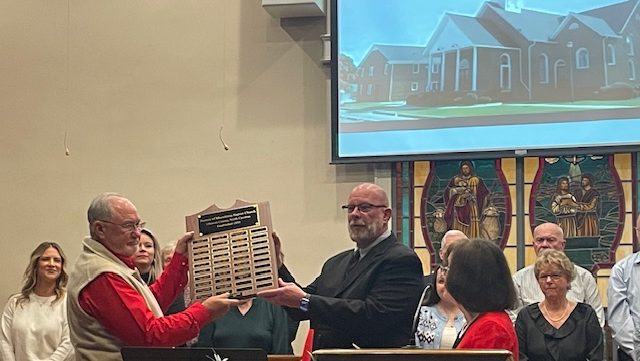
Evans read the names of all 28 ministers, concluding with the current pastor, Stephen Brian Hill. “We are going to honor these faithful servants today with a plaque that contains their names and years of service to God and to His ministry,” she said.
As the congregation reflected on 175 years, the history underscored a legacy of perseverance, growth and devotion that continues to shape Macedonia Baptist Church today.
‘So many wonderful memories that I have of coming to church here’
Memories spanning generations filled Macedonia Baptist Church as Elmer Overton, Janet Respess and other longtime members shared reflections during the church’s 175th anniversary celebration, offering personal stories that brought the building’s history and ministry to life.

Overton opened his remarks by inviting the congregation to remember physical changes to the church over the decades. “How many people remember those steps that you saw with the two big black pipes, when you finally could come in the front?” he asked. “How many of y’all remember that, actually remember that? Yeah. Okay, a lot of people remember that. A lot of old folks in here.”
“I remember it. I remember it very well,” Overton said, recalling when there was no vestibule. “How many of you remember when you just came in the front door and we didn’t have a vestibule? We didn’t have this nice place out here. Who remembers that?” He also remembered classrooms furnished with old seating. “Who remembers when on the wings over here they ran some classes, we had the old theater seats, the flip up wooden seats?”
Overton shared childhood memories tied closely to family. “I used to sit over there beside my granddad for two reasons,” he said. “I love my granddad, but he always had a life saver.” He recalled his grandfather’s impatience with long sermons. “Granddaddy was kind of notorious for if the preach preached too long, he’d just leave,” Overton said. “He said, ‘Come on, boy, let’s go.’”
That decision led to a memorable family conversation. “Mom, she was upset, ‘Why did you leave?’” Overton recalled. His grandfather replied, “‘If you don’t want your boy to leave, then when I leave he needs to know to go sit with you. And as far as when I leave, that ain’t no affair of yours.’” Overton said the conversation “was over with real quick.”
Overton said he never personally witnessed the era when men and women sat on opposite sides of the sanctuary, but he saw its remnants. “I did see the remnant of that with the guys my grandfather’s age would sit over there,” he said. “Their wives would sit right here in front of them.” He remembered Jimmy Apes describing his first visit. “They said, ‘We didn’t know what we done wrong, we just sat down.’”
Architectural changes also stood out. “How many people can remember when also on the sides of the church you had to step down to get into the sanctuary?” Overton asked. He remembered the educational building as well. “I was just a baby, I reckon, when that was built,” he said, before recalling the later addition of a second story when he was “like 12 or 13.”
Church meals and fellowship were simpler in earlier years. “We always had building feedings on the grounds,” Overton said. “We didn’t have that beautiful fellowship hall that we have now, but we made do.” He added, “God has provided that space no matter what kind of weather we have like today.”
One of Overton’s most meaningful memories centered on his faith. “When I accepted Christ, I got up from that back seat and Virgil Wilson was preaching,” he said. “I don’t ever remember getting up here. It’s almost like I glided.” He was “not quite 11” at the time and remembered Wilson’s presence vividly. “As a kid, I had just a great respect for him as a person.”
Overton also shared lighter moments from his youth. “My brother got a little older,” he said, drawing laughter. His brother once remarked, “‘Did you know that those old women that sit over there can look around 360 degrees just like I can?’” Overton said the comment taught him an early lesson about being watched in church.
He recalled outdoor features long gone. “Do y’all remember the spigot and the trough that used to be out this door when you go out?” he asked, along with restrooms that required going outside. “It’s just so many wonderful memories that I have of coming to church here,” Overton said. “And all the people.”
Overton shared details of his baptism. “I was baptized August the 27th, 1967, and I was the only guy. There were six girls,” he said, adding that they were baptized in a river. Holding up a Bible, he said, “This is the Bible they gave me when I was baptized.” He closed by expressing gratitude. “I could talk about church all day and the people, and I love y’all,” he said. “I’m just thankful, and it’s a wonderful occasion.”
Janet Respess highlighted what many considered a defining feature of the grounds. “Especially those of us that are my age and younger, we remember what is probably our church’s trademark, and that’s the big oak tree,” she said. “Under that oak tree, there has been many a talk, many a VBS cookout, many a homecoming.”
Respess paused to recognize the work behind the anniversary celebration. Addressing Joanie Evans, she said, “She has worked so hard for over a year, and she has gone beyond the call of duty for this.”
Respess then read letters sent for the occasion, including one from Tom Leary. “I have fond memories attending the church. God bless, Tom Leary,” she read. Another letter came from former pastor Charles Ledford. “Congratulations for 175 years of ministry to the community,” Respess read. “A number of generations of members have passed through your doors.”
She shared Ledford’s words of affection. “Audrey and I have fondest memories of the seven years of ministry with you,” she read. “You were so good to us.” Respess added her own recollection. “He was just great and fun-loving.”
Respess concluded with a humorous memory. “Pastor Ledford had a yellow Volkswagen,” she said. “We painted that Volkswagen every color you could possibly think of.” She ended by thanking the congregation. “Thank you all for coming. And I hope we celebrate another 175 years.”
Additional reflections came from longtime members, including one who said, “Music is a blessing and a great source of witness. I’m 100 years old now, and I have enjoyed serving the Lord here at Macedonia.” She recalled organizing Bible school and strengthening the WMU, saying, “It was a joy to serve the Lord.”
Another memory centered on a powerful sermon. “I remember one Sunday morning, Verdal Wilson was the pastor,” she said. “After he had preached, it was like a revival. We all felt more dedicated to the Lord.”
Together, the remarks wove a tapestry of shared history, faith and fellowship, underscoring how Macedonia Baptist Church’s story is inseparable from the lives of those who have worshiped within its walls.
Photos come from me or Macedonia Baptist Church


5 responses to “Macedonia Baptist Church: A 175-Year Legacy of Community and Faith”
Thank you for the coverage of our church’s celebration! I thoroughly enjoy reading your articles. You have such a wonderful gift for writing. Come join us again !!
Charlotte,
Thx — great Sunday worship service!
— Miles
Miles – thank you for this beautiful and thorough recap of our 175th anniversary service today. You captured the essence of the message of Christ. May we all embrace Him!
Thx!
Wonderful church!
— Miles
[…] Editor’s NOTE: Let’s start the day off with some good news — a letter from Mike McArthur, a faithful soul who attends Macedonia Baptist Church. To read our story about that church’s 175th anniversary, click this link. […]