BY MILES LAYTON
Grab your reading glasses — this is the sequel to Monday’s meeting about the Confederate Memorial.
Our last story featured many speakers, while this story includes several folks who also made good points from the more than 20 people who spoke at the meeting. The speakers and the points they made are in no particular order.
Quick recap — Edenton Town Council unanimously voted to accept the MOU, while the County Commission opted to table the matter for more study and revisit the issue during open session at its March 3 meeting. Commissioners will inform Town Council of their decision, and Town Council will address that during its March 11 meeting. There may be plans to host another joint session between the Town Council and the Commission in the near future.
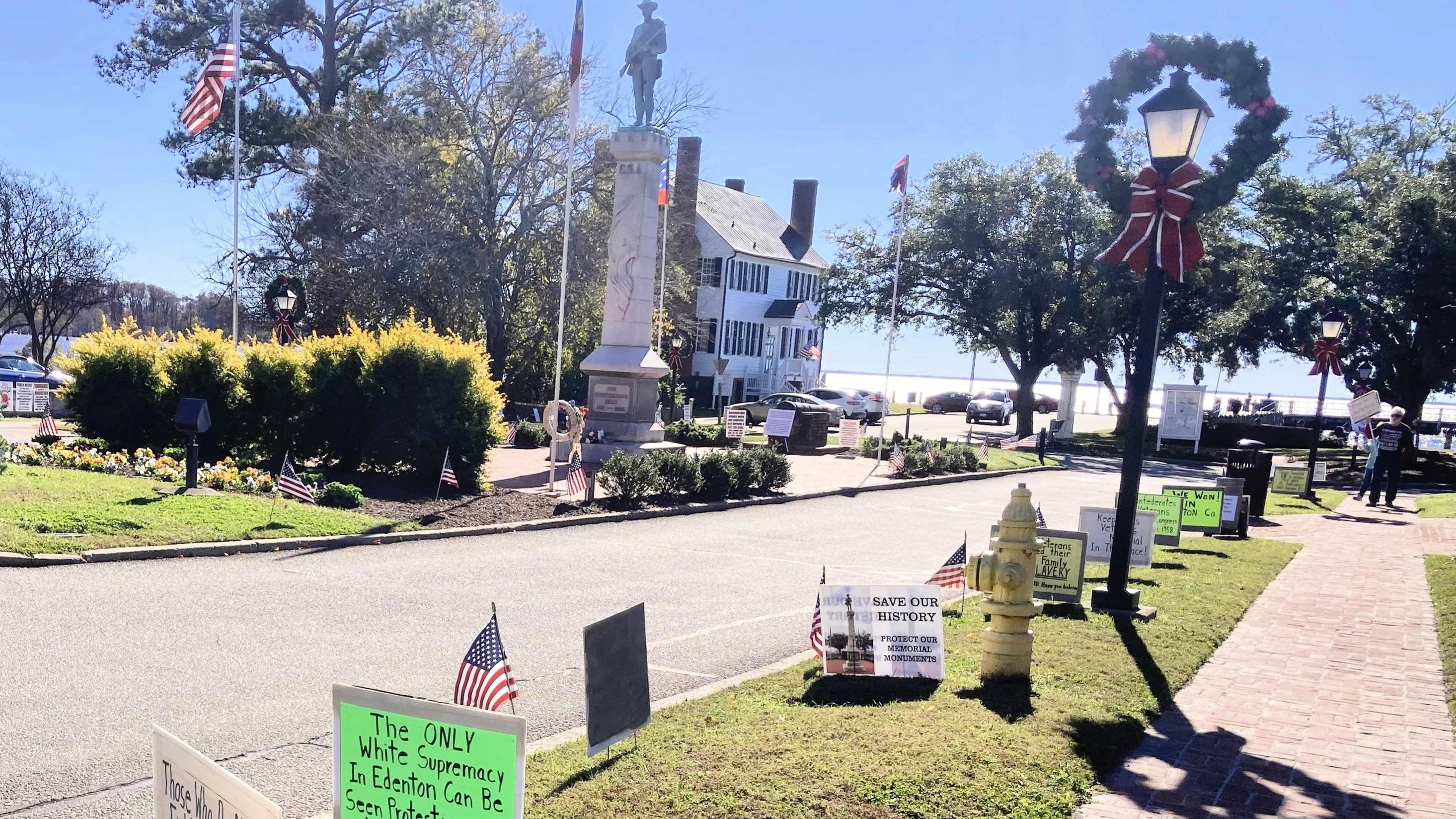
More than 50 people representing both sides of the debate filled the large room regarding the relocation of the Confederate statue from its present location on South Broad Street to property owned by Chowan County and located behind the Chowan County Courthouse in the open space between the Chowan County Detention Center and the Veterans Memorial.
Let’s start with Susan Inglis of East Water Street – she lives in Homestead, circa 1775, one of Edenton’s grand homes.

As a progressive and critic of the monument’s present location, Inglis wants the statue moved to Beaver Hill Cemetery.
“I appreciate the opportunity to share with you yet again that I think it is important that this monument be removed from its current location as soon as possible,” she said to the large crowd. “I think the best plan for replacement of it is the first one that the Human Relations Commission considered — that pretty little piece of town owned property adjoining Beaver Hill Cemetery, where actual Confederate soldiers are actually buried.”
Quick note – During Monday’s meeting, Chowan County Commission Chairman Bob Kirby said state law prohibits the statue from being placed in a cemetery – he specifically said the statue can’t be moved to Beaver Hill.
Back to Inglis – she talks about history and taking responsibility for slavery. Susan is the daughter of Frances Inglis, the Lady of Water Street, who passed away in May of 2019. Their family tree includes one of the three largest slaveholders in North Carolina in the 1800s, Josiah Collins of Somerset Place, and also Tristram Skinner, a slaveholder and Confederate officer.
“My ancestor, Tristram Skinner, got up the first company of volunteers to march off to the Civil War. His first and second lieutenants were Benburys, and that pretty little piece of property by Filberts Creek and all of Beaver Hills Cemetery and beyond were then a Benbury plantation. It would be most fitting for that to be the site where we as a town and a county take responsibility for telling the story of the Civil War and its aftermath, acknowledging and memorializing the facts that our forebears depended on enslaved labor for maintaining their personal wealth and for maintaining the economy that sustained this region they could not imagine otherwise apparently, and fought a deadly war in defense of their brand of exploitation. Then years after the war, they used money that might have actually fed and clothed veterans to put up this statue as a statement of white supremacy, and then they moved it decades later to try to reiterate that message. In this day and age, we know better, we should not have a monument to the lost cause in the heart of our town, city, our pretty city.”
With the passing of Frances Inglis, who was highly regarded as the Town’s unofficial historian, John Morehead probably knows the most about Edenton’s history. He defends the town from claims asserted by others that the statue is a testament to racism.
“What I’ve learned, what we were told was that the monument was put up in the 1910s because we’re racist, that it was put in front of the old courthouse because we’re racist, that it was moved to the foot of Broad Street because we were racist. Well, none of those things are true.”
More about Morehead’s research appears later in this story.
‘Be The Welcoming Town We Say We Are’
Angela Sikes, who grew up in Raleigh, said she moved from Wake Forest to Edenton a couple of years ago thanks to a video about our “sweet, welcoming town in eastern North Carolina.”
“I fell in love with Edenton,” she said. “I soon put an offer in on a house that took me six months to purchase, a year to restore, and now I have a lovely home in downtown Edenton. After two more years of working on purchasing the house next to me, I’ll soon finish restoring it.”
Sikes said the Confederate statue impacted her decision to move to Edenton.
“One of the things I learned in the video was that the Town Council had voted to remove the Confederate statue from its beautiful waterfront that let me know that there were like-minded people here. Otherwise, I never would’ve hopped in the car and driven here much less purchased a home in Edenton,” she said. “Since I moved here a couple years ago, the statue remains also, since I moved here a couple years ago, I’ve had no less than 30 visitors and all but three have commented on how horrible the statue is at our waterfront.”
Sikes spoke of her family’s history, its links to slavery.
“Also, since I moved here, having never been to Edenton before, I found at least two lines of ancestry who lived in Chowan and Bertie counties in the 1700s. The one who owned property in Chowan County, also owned people in Chowan County.”
Sikes’ voice was strained with emotion as she continued, “It’s part of my story. I consider it an awful part of my story. Additionally, I have several ancestors who were Confederates and who fought to continue to own people. As Maya Angelou said, ‘When we know better, we do better.’ I would like to be a part of changing my family’s history here in Chowan County. I would like for our representatives to do the right thing, remove the statue, not move it that they voted to remove and be the welcoming town we say we are.”
‘There Has To Be A Compromise’
Bob Annis of Macedonia Road had this to say about the importance of history and the statue.
“When I first got to Edenton, I fell in love with this town because it wasn’t afraid of its history. It is a word that we use that, today, it’s a dirty word. But the reality is we need to learn from our history without it, where are we? Where I grew up (Massachusetts), there were people that were trying to pull down crosses. There are military monuments that are up that people are trying to pull down because it signifies a god. What I’m afraid of what’s happening here is this is just the start of something else because there are people that are afraid of history that want to take that monument down then what are you gonna do when the guy comes in and wants to take down your cross?”
Annis continued, “What are you going to do when somebody comes around and says, what about that cannon that you got down on the waterfront? What are you going to do then? You’ll never satisfy everybody. There has to be a compromise. That’s just how reality goes.”
Annis said that rather than for battles of the monument, he thinks taxpayer dollars can be better spent.
“What I’m afraid of as a taxpayer is I’m gonna fund to move that monument once again. And then will that be the end of it? Or is there gonna be another long, protracted battle to try and get that removed again.”
Annis was briefly interrupted from someone commenting in the crowd, so Mayor Hackney High said, “Whoever made that comment, that was the first comment we had from the audience. We’re not gonna have any comments. We did not interrupt any of the other speakers and I was about to thank all of y’all for that. So please proceed.”
Annis continued, “So anyway, just in closing, it just, to me it’s, it’s one of the things with history, you have to learn from history. If you remove everything that reminds you of a past, you’ll never learn from it.”
A woman in the crowd later apologized for her interjection.
Paint It Black
Laurie Edwards and her husband William Raucci, both successful business leaders and entrepreneurs, own Strawberry Hill, that nice plantation house, circa 1788, on East Church Street.
“I’m the owner of Strawberry Hill, the granddaddy of houses here in Edenton. My house is nearly two centuries old. My property is nearly two centuries older than that statue. I love Edenton and I love my house. I come from a military family, and I don’t understand why you honor Confederate soldiers in such a big way even more so than you honor the greatest generation.”
To which someone in the back said, “Amen.”
Edwards continued, “It pains me more that so many here refuse to hear the voices of those who are hurt by this statute. It’s a complete lack of empathy from our historians. Those who are hurt represent more than half of our town.”
Edwards spoke of a compromise to move the statue, but that deal faded and folks are back to talking again.
“We had a deal and everyone compromised, and I’m sure no one was happy, but that’s what compromise is all about,” she said. “And then someone backed out, and now here we go again talking, because that’s the game, isn’t it? Keep talking, keep delaying, and we never actually do anything, and I’m really tired of that game.”
Edwards told the crowd, “So in protest, I’m painting the columns of my historic home black, and I’m standing in solidarity with those who feel the pain of the statue. And I want you to know I feel your pain.”
To which some folks in the crowd said, “Amen.”
Saying the Quiet Part Out Loud
A member of the Edenton Bell Battery chapter of the Sons of the Confederate Veterans, Bill Paul of Merry Hill says the quiet part out loud.
“I’ve been searching for a conclusion on why this monument is so important to be moved. Hardly anyone in here wants the tombstones or grave markers of their ancestors moved from one location to another ultimately, and it appears that the folks who are opposed to the current location aren’t going to be happy with any location,” he said. “So that leads me to question: what do they really want? Is it movement or destruction? And my mind tells me it’s destruction if they won’t accept any form of agreement to sit where it is or to move it to another location.”
Paul continued, “And secondly, I wonder if whatever happens to the monument, if it disappears, does it gets destroyed, what are we going to do with the cannons down around the Barker House. If it’s Civil War objections that we see with the monument, what about the cannons? Are they not just as objectionable? If anybody could answer that for me, I’d certainly appreciate the clarification.”
Paul said people should let history be history. If the statue goes, what’s next – perhaps the historic plantation homes built with slave labor may be demolished.
“So really, if the statute is done away with a reminder, what will be next? The canons and then what goes after the canons — the Barker House, anything that was constructed with enslaved labor in the county. Is that ultimately what we’re looking for? My suggestion is to let history be history, learn from it, appreciate it for what it is. And I’m sure things will change in the future to add things that we don’t want to see or don’t like.”
Burdick’s Verdict
Henry Burdick of Edenton is an Episcopal Priest who has preached the Gospel near and far.

Burdick spoke to whether Confederate veterans should be considered the same as US veterans.
“The Sons of the Confederacy have been spreading a false book, a sort they claim, and it’s an erroneous claim that Confederate veterans are, should be considered as the same as United States veterans. And that is not true,” he said. “The Confederates fought the Confederate army for the Confederacy against the United States of America. They are not considered United States veterans. That’s a fact. You can look it up now. In 1958, Congress passed a law that provided pensions for the then living Civil War widows of Confederate soldiers, that the legislation that was passed specifically says that this is just for these widows. It did not justify claiming that the Confederates are US citizens.”
Burdick does not want to see the Confederate Memorial to Chowan County’s soldiers who fought for the South in Veterans Park – applied further, that monument would tower over the monuments dedicated to the branches of the US military and even rival the height of the American flag.
“Now, the proposed location near the Veterans Memorial Park in close proximity, in fact, it’s just gonna be a matter of feet away from the Veterans Memorial Park is in my opinion, a problem,” he said.
Edenton’s Memory: John Morehead
A local attorney, John Morehead has an exceptional memory, especially for names and dates. Morehead applied his formidable research skills to set the record straight for the Confederate Memorial’s history.

An active member of the community, Morehead served as a member of the Human Relations Commission that, by a narrow vote 7-6, set the wheels turning on the monument’s resting place.
“I have no complaint about any of the people on the Human Relations Commission. They have all become among my best friends. But some of the speakers that were brought in told us a lot of things, most of which have been repeated within the last 30 minutes here (at Monday’s meeting), that in fact are not true. They are agendas and they’re speculations. And so I have done primary research back into the Chowan Herald’s starting in 1959, and the county commissioner’s minutes starting at the same time.”
Morehead continued, “The monuments in the counties had begun in the North. The American Battlefield Trust website says the majority of the union monuments were placed from 1880 to 1918. Confederate monuments were not as quick to spring up due to the shattered Southern economy. Early monument funds were raised by wives, widows and daughters of former Confederate soldiers by holding book sales and tea parties. These ladies raised funds and started placing monuments. The majority of Confederate monuments were placed from 1900 to 1918 for that reason. At Memorial Day celebrations every year, the American Legion, the bulletin lists on the back, all the men who died in all the 20th century wars, including Korea and Vietnam. The total of those is 40. I looked back in the North Carolina records published by the state. I was able to count 47 men from Chowan County who died in the Civil War.”
Much like this ink-stained wretch who has spilled a sea of ink on the printed page about this issue, Morehead has done extensive research into the Confederate Memorial’s history – where it was originally located and why it was moved.
“The reason it was put in on the Courthouse green was the condition of the waterfront east and west. At that time, it was railroad yards, docks, bars, and brothels. The Courthouse green was the only decent place in town.”
Citing sources, Morehead continued, “Morley Jeffers Williams, who was from Ontario, was a landscape architecture professor at Harvard after getting his degree in landscape architecture and city planning from Harvard, had been hired to restore the gardens at Mount Vernon and at the White House, and ultimately at Tryon Palace for the restoration of Tryon Palace.
That’s how the Edenton Woman’s Club found him. And he was the one who said, you need to put it as the focal point of the street, of the main street to draw people downtown after, with all the improvements to the waterfront being done with the Barker House, the municipal building, the library, the new sewer plant, and in preparation for the 300th anniversary of North Carolina. So I do think that this is an appropriate decision to put it behind the new courthouse, not a few feet from the Veteran’s Memorial, but in the middle of the block.”
Last Word
Though many other people spoke, this is where we’re going to leave it at this time.
Steve Rader of Washington gets the last word.
Much of the “history” recited by the anti-monument activists was bogus. As George Orwell wrote “from the totalitarian viewpoint, history is something to be created, not learned”.
Lets start with their trying to tie NC’s secession to slavery. If one reads NC’s secession documents, they will see that there is no mention at all of slavery in them. The path NC took to secession even more clearly dispels that notion.
North Carolina voted in February 1861 against secession, as the result of a successful anti-secession campaign of the Unionists led by former Whig leader Zeb Vance. What changed was Lincoln’s call for troops in April 1861. Governor Ellis responded “You will get no troops from North Carolina” and initiated the process for a secession convention. Zeb Vance was actually in the middle of a speech at a Unionist rally when he was handed a note that Lincoln had called for troops and Vance immediately changed his position and called for secession. When the convention met, the vote for secession was unanimous, with a former Unionist leader making the motion to secede.
There is no serious question that the triggering event that caused NC’s secession was Lincoln’s call for troops to invade our fellow southern states, NOT slavery, That was generally also the case throughout the upper south.
Another bogus argument is the claim by the anti-monument activists that Confederate monuments were part of white supremacy and Jim Crow. Confederate monuments were erected in the same general time period prior to World War I when monuments to Union soldiers were erected. It is ludicrous to contend that either had a darn thing to do with white supremacy. All states involved in the war honored their fallen soldiers.
One also has to consider where white supremacy came from when it became a sickening public policy throughout the south. It had nothing to do with Confederate veterans but everything to do with partisan politics.
In the 1890s, white small farmers abandoned the Democrat Party which they regarded as in the hip pocket of the special interests of the day, and formed their own party, the Populist Party. The Populist then allied with the Republicans, then the party of black voters and Union sympathizers from the war, to challenge Democrat control across the South in what was known as the Fusion movement. This alliance was a formidable challenge to Democrat control, and in some states, including North Carolina, they were able to oust the Democrats and elect a Fusion governor and legislative majority.
In response to this political challenge, the Democrats responded across the South with a vicious white supremacy campaign designed to split the Fusion coalition. It worked, and when the Democrats regained political control, they doubled down against any prospect of that coalition returning by passing Jim Crow laws.
I suspect that many of those who falsely connect Confederate monuments with white supremacy are probably registered to vote in the political party that actually was the group that brought in white supremacy as a cynical partisan political power play. If they want to reject white supremacy, changing their voter registration would make more sense than attacking monuments that had nothing to do with the problem.
One of the speakers mentioned a campaign against historic monuments by the extreme left “Southern Coalition for Social Justice” out of Durham. We should not let the far left blackmail us into giving up our history. As George Orwell wrote “the most effective way to destroy people is to deny and obliterate their own understanding of their history.” We should also understand that “social justice” is the far left’s euphemism for “socialism”.
Subscribe/Donate
If you want to subscribe — FREE — check out our website at https://albemarleobserver.news/
If you want to subscribe – you can enter your email address at the website or send it to us at albemarle.observer@gmail.com and we will gladly add you to our growing subscriber list.
You can also donate by going to the Donations page by clicking here or send us a check at Albemarle Observer, C/O Miles Layton, 205 E. Church St. Apt. A, Edenton, NC 27932.
5 responses to “Community Voices on Confederate Memorial Discussions”
Susan Inglis claims “our forebears depended on enslaved labor”. My forebear did not. Joined the infantry at 14 and made it to 1865, wounded seven times. Susan is in a 4 bedroom, 3,695 square foot house. If her need for public approval is sufficient and, rather than sacrificing the history of others, and if truly selfless, Susan could bring in the descendants of her family’s enslaved labor and share Homestead (“one of Edenton’s grand homes”) with the people who’s labor (and freedom) was stolen in order to build and maintain the home.
It appears Henry Burdick may be unaware that in 1868 pardons and full amnesty with a restoration of political rights were issued to all Confederate soldiers who fought in the Civil War. They only need take an oath. General Robert E. Lee’s citizenship was restored by a joint congressional resolution in 1976. In 1978, full rights of citizenship were restored for Jefferson Davis. And all, of course, all Confederates were American veterans. Our own were North Carolina veterans.
Mr. MILES LAYTON,
As a follower of the Edenton Confederate Memorial, I read with great interest, every word from every speaker, you quoted in this article. Once again, I must comment as to the neutrality of your excellent journalism. I feel you are committed to showing both sides of this contentious issue.
I am particularly moved by the final comments by Mr. Steve Rader. His grasp of history and the political environment of the day (and the current day) is impressive. His comments mirror the reality of the 1860 period. North Carolina seceded only after Mr. Lincoln essentially declared WAR on the Southland. North Carolina’s leaders of the day were loyal to their compatriots, not to northern aggressors who sought to obsessively TAX the outputs of the South and treat Southerners as second-class U.S. citizens.
Personally, I believe the Confederate Memorial in Edenton is displayed very well as a plaza, complete with flags and beautiful landscaping. As it currently stands, it is a tribute to not only the Confederate soldiers who fought and died to protect their families and friends, but also to the town of Edenton. I hope the eventual outcome is to leave the memorial where it is and continue to honor those sons of Chowan County who gave their last full measure for their homeland.
Bravo Sir, for your excellent continued coverage of this issue.
J. McRoy
Pitt County
Much appreciated
— Miles
[…] last week, advocates on both sides of the issue made their case — see our stories, here and here. […]
[…] Miller of Edenton spoke next. Referencing that same joint meeting, Miller said, “Not erasing and preserving history were brought up along with the question of what […]